

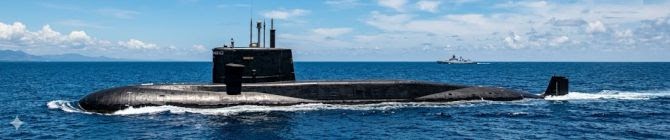
Sea-based deterrence has emerged as a cornerstone of India’s strategic posture, transforming the nation’s defence calculus in an increasingly volatile geopolitical landscape. This shift underscores the imperative for a survivable second-strike capability, particularly as adversaries probe vulnerabilities across multiple domains.
The China factor looms large in this equation. China’s expanding footprint in the Indian Ocean, manifested through research vessels, survey ships, and dual-use technology platforms, poses a persistent intelligence-gathering threat.
These assets map undersea terrains, track submarine movements, and gather acoustic signatures, eroding India’s operational secrecy.
Compounding this challenge is China’s naval expansion, including its burgeoning fleet of nuclear-powered ballistic missile submarines (SSBNs). Beijing’s underwater arsenal now patrols distant waters, demanding a credible Indian counterforce to maintain regional stability.
India’s response hinges on advanced weaponry like the K-4 and K-5 submarine-launched ballistic missiles (SLBMs). Fired from the Bay of Bengal, these missiles can strike deep into Chinese territory, penetrating defences and restoring strategic balance. Their range—over 3,500 km for the K-4 and potentially 5,000 km for the K-5—ensures that no corner of China’s heartland remains beyond reach.
The Pakistan factor adds urgency to sea-based deterrence. Operation Sindoor in May 2025 exposed the realism of a naval dimension in Indo-Pakistani conflicts, with maritime skirmishes escalating alongside land and air operations. Pakistan’s mid-conflict partnerships with Turkey and Azerbaijan, including alleged transfers of advanced naval technologies, highlighted the risks of coalition-enabled escalation.
These alliances underscore the necessity for multi-domain deterrence options. India’s surface fleet proved vulnerable to asymmetric threats during Sindoor, making an underwater nuclear triad essential to deter adventurism across sea, air, and land.
Modern warfare further amplifies this need. The West Asia conflict of 2025, marked by US-Israel strikes on Iran, illustrated how air campaigns swiftly acquire maritime dimensions. The Strait of Hormuz rapidly became the epicentre, choked by mines, swarms of drones, and missile barrages that paralysed global energy flows.
Domain boundaries in contemporary conflicts are porous, with actions in one theatre igniting chain reactions elsewhere. Deterrence must therefore span all domains simultaneously, from cyber intrusions to subsurface strikes, ensuring comprehensive coverage against hybrid threats.
At the heart of this evolution lies India’s defence self-reliance dimension. The SSBN programme stands as one of the nation’s most significant triumphs in indigenous production, embodying the pinnacle of technological sovereignty.
Designed and constructed at the Ship Building Centre in Visakhapatnam under layers of strict secrecy, these vessels represent a quantum leap in domestic capability. Every weld, sensor, and reactor component reflects years of painstaking innovation by Indian engineers.
This endeavour reduces dependence on Russia, India’s traditional defence supplier, whose chains are strained by the ongoing Ukraine war. Sanctions, battlefield losses, and production bottlenecks have made foreign procurement unreliable, pushing New Delhi towards self-sufficiency.
The SSBN initiative advances India’s Aatmanirbhar Bharat vision in defence—the most challenging domain to indigenise due to its fusion of nuclear physics, stealth materials, and propulsion technologies. Success here cascades benefits across the sector.
Moreover, it lays the industrial and engineering foundation for the SSN (nuclear attack submarine) programme, slated for fruition by 2036. Shared hull designs, reactor expertise, and supply chains will accelerate this next phase, enabling hunter-killer operations to neutralise enemy carriers and submarines.
Yet formidable challenges persist. Resource allocation remains a perennial hurdle: balancing SSBN upgrades, SSN development, and conventional naval modernisation strains finite budgets. Prioritising subsurface nuclear forces without neglecting frigates, destroyers, and Amphibious assault ships demands ruthless fiscal discipline.
Technology integration poses another test. Incorporating artificial intelligence and autonomous systems into submarine design and operations is vital, as China races ahead with AI-driven sonar evasion, predictive maintenance, and unmanned underwater vehicles. India must bridge this gap to avoid technological obsolescence.
Crew and operational readiness present human capital imperatives. Nuclear submarine operations demand exceptional training pipelines for silent running, weapons handling, and prolonged submerged patrols. Scaling this expertise nationwide requires sustained investment in simulators, academies, and psychological resilience programmes.
Maintaining no-first-use (NFU) credibility grows more intricate as the arsenal expands. Clear signalling to adversaries—through patrols, missile tests, and doctrine reiterations—is essential to prevent misinterpretation, especially amid escalating tensions.
The China gap remains stark. The People’s Liberation Army Navy (PLAN) submarine fleet vastly outnumbers India’s, with over 70 boats including advanced Yuan-class diesel-electrics and Type 096 SSBNs. Achieving parity is a distant goal, necessitating asymmetric innovations like quieter propulsion and networked sensing.
INS Aridhaman transcends its role as merely a new vessel; it embodies a strategic statement. This 6,000-tonne behemoth, armed with K-4 missiles and powered by an 83 MW pressurised water reactor, signals India’s nuclear deterrence maturing from a minimal, land-centric posture to a robust, survivable, multi-domain architecture.
In an era where wars ignite in one domain and spill rapidly into others—be it from cyberattacks cascading to blockades or drones cueing missile salvos—the capacity to threaten unacceptable retaliation from beneath the sea is not optional but a necessity. Adversaries increasingly contest the Indian Ocean, from Gwadar to the Malacca Strait, making underwater impunity decisive.
The road ahead is arduous: achieving continuous at-sea deterrence with multiple SSBNs on eternal patrol; commissioning indigenous SSNs for offensive punch; and weaving AI into submarine operations for god-like situational awareness. These milestones demand unwavering resolve and resources.
Yet the direction is unequivocal. INS Aridhaman marks a point of no return in India’s odyssey towards genuine nuclear second-strike credibility, ensuring that any aggressor contemplates the abyss before striking.
IDN (With Agency Inputs)
