

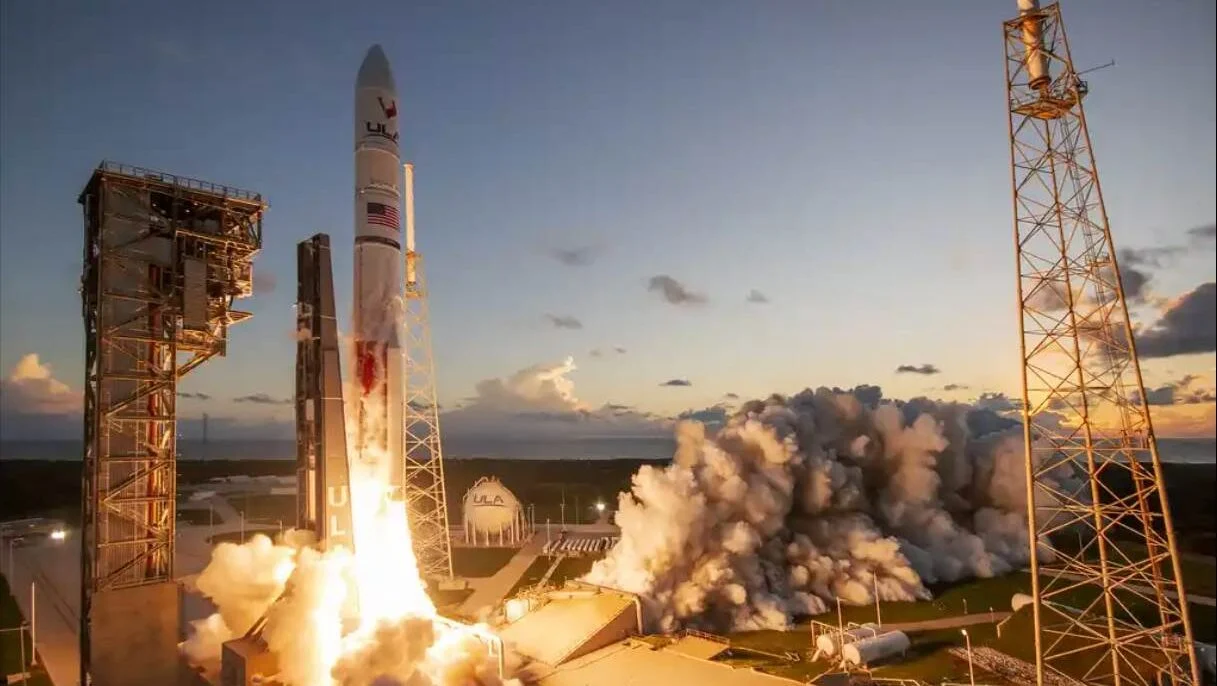
WASHINGTON — The Space Force today announced that SpaceX, rather than United Launch Alliance (ULA), will provide the upcoming launch of the final satellite in the Global Position System (GPS) III series.
GPS III SV-10 now will lift off on a Falcon 9 from Cape Canaveral, Fla., no later than the end of April, Space Systems Command (SSC) said.
The change up follows the service’s late February decision to ground ULA’s heavy-lift Vulcan-Centaur under the National Security Space Launch (NSSL) program, due to persistent problems with the nozzles on its solid rocket boosters.
“With this change, we are answering the call for rapid delivery of advanced GPS capability while the Vulcan anomaly investigation continues. We are once again demonstrating our team’s flexibility and are fully committed to leverage all options available for responsive and reliable launch for the Nation,” Col. Ryan Hiserote, commander of SSC’s System Delta 80 and NSSL system program director, said.
ULA was unable to respond to a request for comment for this report by press time.
While another setback for the long-troubled Vulcan, the Space Force has not yet given up on the rocket’s potential as an NSSL launch provider. According to today’s announcement, Vulcan is now slated to launch the USSF-70 mission, expected to blast off no earlier than the summer of 2028.
USSF-70 will carry Northrop Grumman’s Rapid On-orbit Space Technology Evaluation Ring (ROOSTER)-5, also known as the Geosynchronous Auxiliary Support Tanker (GAS-T) designed to serve as a refueling station for satellites in geosynchronous Earth orbit. Carrying enough hydrazine to refuel multiple birds, the Space Force expects GAS-T to dock with and refuel Redwire’s Mako spacecraft being co-launched on the mission as part of the Space Force’s Tetra-6 demonstration.
