

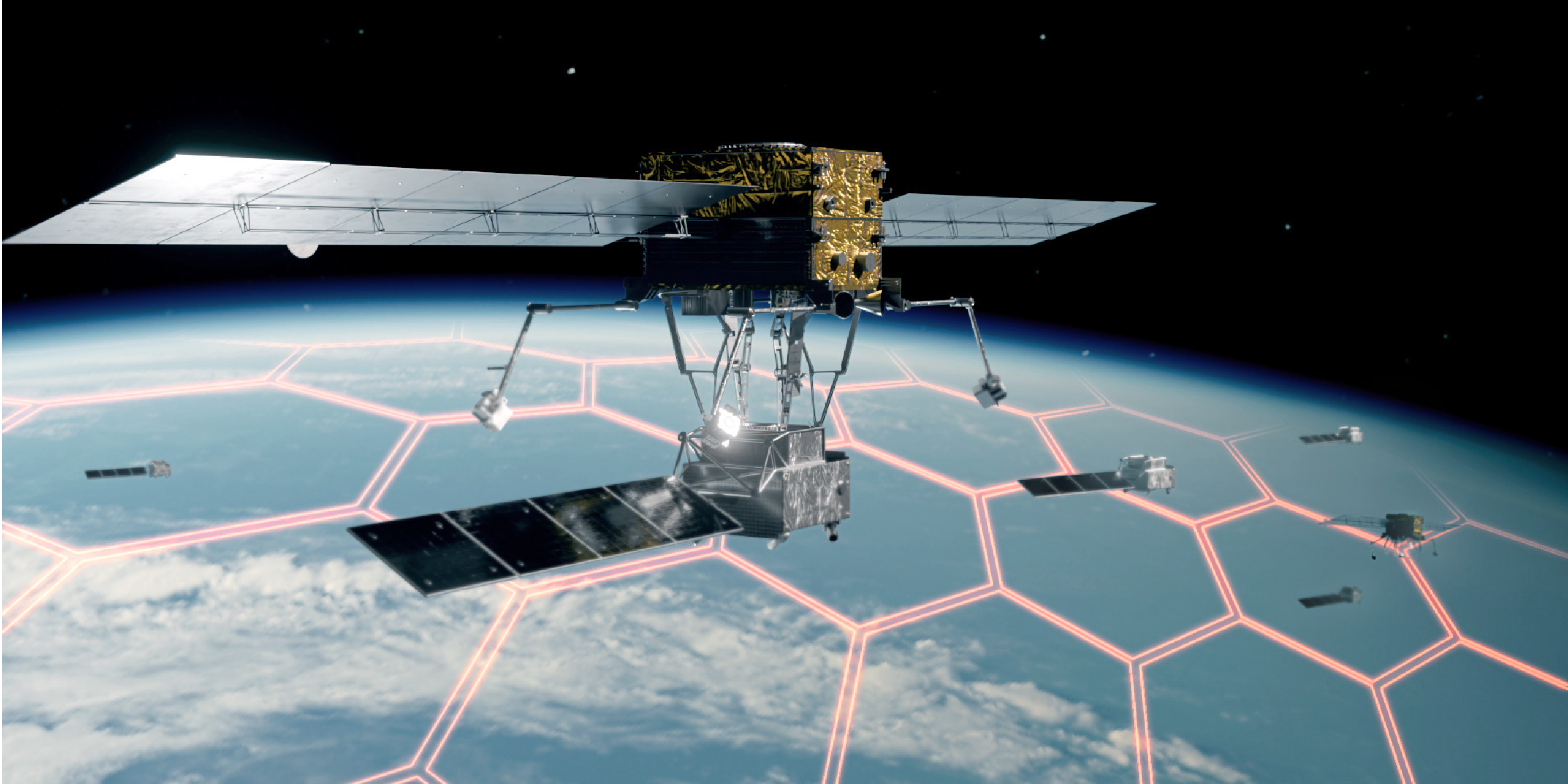
The efficacy of space operations will depend on logistical solutions that enable adaptability and ensure resiliency after attack. The Golden Dome for America is positioned to be the most capable space defense system in history, and integrating an on-orbit logistical solution into its initial systems architecture is critical to maintaining that advantage — a capability that Astroscale U.S. can provide.
The Golden Dome is intended to be a multi-layered protective shield that can defend the U.S. against advanced missile threats. This architecture goes far beyond our current missile defenses by combining several capabilities, including integrated command, control, communications, computers, and battle management systems that link space-, air-, and ground-based elements:
• Space-based sensors to detect launches early and provide persistent global tracking
• Space-based interceptors (SBI) to engage missiles in boost phase shortly after launch
• Ground-based and sea-based systems for additional defensive layers during midcourse and terminal phases
Together, these elements form a layered defensive shield intended to counter emerging threats. To ensure operations in a contested and dynamic orbital environment, these systems will require refueling, repositioning, and maintenance to deliver persistent presence, resilience, and credible deterrence. On-orbit servicing can provide crucial support and enable agility and resilience of the constellation.
The logistical layer
Across all military domains, logistics is the foundation for sustained operations, and this is true in space as well. Astroscale U.S. can give the Golden Dome a distinct edge in the fight against the threats of today and tomorrow by providing a layer of force-multiplying servicing spacecraft that are robust and scalable and can be tailored to meet the program’s needs.
The proposed logistical architecture contains a fleet of servicing spacecraft designed for real-time maneuverability, in-space inspection, repair, refueling, deorbit, and modular payload hosting — all integrated through open architecture interfaces and supported by a secure operations capability that can augment or seamlessly extend Department of War infrastructure. Built to military standards (MIL-STD) and NASA safety standards, it can provide responsive logistics for satellites operating across multiple orbital regimes.
Mission impact
The Astroscale U.S. solution can build resiliency into Golden Dome operations across several mission areas by providing:
• Post-launch inspection to verify satellite deployment, sensor integrity, and propulsion status — identifying anomalies early improving reliability and mission assurance
• On-orbit servicing to enable refueling, maintenance, repair, life extension, and maneuvering — reducing reliance on replacement launches
• Debris mitigation to reduce collision risk and improve orbital safety
• Standards-based integration compliance with Space Plug-and-Play Architecture, Universal Command and Control Interface, Platform-Agnostic Kit Communication Baseline (SPA/UCI/PAK-CB) ensures rapid integration with planning tools and secure communications networks.
The solution can operate as a dedicated support asset within the constellation, providing sustainment and operational support to interceptor and sensor satellites.
Because it carries no intercept payload, it presents minimal risk to friendly systems while enabling maintenance and sustainment. It can also assist in post-launch calibration and inspection of newly deployed SBIs and enhances the engagement sequence.
Shortly after an interceptor satellite is placed in orbit, the spacecraft can verify solar panel deployment, sensor integrity, and thruster status. This close-range inspection can catch anomalies early, increasing mission assurance from the outset and complementing ground-based health checks, providing a level of insight not otherwise possible.
The proposed logistical architecture can operate in tandem with allied systems (e.g., inspecting a partner nation’s satellite as part of coalition operations) without policy hurdles. By design, it would adhere to U.S. Space Force (USSF) safety and autonomy guidelines, ensuring human operators retain override authority, especially for any high-risk actions. This careful integration approach aligns with the Golden Dome’s philosophy of a layered defense with human oversight. The architecture can interface directly with the Golden Dome’s command and control systems through standard APIs, allowing tasks like inspection or repositioning to seamlessly incorporate into operations.
Improving deterrence
Missile defense architecture in space will inevitably face counterspace threats, including anti-satellite weapons, electronic warfare, and cyber operations.
By providing on-orbit servicing, rapid repair, and recovery capabilities, this solution from Astroscale U.S. can ensure that degraded or disabled sensors and interceptors can be restored or supplemented, which could prevent gaps in coverage and reduce the effectiveness of attacks on a small number of satellites. Its servicing and tug capabilities can strengthen deterrence by reducing the effectiveness and appeal of counterspace attacks, while enabling dynamic repositioning of interceptors to optimize coverage and responsiveness. This agility allows assets to be pre-positioned during crises and redistributed after engagements.
These capabilities also complicate adversary planning. When satellites can be repaired, repositioned, or refueled, attempts to degrade the architecture through limited attacks become less effective. In this way, logistics support not only resilience but deterrence.
Extending operations and reducing costs
By bolstering constellation proliferation with on-orbit servicing, the Astroscale U.S. solution can create a stronger, more resilient Golden Dome and provide practical cost savings and increased return on investment by extending missions and reducing replacement launches.
It can further reduce the total number of spares needed on orbit, allowing strategies to make the shift from redundancy planning to addressing multiple contingencies. Extending satellite lifetimes and reducing replacement launches will significantly reduce lifecycle costs while increasing operational availability.
Proven capabilities
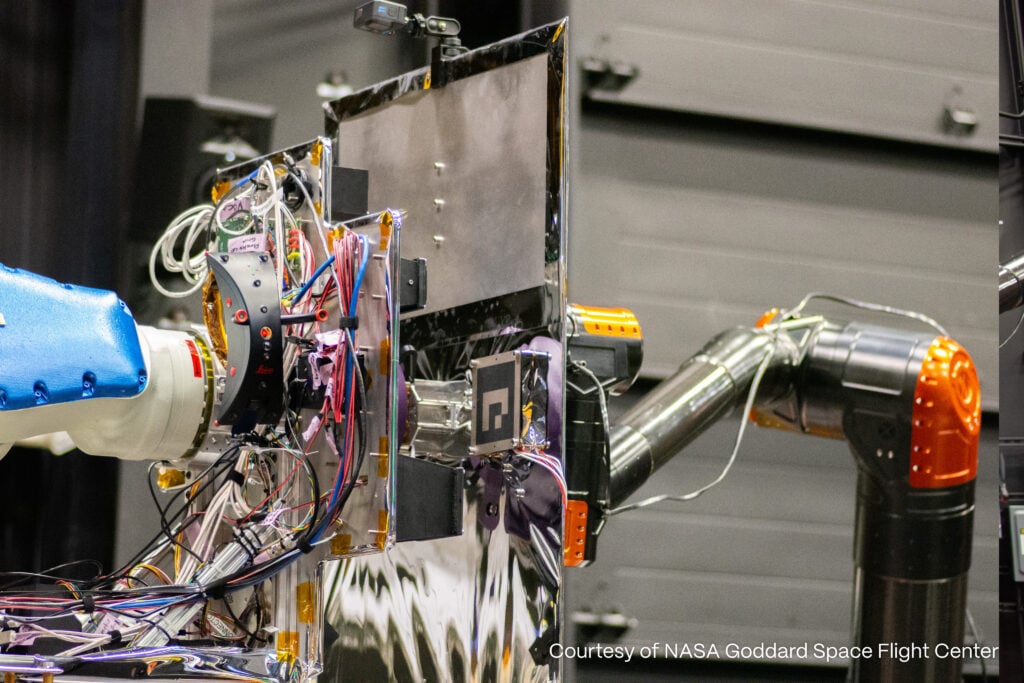
This logistical architecture solution is built upon Astroscale U.S.’s combined core capabilities, including operations, mission design, docking, and rendezvous and proximity operations (RPO). By leveraging this expertise, the system improves intelligence, surveillance, and reconnaissance continuity, maneuverability, and resilience while reducing coverage gaps. Astroscale’s flight heritage affirms these capabilities with the ELSA-d mission in 2021, which was the first-ever demonstration of magnetic docking and debris removal, and the 2024 ADRAS-J mission that accomplished the first close approach and inspection of an uncontrolled debris object, achieving a historic 15-meter approach.
On the horizon, Provisioner™, the Astroscale U.S. Refueler, will conduct the first-ever refueling of a USSF asset. Additionally, Astroscale U.S. has been awarded a study by NASA to explore how incorporating serviceability into the design of the Habitable Worlds Observatory (HWO) can enhance its scientific returns and operational lifetime.
This all validates the solutions’ key capabilities — including guidance, navigation, and control, autonomous rendezvous sensors, and safety protocols — in operations around controlled and non-controlled objects.
Designing resilience from the start
The proposed solution architecture from Astroscale U.S. represents an ambitious step that can further the USSF goal of maintaining space superiority across orbits. But achieving this goal will depend on whether sustainment and adaptability are built into the Golden Dome system from the beginning.
The solution can deliver the critical enabling sustainment layer for the Golden Dome, providing on-orbital resilience, maneuverability, and on-demand servicing. It also introduces flexibility that allows the architecture to evolve after deployment, reducing the risk of obsolescence and enabling rapid response to new threats.
As space becomes more contested and operationally critical, logistics will increasingly determine which space architectures can endure.
For the Golden Dome, integrating a logistics layer from the outset will prove essential to ensure that the system remains resilient, responsive, and operational for decades to come.
