

Source: SSC Space
The commercial space industry is no longer defined by single, bespoke missions. It is increasingly shaped by high-volume constellations, shorter development cycles, and customers who expect space-enabled services to behave like digital infrastructure: always available, secure, and fast.
That shift is visible in the numbers. Independent trackers put the current number of operational satellites in orbit in the mid‑14,000 range as of early 2026, with mega-constellations accounting for a large share. The European Space Agency, ESA, expects an even higher number, that as many as 100,000 satellites could be in orbit by 2030, underscoring how quickly orbital activity is accelerating.[i]
This growth is tied to a broader expansion of the space economy. The World Economic Forum estimates the space economy could reach $1.8tn by 2035[ii], up from $630bn in 2023 – a near tripling in value driven largely by space-enabled services (connectivity, navigation/timing, earth observation, and their downstream applications).
The competitive landscape reflects that momentum.
An underappreciated truth: the significance of ground stations to the future of communications and earth intelligence
Large Low Earth Orbit (LEO) broadband and data constellations continue to expand, while new entrants in earth observation, IoT, logistics, surveillance, defense, and direct-to-device communications are pushing hard for shorter time-to-orbit and faster time-to-revenue. In this environment, access to space is not only about accessibility to launch sites, it’s also about how quickly operators can establish reliable links to their spacecraft once they’re in orbit.
And that’s where an underappreciated truth becomes mission-critical: space capability doesn’t become real-world value until data and commands can move reliably between orbit and Earth – at the speed and scale customers now expect.
In this exclusive Q&A with Nick Priborsky, President of the Connect division at SSC Space, we learn more about what’s changing in the ground segment market. Why are automation and self-service – known as ground-segment-as-a-service (GSaaS) – becoming central to the next phase of commercial space growth?
Nick, what is a ground station?
NB: A ground station is the earth-based part of any space mission that communicates with the spacecraft or satellite. It’s the antenna systems, radio frequency (RF) equipment, software, networks, and operational processes that enable telemetry, tracking and control (TT&C), as well as payload data reception, like earth observation imagery or communications traffic.
People often focus on the spacecraft itself because that’s where the sensors or communications payload are. But the truth is: data in space has no value until it’s reliably brought down, secured, and delivered to the user in a usable form.
What’s driving demand from new entrants for ground station services?
NP: New entrants typically have three pressures at once. Speed: They need to get from launch to operational service quickly. Simplicity: They don’t want to build a bespoke ground segment, hire a large operations team, and integrate multiple vendors just to start commanding spacecraft and moving data. Scalability: What works for one satellite must work for 10, 50, or 500 – without the ground segment becoming a bottleneck.
This is why we’re seeing rapid growth in automated ground segment services – offerings designed for fast onboarding, self-serve scheduling, API-based integration, and standardized operations. These services help emerging operators access global ground infrastructure without building their own networks, and without months of integration work.
In short, “easy and fast access to space” increasingly means easy and fast access to ground communications.
Why is there more focus on ground stations now?
NP: The space-earth market is scaling fast, and the use cases are becoming operational rather than experimental. So, it’s an exciting time.
The primary growth driver will be an increase in the adoption of LEO satellites, productivity improvements in satellite equipment manufacturing, the competitive launch services landscape, and demand for services around data communications, navigation, and earth observation, like climate monitoring and infrastructure tracking, which is hugely valuable for industries like mining. Other growth drivers include falling manufacturing and launch costs, non-Western companies entering the space economy market, increased space militarization, and new commercial uses for data from space.
Earth observation is already shifting toward earth intelligence – moving from specialist imagery to real-time, actionable inputs for decision-making. That creates a step-change in expectations: customers want higher revisit rates, more data volume, lower latency, and stronger security. Add geopolitics: earth observation has become strategically important, and many governments – especially in Europe – are investing to strengthen sovereignty and reduce dependence.
Ground stations are where those expectations either become reality – or the mission falls short. Most new space companies are focused on the outcomes and want to rent the infrastructure to achieve their mission. In that model, ground stations are a crucial bridge between space capability and real-world value – and the rapid growth of LEO constellations and satellite-based communications raises the bar on throughput, scheduling and network orchestration.
Is this why you’ve recently launched a new service for the SmallSat market?
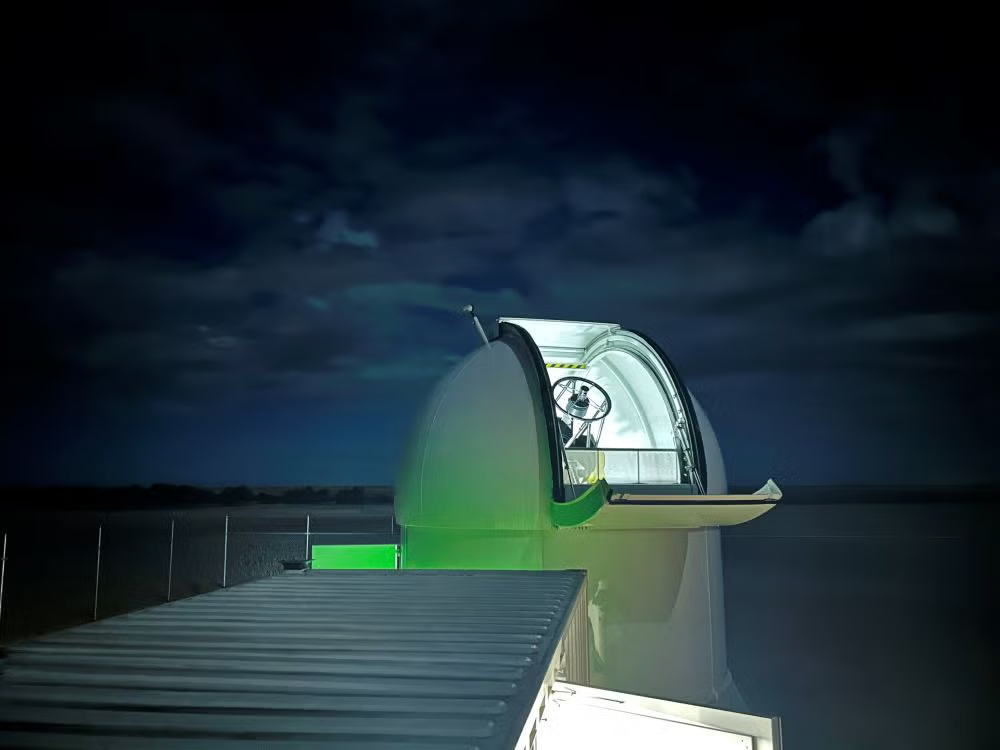
Exactly. SSC Space Go is our new ground station service designed for the small satellite and constellation market, especially operators that need reliable access but don’t need, or can’t justify, premium large-antenna solutions. It’s built on a global network of compact 4m-class antennas supporting S-, X-, and Ka-band and starting with five sites worldwide: Esrange in Sweden, Alaska for North Pole coverage, Inuvik in Canada, Western Australia and Punta Arenas (Chile). The network will expand as volumes grow.
The focus is on fast onboarding, simple scheduling, built-in security, and automation, so emerging operators can scale without building their own ground infrastructure.
This service adds to our existing ground station capability. SSC Space runs one of the world’s largest commercial ground networks – 21 sites across 10 countries – serving space missions ranging from small satellites in low-earth orbits, to bespoke journeys to the Moon, Mars and beyond.
Can you tell us who you work with?
We work with NASA, , the European Space Agency and leading primes on many missions you’ve probably heard about. For example, SSC Space has supported ESA’s climate monitoring and crisis management Copernicus program since 2020, and we are providing communication services for many of NASA’s satellite missions. Additionally, we have been selected to provide communications services for the Earth proximity and beyond cislunar regions for NASA’s Near Space Network program.
We are also very excited about our partnership with Firefly Aerospace providing all the antennas required to track and communicate with its Blue Ghost lunar lander, which set a historic milestone by successfully delivering science and technology instruments to the Moon in March 2025. It touched down near a volcanic feature called Mons Latreille within Mare Crisium, a basin over 300 miles wide in the northeast quadrant of the Moon’s near side.
During its 2.8-million-mile journey, Blue Ghost downlinked more than 27 GB of data and supported several payload science operations. This included history-making signal tracking from the Global Navigation Satellite System (GNSS) at a record-breaking distance with the LuGRE payload, radiation tolerant computing through the Van Allen Belts with the RadPC payload, and measurements of magnetic field changes with the LMS payload.
The mission operated for 14 days, marking the longest commercial operations on the Moon to date. With all the developments around connectivity and the potential of space data for earth impact, we don’t often get to talk about our lunar communication capabilities
For a satellite or spacecraft operator needing a ground network, what would you say are the key planning considerations?
All successful space missions have one thing in common. Well-planned ground station operations.
Spacecraft connectivity – whether for telemetry, tracking and control or data reception – is a crucial aspect for all spacecraft operators, one that needs to be well thought through to improve the mission’s operations while remaining cost-efficient and innovative.
One thing to consider is the geographical coverage you’d need to fulfil the mission.
Most of the satellites we serve today are sun-synchronous and polar-orbiting satellites. These satellites orbit the Earth at a very high inclination, allowing them to pass over the poles. Orbiting the polar regions brings challenges.
There’s significant RF interference because so many satellites cross those paths and there are relatively few suitable ground station locations. Site diversity is one of the best mitigations. We are fortunate to offer our clients access to our Esrange Space Center in the Arctic Circle near the town of Kiruna in Sweden at 68’ Latitude, which typically works together with our stations over Alaska and North Canada to cover the Northern Polar region. Our station in Punta Arenas in Chile offers access to the South Pole.
Other considerations would be the daily data volume you’d need to bring down to Earth, how often the satellite need to be contacted per day and latency requirements.
Explore how ground segment technologies are advancing to facilitate higher data rate transmissions as lunar and deep space exploration enters a new era.
[i] [esa.int]
[ii] https://www.weforum.org/press/2024/04/space-economy-set-to-triple-to-1-8-trillion-by-2035-new-research-reveals/

