

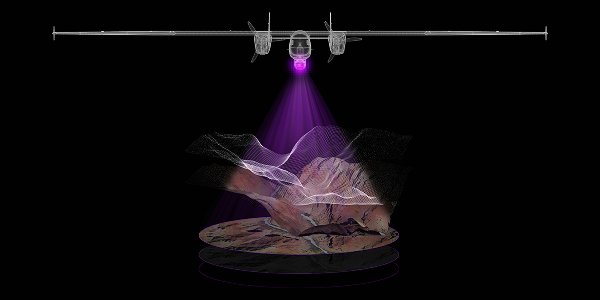
As drones scale across logistics, reconnaissance, and combat missions, adversaries are prioritizing ways to deny or spoof the Global Positioning System (GPS). From nation-states to rogue actors — and even hobbyists — the tools to disrupt GPS are becoming cheaper, more accessible, and easier to deploy.
Without GPS, drones can lose the ability to navigate accurately or stay on course, increasing the risk of mission failure, interception, or loss. To mitigate this, a new approach is gaining traction: 3D vision-based navigation. By combining onboard cameras with high-resolution map data, drones can continuously verify their position and maintain their route — even in GPS-denied environments.
At the core of this approach is accurate, up-to-date 3D terrain data. Precise reference points allow drones to match what they “see” in real time against a known environment, ensuring they remain on course. This is the foundation of Vantor’s Raptor solution, which leverages decades of global mapping to provide a 3D reference layer for real-time positioning.
“Raptor isn’t interpreting a flat, 2D image — it’s understanding terrain,” said Kara Kramer, head of sales for Raptor. “That’s critical for UAS operations, where you’re often flying closer to the ground than traditional crewed aircraft.”
Countering the rise of anti-drone systems
Drones are becoming both ubiquitous and expendable in modern conflict — and counter-drone technologies are evolving just as quickly.
“GPS is part of everyday life, which makes it a highly attractive target,” said Paul Millhouse, senior director of Raptor products at Vantor. “Jammers and spoofers are inexpensive, widely available, and easy to deploy. A single device can disrupt navigation across an entire neighborhood — or more.”
In many regions, GPS coverage is inconsistent, creating what Kramer describes as the “tyranny of distance” — long-range operations without reliable positioning.
“In many cases, uncrewed systems are used precisely where it’s unsafe for humans to operate,” Millhouse added. “That includes remote environments, where GPS might be unreliable.”
Why absolute positioning matters
Effective navigation begins with absolute positioning — knowing exactly where a drone is at any moment. GPS provides this natively, but in its absence, most systems fall back on relative positioning, which degrades quickly over time.
“Without an alternative, the moment GPS is gone, you’re estimating using relative measurements from your last known location,” said Millhouse. “You know where you were — but not precisely where you are. That uncertainty compounds fast.”
Vision-based navigation addresses this gap. By comparing live camera feeds to 3D terrain maps, drones can determine their absolute position without relying on external signals.
Unlike traditional 2D maps, 3D data incorporates elevation and terrain features such as buildings, mountains, and infrastructure. This enables drones not only to track their position, but also to navigate around obstacles — an essential capability for low-altitude operations.
“When you compare what a drone sees through its camera to our 3D maps, the alignment is remarkably close to human vision,” Kramer said. “That’s what enables reliable navigation from launch to destination.”
Millhouse likens the difference to perspective: “If you’re looking straight down, your view is limited. When you look forward, you gain context — and far more reference points to determine where you are.”
From autonomy to operator awareness
Raptor is deployed in two primary forms. The first is an onboard software development kit, enabling fully autonomous navigation by continuously updating the drone’s position in real time. The second is a user interface that allows operators to visualize the drone’s location within a 3D environment — zooming, tilting, and adjusting perspective for greater situational awareness.
“You don’t need specialized hardware,” said Millhouse. “Most drones already have cameras. Raptor simply leverages existing video feeds.”
Vantor’s satellite infrastructure ensures map data remains current. The company produces up to 2 million square kilometers of 3D mapping each month, while also supporting rapid, targeted updates — often within 24 hours of a request.
In connected environments, updates can be delivered automatically. In contested or denied settings, maps can be preloaded as part of standard mission planning.
“This fits into workflows operators already follow,” Kramer said. “It doesn’t add complexity — it reduces the burden of managing large datasets in the field while ensuring they have the data they need before launch.”
Resilience as a baseline requirement
As electronic warfare becomes more pervasive, resilient positioning is no longer a niche capability — it is becoming foundational.
Vision-based navigation, anchored in high-resolution 3D terrain data, offers a path to reduced reliance on vulnerable signals like GPS. By enabling drones to continuously validate their position and adapt in real time, it helps ensure mission continuity in the environments where it matters most.
For autonomous systems operating at scale in contested or infrastructure-limited regions, that resilience is quickly shifting from advantage to necessity.
Learn more about Raptor: https://vantor.com/product/mission-solutions/raptor/
