

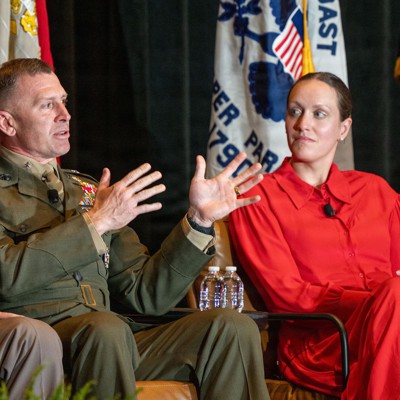
As private-sector investment in defense-technology research rises, the Navy’s chief science office is refocusing its efforts on areas that companies are ignoring, but that will be relevant 15 years into the future, the head of the Office of Naval Research says.
“It’s our goal to actually help folks see not just what the Navy needs now, but what the Navy will need in the next three” future years defense program, or FYDP, cycles, Rachel Riley, who heads the office, told the audience at the Sea-Air-Space symposium Tuesday. “What we’re trying to identify is: what are the things that industry cannot or will not solve?”
These include new undersea technologies and novel forms of power and energy.cIt also means artificial intelligence that delivers answers in a way that is transparent and understandable to humans, and especially commanders.
Riley’s priorities reflect the Trump administration’s decision to spend less on military-led basic scientific research—an ONR specialty—and more on applied research.
“We have roughly $3 billion a year. That’s a lot as a taxpayer; as an innovation leader like you, you can do a lot with it, but maybe not as much as you might want to. And so what we’re trying to identify is, what are the things that industry cannot or will not solve,” Riley told the audience.
In the past, Riley said, ONR hasn’t done a good job of surveying private-sector research so it can focus its own efforts on challenges unlikely to be solved for the commercial market.
“Interestingly enough, a reaction that I get a lot [from ONR colleagues] is, ‘We just don’t know what industry will do.’ If there’s a large addressable market, if there’s dual use, if there’s a short time in terms of from flash to bang, then that’s really right for investment” by the private sector, she said.
Correctly choosing ONR’s projects, she said, “requires us to be a little humbler in terms of—you know, some of the things that historically have been only our problems aren’t anymore. I think that’s a success story.”
One of those areas is explainable AI. While the cost of a false positive, or “hallucination” in AI-speak, might be low in a commercial setting, the consequences can be far higher in military operations. A growing body of research indicates that such errors are inescapable in commercial large language models, so the military needs a new approach—one that has no immediate market need.
“If you are trusting an autonomous system with American lives, then you need to make sure that you have full confidence in what that does. And a lot of times that requires looking inside the black box. That’s actually harder from a technical perspective and requires more work up front,” Riley said. “How do we invest in encouraging people—don’t just train this thing and say, ‘It’s a great idea.’ Let’s actually be able to give the operator confidence.”
The office plans to launch a series of “innovation-to-industry days” to “influence industry [internal research and development or] IRAD investments, to help educate our folks about capabilities that may be more mature in industry than we know today, and also to help you all see the things that may be dual use coming down the pike.”
ONR’s Naval Research Laboratory, led by Capt. Randy Cruz, is also refocusing on research areas that the commercial sector is ignoring.
“Of our one and a half billion dollars of revolving funds, about 80 percent of it is someone telling us what to do, as in ‘I need you to solve this problem,’” Cruz told the Sea-Air-Space audience on Monday. “Another 20 percent roughly is our researchers coming up with these ideas,” based on post-deployment reports and market research trends.
That process has led to new programs like the Mission Robotics Vehicle, a satellite with arms to repair other satellites. NRL, working with Northrop Grumman, will launch the satellite in July. Cruz called it a tow-truck for satellites. It’s an area that private space companies have ignored, since their business model is based on more launches to put more satellites in orbit, not fixing old ones. “The cost of these exquisite systems is unbearable, so the idea of servicing them… is looking very, very appealing.”
