

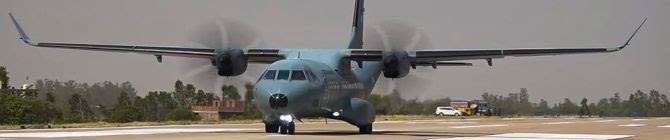
An Airbus C295 successfully landed on the Purvanchal Expressway in Sultanpur, Uttar Pradesh, during an Indian Air Force emergency drill on 22 April.
The exercise was designed to test the expressway’s suitability as an alternative runway in times of war or national emergencies. Alongside the landing, IAF fighter aircraft carried out a flypast over the designated airstrip section, marking the activation of the Emergency Landing Field.
The Airbus C295 is a versatile transport aircraft capable of carrying up to eight tons of cargo or approximately 70 personnel. It can cruise at speeds of up to 260 knots and is adaptable for air-to-air refuelling operations involving both fixed-wing aircraft and helicopters.
The aircraft features retractable landing gear and a 12.69-metre pressurised cabin, enabling operations at altitudes of up to 30,000 feet. Its short take-off and landing capability allows it to operate from unpaved, soft or grassy surfaces, making it suitable for missions in remote or austere environments.
Powered by two Pratt & Whitney Canada PW127G turboprop engines, the C295 can sustain missions lasting up to 13 hours. This engine model has been widely deployed, with more than 6,000 aircraft worldwide accumulating over 160 million flight hours.
The latest version of the C295 incorporates winglets that improve performance during take-off from high-altitude locations, enhance cruising efficiency, and extend endurance, while reducing fuel consumption by three to six per cent.
Beyond its military role, the C295 is extensively used in humanitarian operations such as disaster relief, search and rescue, and surveillance missions.
It has been deployed to monitor illegal immigration, drug trafficking, piracy, deforestation, and marine pollution. Its ability to operate from unprepared strips makes it particularly effective for supply missions in remote regions, underscoring its versatility and strategic importance.
Agencies
