

Thailand has cancelled a longstanding agreement with Cambodia over joint offshore energy exploration in the Gulf of Thailand, a move likely to worsen further the relations between the two estranged neighbors.
Signed in 2001, the memorandum of understanding – often referred to as “MoU 44,” after the Buddhist calendar year 2544 – set up a framework for discussions on joint oil and gas exploration in areas of the Gulf where the two countries’ maritime claims overlap, and for the demarcation of maritime boundaries.
The withdrawal, which was approved by the Thai cabinet on Tuesday, has long been expected. Prime Minister Anutin Charnvirakul made it a key campaign promise ahead of the general election in February, when he was decisively re-elected after harnessing the nationalistic sentiment that was uncorked by last year’s border dispute with Cambodia. The dispute erupted into armed conflict on two occasions in 2025, displacing hundreds of thousands on both sides of the border and pushing relations to their lowest point in decades.
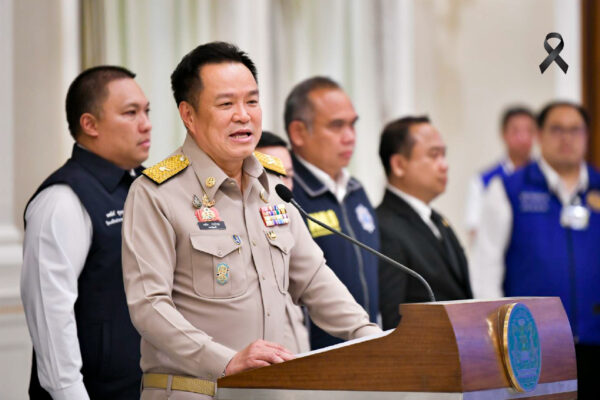
Speaking to reporters on Tuesday, however, Anutin denied that the cancellation of the MoU had anything to do with the border conflict. Instead, he cited the lack of headway negotiations with Phnom Penh, saying that “it has been 25 years and there has been no progress.”
The 26,000-square-kilometer Overlapping Claims Area (OCA) in the Gulf of Thailand is believed to contain significant deposits of oil and gas, and the MoU stated that it was “in the best interests of the two countries to agree upon an early mutually acceptable basis for exploration of the hydrocarbon resources of the [OCA] as soon as possible.” The agreement also pledged both sides to “agree upon a mutually acceptable delimitation of the territorial sea, continental shelf, and exclusive economic zone” within the OCA.
Anutin is right that there has been little progress on the talks, although a large part of the reason is the chronic instability in Thai domestic politics. The MoU has long been opposed by Thai nationalists who, nurturing resentments about colonial-era territorial amputations, have argued that the two agreements hamstring Thailand’s ability to assert and defend its sovereign claims.
The most recent illustration of this took place just prior to the recent conflict, when the governments of Prime Minister Paetongtarn Shinawatra and Cambodian Prime Minister Hun Manet made efforts to resume negotiations on the OCA. These led to immediate (and incorrect) claims from Thai nationalists that Thailand could “lose” the island of Koh Kut, to which some Cambodian nationalists continue to lay claim. The talks soon collapsed, and the tensions over the maritime border soon migrated to the land border, where they snowballed into last year’s armed clashes.
The 2001 MoU is one of two agreements that Thailand and Cambodia signed in the early 2000s to create a framework for the resolution of contentious land and maritime boundary issues. The other – known as “MoU 43,” signed in 2000 (Buddhist year 2543) – provides for a joint framework for surveying and demarcating the two nations’ land boundary and establishes a Joint Border Committee for this purpose. While this remains in effect, the border conflict has prompted Thai politicians to consider whether it, too, should be scrapped.
Cambodia has since expressed its disappointment about Thailand’s withdrawal. In a statement, Foreign Minister Prak Sokhonn described it as “a departure from the spirit and political will that enabled our two countries to establish a framework for peacefully resolving these issues in accordance with international law.” He said that his government “has no option” but to settle the boundary issue under processes outlined in the United Nations Convention on the Law of the Sea (UNCLOS).
“Cambodia’s decision to pursue compulsory conciliation under UNCLOS reaffirms its commitment to resolving maritime disputes peacefully and in accordance with international law,” he added.
Thailand has previously resisted Cambodia’s attempts to internationalize the border conflict, preferring to deal with its smaller neighbor bilaterally. But government spokespeople say that it is also willing to rely on UNCLOS to resolve the overlapping claims, albeit on a bilateral basis.
“At least both countries will now be operating under the same set of rules,” Anutin said yesterday, Khaosod English reported. “Thailand no longer has the MOU 44, so whatever discussions take place from now on, new rules and frameworks must be agreed upon together.” Anutin added that he planned to meet with Hun Manet on the sidelines of the 48th ASEAN Summit, which is being held today and tomorrow in Cebu, Philippines.
Whatever framework is utilized, the key to progress on border demarcation issues is a willingness to compromise. After last year’s border clashes, there is still little sign that this is in evidence either in Bangkok or Phnom Penh.
