

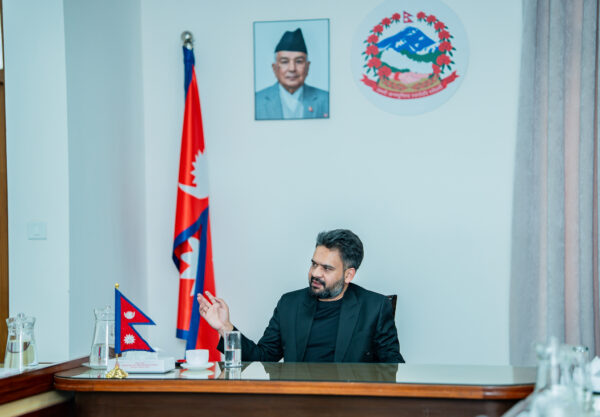
The most immediate threat to Nepal’s ruling Rastriya Swatantra Party (RSP) comes not from outside but from within the outfit. Ever since Balendra Shah, the erstwhile popular mayor of the national capital, Kathmandu, joined the party at the end of 2025, there have been speculations over Shah’s ability to work with RSP founding chairperson Rabi Lamichhane.
In the March 2026 elections, the RSP romped home to victory by riding the wave of antipathy against the old political parties, winning nearly a two-thirds majority in the federal lower house. Both during the elections and in their aftermath, the two leaders continued to project unity. Yet signs of strain are already visible.
According to a pre-poll agreement between Shah and Lamichhane, if the RSP got to form the government, Shah as prime minister would look after state affairs while Lamichhane managed the party.
It was a marriage of convenience. As the mayor of Kathmandu, Shah had developed the image of an efficient technocrat among the educated urban voters. Lamichhane, meanwhile, was popular among the less educated, rural masses. Together, they could have a pan-Nepal appeal. Lamichhane’s legal troubles, which stood in his way of being prime minister, also made it easier for him to project Shah as the party’s prime ministerial candidate.
Even at the time of its signing, the deal appeared idealistic. By design, in Nepal’s parliamentary system, the head of the party leading the government dictates its functioning. Often, unlike the current arrangement in the RSP, the same person heads both the party and the government.
It was thus only a matter of time before Shah started seeking greater space in the RSP, if only to consolidate his hold on the government.
The recent RSP general convention, the party’s supreme decision-making body, marked Shah’s debut as a political leader within the organization. Before that, he had avoided all party-related gatherings.
Nearly three weeks after the general convention, the RSP has been unable to give a full shape to its central committee or to fill all of its office-bearer positions as Shah and Lamichhane tussle over the pick of nominees. Perhaps an even bigger sign of strain is the party statute endorsed by the convention. It has a provision whereby the party chair can change the RSP parliamentary party leader if the latter veers off the official party line. This is not a minor arrangement. If Shah, the current RSP parliamentary leader, is removed from the position for some reason, his hold on the prime minister’s office would become untenable.
The new party statute also provides for another senior leader besides Shah. This appears to be another way for Lamichhane to check Shah’s growing influence in the party.
Even in the past, such top-down, personality-driven unity in Nepali political forces tended to quickly unravel — most famously in 2021, when the Nepal Communist Party, with similar strength to that of the RSP now, imploded following a prolonged power struggle between its two top leaders.
In a way, the divergence between Shah and Lamichhane, two politicians with competing centers of authority, was inevitable as the RSP gradually morphed from an anti-establishment movement to an established political party.
Foreign engagement has turned into another theater of the internal Shah-Lamichhane contest. In the first three months of his premiership, Shah had assiduously avoided any one-on-one engagement with foreign dignitaries. So much so that he held off on accepting Indian Prime Minister Narendra Modi’s invitation to visit India. Instead, Lamichhane travelled to Delhi, where he got a rapturous welcome. While there, the RSP chair met many top Indian officials, including Modi and Indian Home Minister Amit Shah.
But following the party convention, Shah seems to have realized the folly of limiting his foreign engagements. Over the years, India has had an outsized influence on governments in Kathmandu. While it has been beneficial for Nepali prime ministers to cultivate India, China and the U.S. have traditionally helped them balance New Delhi’s outsized influence.
This is why Shah last week broke with his pledge of keeping a safe distance from visiting foreign dignitaries and met the top Asian Development Bank (ADB) official. Meeting the ADB official is not the same as full diplomatic re-engagement, but it suggests that Shah may be reconsidering his policy of keeping foreign actors at arm’s length.
Shah needs to tread carefully. India is unhappy with the way he has “sidelined” it, especially by refusing to meet the visiting Indian Foreign Secretary Vikram Misri, who was coming to Nepal to extend Modi’s invitation. Many in Nepal saw Lamichhane’s warm welcome in New Delhi as a signal from India that, should Shah continue to rebuff it, it would be prepared to cultivate an alternative power center in the RSP.
China, too, is unhappy with the drastic reduction in the clout of the Nepali communist parties in the March elections and a recent increase in “anti-China activities” on Nepali soil.
There appears to be a perception in both Beijing and New Delhi that the current government is increasingly tilting towards the U.S. The American government and its agencies, in their eyes, have steadily increased their engagement in Kathmandu since the Gen Z protest last year. Shah will have to reassure the Indians and Chinese without appearing to relinquish his foreign policy autonomy.
The RSP was until now an amalgam of people from different political and socioeconomic backgrounds united by a common anti-establishment sentiment. Now that the party is in a position to distribute patronage and posts, the interests of these people from disparate backgrounds are bound to surface, which also creates openings for external actors to exploit.
The RSP has already vanquished the old political parties. Can it survive the tussle for power between the two men at its helm?
