

It has been a year since the Indian and Pakistani militaries engaged in hostilities. Following a brutal terrorist attack in Pahalgam in Kashmir on April 22, 2025, which New Delhi blamed on Pakistan, India launched Operation Sindoor, an 88-hour combined military forces attack on terrorist training camps in Pakistan and Pakistan-administered Kashmir on the night of May 6-7. With Pakistan striking back, the conflict escalated.
Operation Sindoor and Pakistan’s retaliation had triggered alarm across the world, given that the two nations are nuclear-armed. But a year later, while India has been trying to isolate Pakistan for being the perpetrator of terrorism, Pakistan’s profile has undergone a major makeover.
In recent months, Pakistan has been basking in international attention for its role as a peacemaker between Iran and the United States in the current West Asia crisis. Islamabad hosted direct talks between the United States and Iran on April 11-12. “Now [Pakistan] has shown itself to be a deft handler of global power politics,” noted The Economist in a commentary in April 2026.
Quite a bit of this rise in Pakistan’s global stature has to do with memories of the 9/11 terrorist attacks in the United States and the subsequent Global War on Terror having receded. The U.S. seems to have forgotten that it was in a Pakistan military safe house in Abbottabad that its security forces found al-Qaida chief Osama bin Laden in December 2011, prompting The Atlantic magazine to describe Pakistan as Washington’s “Ally From Hell.” During his first term as president, Donald Trump suspended $1.3 billion in military aid to Pakistan in 2018 because of its continuing link with terrorist groups.
The international community seems to have forgotten the Pakistani role in nurturing terrorism directed at other countries. When the Pahalgam attack happened last year and India blamed Pakistan, the international community did not rally behind India as they had in the past. The world is preoccupied with crises in West Asia and the Russia-Ukraine war, and does not want another India-Pakistan crisis to deal with.
Targets struck by India in Pakistan during Operation Sindoor included the headquarters of the Lashkar-e-Taiba and the Jaish-e-Mohammed, besides training camps and launch pads for terrorists. Many of those camps still exist, according to Indian army officers. The difference is that they are now situated deeper inside Pakistan.
In other words, Pakistan’s India policy hasn’t changed. What has changed, though, is Pakistan’s profile, aided in large measure by a combination of developments that, ironically, includes Operation Sindoor, as well as the change of administration in the White House and the current churn in global geopolitics.
News reports have noted how Operation Sindoor helped boost Pakistan Army Chief Asim Munir’s image, despite India making public satellite pictures as proof of the damage caused to 11 air bases in Pakistan, making runways inoperable and destroying military assets. Munir was lauded and celebrated by a vast majority in Pakistan for standing up to India. This helped consolidate domestic support for the military, which was widely seen in the country as having effectively guarded Pakistan’s sovereignty. The Shehbaz Sharif government elevated Munir to field marshal in May 2025.
In December 2025, Munir was further elevated to the newly minted post of chief of defense forces (CDF) for a five-year term. The post was created by a constitutional amendment approved by the Pakistan parliament to ensure unity of military command and expedite decision-making in critical situations. Naming Munir the CDF meant giving him effective control of the Pakistan Air Force and the Navy, besides the Army – consolidating unprecedented power in his hands.
Interestingly, Operation Sindoor is also seen as partly responsible for the turnaround in the Pakistan-U.S. relationship.
Islamabad repeatedly credited Trump with mediating the ceasefire on May 10, 2025, and went on to nominate him for the Nobel Peace Prize. That endeared Pakistan to Trump. In contrast, India refused to credit Trump for the ceasefire and insisted the conflict was settled bilaterally. This is said to have cooled the once warm relations between Indian Prime Minister Narendra Modi and Trump.
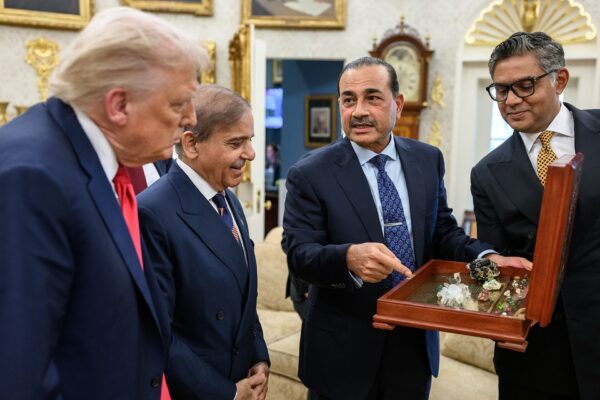
Relations between Trump and Munir have soared over the past year. The two met at least twice last year. In addition to hosting Munir for lunch at the White House, Trump has showered him with praise repeatedly and referred to Munir as his “favorite field marshal.” In the ongoing Iran negotiations, Trump has admitted to acting on Pakistan’s advice many times – even extending the ceasefire with Tehran on Islamabad’s urging. Pakistan was also quick to join Trump’s Board of Peace to help stabilize Gaza. The mining of Pakistan’s critical minerals is another key reason for Trump’s growing interest in that country.
Paul Staniland, a professor of Political Science at the University of Chicago, pointed out that Pakistan’s strategy to build influence with the Trump regime included reaching out to the Trump administration and Trump personally, as well as his family members.
“Under the first Trump administration, Pakistan was kind of a sideshow. Trump even tweeted negative things about it. But it has shown itself to be more useful in the second Trump administration. So, there’s a preexisting basis for U.S.-Pakistan cooperation under this administration,” Staniland said.
Recent news reports said Pakistan seemed a natural choice for the role as mediator between the United States and Iran, given its good relations with both countries. Pakistan is seen as neutral, especially by Iran, as it does not have diplomatic relations with Israel. In the 1970s too, Pakistan worked as an intermediary to arrange secret talks between the U.S. and China. Those efforts led to then-U.S. Secretary of State Henry Kissinger’s visit to China in 1971, followed by then-President Richard Nixon’s visit to Beijing in 1972.
In the case of the ongoing West Asia conflict, geography also worked in Pakistan’s favor – it shares a 1,000 km border with Iran. The closeness with the U.S. is despite the strong relationship Pakistan enjoys with Washington’s strategic rival – China.
And last year, Saudi Arabia and Pakistan signed a Strategic Mutual Defense Agreement (SMDA) that injects new dimensions into an existing strategic cooperative partnership between Islamabad and Riyadh. Taken together, Pakistan has revived its relevance for the U.S. and seems to be comfortably placed to play a major role in the Middle East.
Noting the affinity and bond between Trump and Munir, Brig (Retd) Anil Raman, a research fellow in the Geostrategy Program at the Bengaluru-based Takshashila Institution, drew attention to the similarity in the internal dynamics of the U.S. and Pakistan.
“Under their current leaderships, both countries are governed by a strikingly similar operating logic: institutions are weak or weakened, personalities dominate, and outcomes depend less on process than on who knows whom and what they have to offer each other,” he wrote in a recent opinion piece. “In Pakistan, this is a structural condition. The military has always been the institution that actually decides. Civilian governments come and go; the army remains. Munir has simply made this arrangement more explicit than most predecessors.” The reference was to the traditional hold Pakistan’s army has over the country’s politics and civilian institutions.
None of this, however, detracts from the immense challenges Pakistan is facing at home – a weak government, an assertive military and economic hardships. Pakistan’s government is accused of managing dissent through bans on physical rallies and protests and through internet firewalls in the digital sphere. Pakistan’s popular former Prime Minister Imran Khan has been in prison since 2023, with concerns growing over his health. Unrest in provinces like Balochistan and Khyber Pakhtunkhwa has grown, as have terrorist attacks in the country.
The economic situation is also troubling. Although the International Monetary Fund and Pakistan reached a staff-level agreement on Pakistan’s loan program in March, a key step toward unlocking $1.2 billion in funding, the West Asia crisis has plunged the Pakistani economy into trouble again, other reports said.
Pakistan’s plans to stabilize its economy through the extraction of rare earth minerals could run into trouble as stability in Balochistan remains elusive.
For now, Pakistan seems to have “bet that international legitimacy can be translated into domestic stability,” said an assessment by the Washington-based Carnegie Endowment for International Peace think tank. “But this will depend upon whether the regime can leverage this international goodwill and relevance to manage domestic grievances, deliver economic stability, and avoid strategic overreach. If it cannot, or if international fortunes reverse, political and economic pressures will converge and the very concentration of power that has secured Munir’s position could also magnify the consequences of failure,” CEIP added.
