

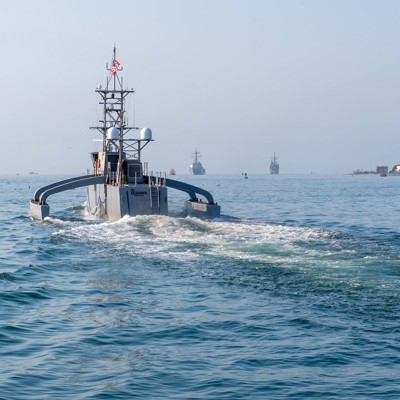
The Navy’s new 30-year shipbuilding plan outlines an effort to buy 15 battleships by 2055, and reveals details about the 80-plus robot boats it aims to add within five years.
“Our success will be measured by one metric: a larger, more capable fleet—manned and unmanned—ready to defend our homeland and project power globally,” Acting Navy Secretary Hung Cao said in the report’s foreword.
The fiscal year 2027 update of the plan, released Monday, adds new details on the Navy’s vision for a 450-vessel fleet by 2031, including 299 warships, 68 auxiliary ships, and 83 unmanned vessels, which would likely include medium unmanned surface vessels and extra large unmanned underwater vessels.
“High-end platforms remain essential, but they must be complemented by systems that can be produced at volume and adapted in real time. That includes a range of unmanned systems operating everywhere from the seabed to space, fully integrated with current force structure. The high-low mix is how we increase new market entrants and competition within the industrial base,” the plan says.
The Navy did not submit a fiscal year 2026 shipbuilding plan. While previous shipbuilding plans have mentioned unmanned vessels, this year’s plan details what exactly the Navy wants to buy and when. Specifically, the service wants to buy 47 MUSVs by 2031, with the goal of having 72 in the inventory by 2056. However, footnotes for several inventory and funding tables state that “all items beyond the FYDP are under review by the administration.”
Before the 2027 budget, the Navy didn’t outline how many MUSVs it wanted, said Bryan Clark, who leads the Hudson Institute’s Center for Defense Concepts and Technology.
The move comes after the Navy announced plans for a new MUSV marketplace earlier this year.
According to the proposal request, the Navy “wanted to know if a contractor could build five or 10 in FY27,” Clark said.
“The difference now is there are several vendors with mature designs or vessels under construction that they can rapidly move into prototyping. The Navy can now ask for them to demonstrate their vessels and move into serial production right away.”
On the subsea side, the Navy plans to spend $135.8 million on two UUVs in fiscal year 2027 and $1.1 billion through fiscal year 2031 for 16 vessels, the document states.
“We will field a high-low mix of platforms, integrate unmanned and autonomous systems, increase payload capacity, and ensure the power and digital architecture needed for future weapons and networks. Leveraging a smart mix of capabilities allows us to solve the most pressing operational problems faced by combatant commanders globally,” Adm. Daryl Caudle, chief of naval operations, wrote in the report’s opening.
As part of that high-end mix, the Navy also wants to buy 15 new Trump-class battleships by 2055, including three in the next five years.
The report spends 876 words laying out the Navy’s rationale for the battleship, including its potential to launch nuclear weapons and to “reduce reliance on high-cost single-use munitions” through electronic warfare and high-energy lasers.
“The nuclear-powered battleship is designed to provide the fleet with a significant increase in combat power by longer endurance, higher speed, and accommodating advanced weapon systems required for modern warfare,” the report states. “Adding capability at the highest end of the high-low mix, the battleship’s primary role is to deliver high-volume, long-range offensive fires and serve as a robust, survivable forward command and control platform; it is not a destroyer replacement.”
Eric Labs, a senior naval analyst at the Congressional Budget Office, noted the shipbuilding plan eschews a next-generation destroyer, DDG(X), seemingly in favor of the battleship, and would continue building about two Arleigh Burke destroyers per year. The three Zumwalt-class destroyers are described as the “bridge between existing DDG technologies and the battleship,” the plan says.
But just who would build the U.S. Navy’s first nuclear-powered surface combatant in decades?
“Since they have decided to build the nuclear-powered battleship, that’s a bigger challenge for the shipbuilding industrial base. And it becomes a big question [of] who, at the very least, does the final assembly of these ships? Is it one yard? Is it two?” Labs said.
“The traditional surface-combatant-building builders are not, as of now, nuclear-capable. One of them, at least, if not both, might need to become nuclear-capable if the Navy wants to build their ships there. Alternatively, if the Navy wants to…maybe they do final assembly of a nuclear-powered battleship at Newport News, which is certified because it builds nuclear-powered aircraft carriers and submarines…but then Newport News is already very, very full with its carrier work and its submarine work.”
The report also calls for a five-fold increase in modular or distributed shipbuilding for new construction across multiple sites.
“Today, roughly 10 percent of shipbuilding work is performed at distributed sites. Our goal is 50 percent. New hulls will prioritize modular, digital designs that enable distributed shipbuilding across multiple yards and suppliers. Modular construction expands production capacity, reduces bottlenecks, and accelerates delivery by leveraging industrial capability across the country, not just at a handful of legacy shipyards. It also provides flexibility to ensure we are not locking capability into a single hull, but building systems that can evolve, integrate, and expand across the fleet,” the report says.
The battleships, designated BBG(X), are expected to cost $43.5 billion for three ships through fiscal year 2031, according to the report, noting that advanced procurement of $1 billion in fiscal year 2027 would use “existing efforts with the lead ship of the class to be procured in [fiscal year 2028].”
But those numbers don’t account for the ship being nuclear-powered, which will be an additional expense.
“The Navy could buy a larger surface combatant in around those numbers and field 15 by 2055. Our force design study for the Navy proposes building a dozen CG(X) cruisers (rather than a battleship) with the expectation it will cost $9 billion to $10 billion each, and that is possible even if budgets return to their 2025 levels,” Clark said.
“However, the battleship the Trump administration is envisioning would be more expensive than they estimate because it will be nuclear powered and incorporate several new technologies that have not been integrated into a new ship before, such as high-power lasers and electromagnetic railguns. Those elements will drive the cost up toward $20 billion for the first ship and will make it hard to design and build the first ship in 10 years. Normally a ship like this would take five years to design and seven or more to build and deliver.”
There’s also the matter of increased sustainment costs.
“The shipbuilding plan envisions buying more ships and growing the fleet, but the expected sustainment costs seem to rise only at the rate of inflation (assuming inflation gets back down to 2–3 percent),” Clark noted in an email. “If the fleet is going to expand by about 100 ships (33 percent), I would expect sustainment costs to grow by much more. In practice, this means future Navy leaders will likely need to retire ships or inactivate them to reduce sustainment costs.”
A Congressional Budget Office analysis of the 2025 plan estimated it would cost $1 trillion for new ship builds. A detailed analysis of the current plan is expected later this year.
“This is a shipbuilding plan that will definitely cost more than the previous shipbuilding plan because you have a somewhat larger number of ships in the 30-year period, and a number of those ships—if not most of those ships—are more expensive than they were two years ago,” Labs said.
The Navy plans to buy four frigates, which it envisions working closely with MUSVs, by fiscal 2031 and plans to have 66 by fiscal year 2056. A predecessor program was canceled last year amid ballooning costs and delays.
But estimated costs for the frigate are higher than they were in the last shipbuilding plan.
“The frigate is a realistic cost estimate in the shipbuilding plan. But it was not a realistic cost estimate in the prior Navy shipbuilding plan,” he said. “It’s a smaller ship, but it’s more expensive…so it’s definitely going to cost more money than the prior Navy shipbuilding plan one way or the other.”
