


The Fatah-2 (also written Fatah-II) is Pakistan’s medium-range manoeuvrable surface-to-surface missile (SSM) – a quasi-ballistic guided missile with a domestic range of 400 km and supersonic terminal speed exceeding Mach 2. The Fatah-2 missile was developed by Pakistan’s National Engineering and Scientific Commission (NESCOM) and is marketed by Global Industrial and Defence Solutions (GIDS).
The Fatah-2 is the second member of the broader Fatah missile family and occupies the medium-range tier of the Army Rocket Force Command’s (ARFC) layered strike portfolio. It also serves as the common platform for the Pakistan Navy’s (PN) SMASH anti-ship ballistic missile (ASBM).
Move earlier than the market does.
Get procurement-focused reporting, market signals, and exhibition intelligence built for teams tracking Pakistan’s defence industry and adjacent regional opportunities.
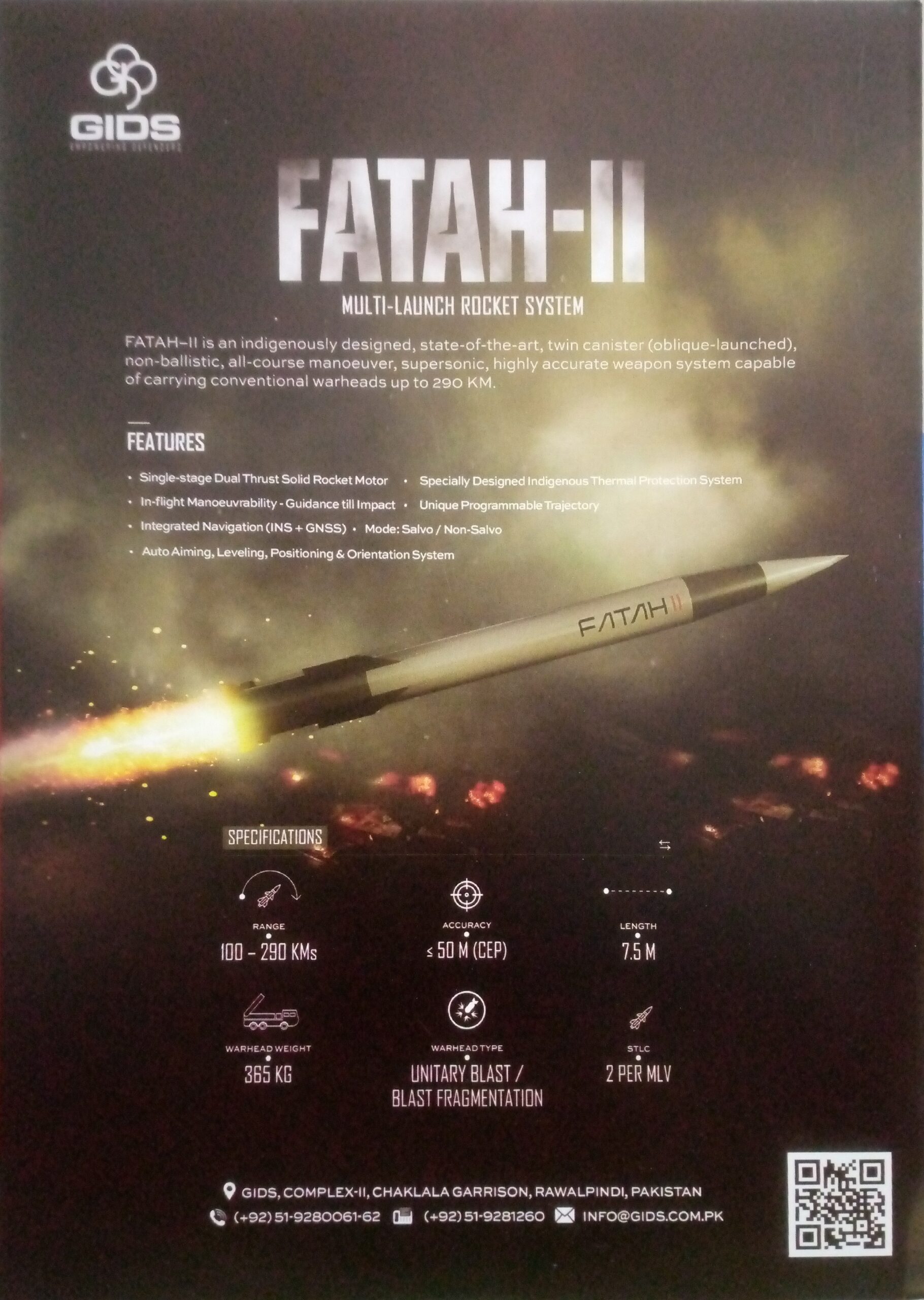
Fatah-2 Specifications
| Parameter | Specification |
|---|---|
| Type | Surface-to-Surface Missile (SSM) / Tactical Ballistic Missile (TBM) |
| Developer | NESCOM / GIDS |
| Range | 100–290 km (export); 400 km (domestic) |
| Accuracy (CEP) | ≤ 50 m |
| Warhead Weight | 365 kg |
| Warhead Type | Unitary blast or blast fragmentation |
| Diameter | 600 mm |
| Length | 7.5 m |
| Terminal Speed | Supersonic (> Mach 2) |
| Propulsion | Single-stage dual-thrust solid rocket motor |
| Guidance | INS + GNSS; all-course manoeuvre capability |
| Launcher | Twin-canister oblique-launch system on 8×8 wheeled chassis |
| Naval Derivative | SMASH ASBM (common 600 mm platform) |
| Status | Operational; ARFC training launch April 2026 |
Development and Induction History
The Fatah-2 was first tested in December 2023, demonstrating a range exceeding 290 km alongside the supersonic glide vehicle and all-course manoeuvre capability that distinguish it from the Fatah-1. GIDS subsequently presented the system at international defence exhibitions, disclosing detailed specifications including the 600 mm diameter, 365 kg warhead, and dual-thrust solid rocket motor.
The Fatah-2 was officially inducted into the Pakistan Army’s inventory in early 2024 – making it the second Fatah-series system to achieve operational status after the Fatah-1. The domestic variant is understood to have a range of approximately 400 km, with the export variant capped at 290 km to comply with Missile Technology Control Regime (MTCR) thresholds.
On 28 April 2026, the ARFC conducted a training launch of the Fatah-2 – the first publicly acknowledged firing since the ARFC’s formation and the May 2025 conflict. The launch was framed as a “training launch” rather than a developmental test, confirming that the Fatah-2 has moved beyond the testing phase and is now an operational system within the ARFC’s deployed inventory.
Supersonic Glide Vehicle and Manoeuvrability
Unlike the Fatah-1, the Fatah-2 incorporates a supersonic glide vehicle that separates from its propulsion system in the upper atmosphere. GIDS’s official product datasheet describes the Fatah-2 as a “non-ballistic, all-course manoeuvre, supersonic” weapon system – language intended to distinguish it from conventional ballistic missiles that follow a predictable parabolic arc.
In practice, the “non-ballistic” label is somewhat of a marketing simplification. The Fatah-2 still follows a ballistic trajectory during its boost phase – the solid rocket motor lofts the missile along a conventional arc. It is after boost-phase separation, when the glide vehicle detaches and begins its autonomous flight, that the trajectory becomes non-ballistic. From that point onward, the glide vehicle can execute evasive manoeuvres throughout the mid-course and terminal phases rather than following a predictable descent path. The system is more accurately described as quasi-ballistic – ballistic in its initial phase, manoeuvrable thereafter.
This all-course manoeuvrability makes the Fatah-2 considerably more resilient against ballistic missile defence (BMD) systems than a conventional ballistic trajectory would allow. By varying its flight path at multiple points after boost-phase separation, the missile reduces the window available for interception and complicates the predictive algorithms that BMD radars rely on for fire-control solutions.
The terminal speed exceeds Mach 2, though GIDS has not disclosed the precise figure. At supersonic terminal velocity, the Fatah-2’s kinetic energy alone – independent of the 365 kg warhead – adds a significant destructive component upon impact.
Guidance and Navigation
The Fatah-2 uses integrated INS+GNSS navigation and offers programmable trajectory options for precision strikes. The dual-mode guidance allows the missile to maintain accuracy even in contested electromagnetic environments, as the inertial system provides autonomous navigation when GNSS signals are jammed or degraded.
GIDS claims a circular error probable (CEP) of 50 metres or less for the Fatah-2. While this is less precise than the Fatah-1’s claimed 15 m CEP, the Fatah-2 compensates with a substantially heavier warhead (365 kg) and the ability to engage targets at nearly three times the range.
Launcher Configuration
The Fatah-2 uses a twin-canister oblique-launch system mounted on an 8×8 wheeled chassis. This configuration supports both salvo and non-salvo modes, enabling the launcher to fire both canisters in rapid succession or space launches for sequential target engagement.
SMASH ASBM: Naval Derivative
The Fatah-2’s 600 mm-diameter core platform is shared with the Pakistan Navy’s SMASH anti-ship ballistic missile (ASBM). The SMASH was first test-fired in November 2025 and formally unveiled for export at the 2026 World Defense Show in Riyadh.
This common-platform relationship is significant because it allows NESCOM to consolidate supply chains across the PA and PN, amortising production costs across a larger procurement base. The SMASH adds a terminal seeker – likely active radar-homing (ARH) – to the Fatah-2’s airframe for maritime target engagement, but the propulsion, guidance backbone, and airframe structure appear to be shared.
Comparison with BrahMos
The Fatah-2 and India’s BrahMos supersonic cruise missile are often compared, though they occupy different technical categories. The BrahMos is a ramjet-powered supersonic cruise missile that maintains Mach 2.8–3.0 throughout its flight. The Fatah-2 is a solid-fuel ballistic missile with a supersonic glide phase – it achieves supersonic speed through ballistic trajectory and gravity-assisted acceleration rather than sustained powered flight.
In practical terms, the Fatah-2’s all-course manoeuvre capability provides a different form of survivability than the BrahMos’s sustained speed. Where the BrahMos compresses reaction windows through raw velocity, the Fatah-2 complicates interception through unpredictable trajectory changes.
The PA’s answer to the BrahMos’s sustained supersonic cruise capability is the Fatah-3 SSCM – a ramjet-powered missile that more directly mirrors the BrahMos’s flight profile.
Doctrinal Role Within the ARFC
The Fatah-2 occupies the medium-range tier of the ARFC’s layered strike architecture. Its 400 km domestic range enables engagement of targets well beyond the forward edge of the battle area – including air bases, logistics hubs, and operational headquarters.
Together with the Fatah-1 (140 km), Fatah-3 (SSCM), and Fatah-4 (750 km), the Fatah-2 provides the PA with a multi-modal strike capability that approaches targets through different speed regimes, altitudes, and flight profiles.
Quwa Pro
Spot Pakistan’s Next Procurement Opportunities Earlier
Market Intelligence for industry professionals: procurement signals, vendor activity, capability gaps, and industrial shifts across Pakistan and adjacent defence markets.
Featured & Trusted By
Frequently Asked Questions About the Fatah-2
What is the range of the Fatah-2?
The Fatah-2 has a domestic range of approximately 400 km. The export variant is capped at 290 km to comply with MTCR thresholds.
What speed does the Fatah-2 reach?
The Fatah-2 achieves terminal speeds exceeding Mach 2 during its descent phase via the supersonic glide vehicle.
Is the Fatah-2 the same as the SMASH?
They share a common 600 mm core platform. The SMASH adds a terminal ARH seeker for anti-ship engagement.
What does all-course manoeuvre mean?
GIDS describes the Fatah-2 as having all-course manoeuvre capability after boost-phase separation, complicating interception by BMD systems.
Has the Fatah-2 been operationally tested?
The ARFC conducted a training launch on 28 April 2026.
