

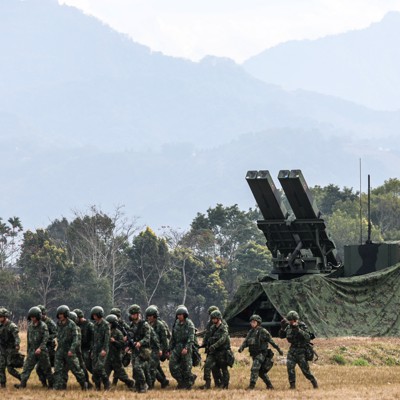
Taiwan is everything Donald Trump says he wants in an ally. It is investing unprecedented sums in its own defense, including billions spent on American-made weapons. It manufactures the world’s most advanced semiconductor chips, which power U.S. commercial products and cutting-edge weapons, such as the F-35 stealth fighter.
As Trump heads to Beijing this week for a summit with Xi Jinping, the question is whether the U.S. president recognizes that Taiwan is a “model ally”—a term his administration has applied to Israel, South Korea, and other countries—and will resist the temptation to trade its security for Xi’s hollow promises to import more U.S. goods and allow American firms to purchase more of the critical minerals whose supply China nearly monopolizes.
Taiwan demonstrates the success American partnership can bring to a hungry country. It is a vibrant democracy of 23 million that holds free and fair elections, has peaceful transfers of power, an independent judiciary, free press. It also has a vigorous civil society that has consistently chosen self-government over absorption into a Chinese system whose autocratic rule over Hong Kong shows what unification looks like. The contrast with the People’s Republic of China could not be more stark or more relevant. Amid a global competition between free nations and aggressive dictatorships, Taiwan stands firm. It reflects the world the United States is trying to build and sustain.
Likewise, Taiwan’s contributions to American prosperity are so fundamental that their loss would reverberate through every sector of the U.S. economy. Two Taiwanese companies, Taiwan Semiconductor Manufacturing Company and United Microelectronics Corporation together account for nearly three-quarters of the semiconductor chips produced world-wide. TSMC alone produces about 90 percent of the world’s most advanced logic chips. These components run every smartphone, every data center, every AI application, and every advanced weapon that gives the United States military its battlefield advantage. The algorithms that power American intelligence analysis also run on Taiwanese chips. Last year, Taiwan exported about $200 billion of goods to the United States of which $150 billion was advanced computing components. These components, in turn, were used to manufacture trillions of dollars of U.S.-made products. This is what a secure supply chain looks like.
Taiwan has doubled down on this economic commitment by pledging more than $500 billion in foreign direct investment in the United States, $250 billion of which will be in advanced computing, artificial intelligence, and other innovation efforts. This is a far greater per capita investment than any other Asian or European partner. It is not the behavior of a free-rider, but of a partner investing its capital in an enduring alliance.
The Chinese Communist Party is desperate to subjugate Taiwan, whose very existence is a visible reminder that Chinese people can have both freedom and prosperity. The People’s Liberation Army threatens and challenges Taiwan’s military and coast guard on a daily basis. Taiwan responds professionally and does not flinch. It does not ask American forces to fight every skirmish on its behalf.
Taiwan’s defense spending has increased every year this decade and currently stands at over 3 percent of GDP. Taiwan’s president, Lai Ching-te, has committed to reaching 5 percent of GDP by 2030, a target that would make Taiwan one of the highest defense-spending democracies relative to the size of its economy.
Critically, Taiwan is spending this money on American weapons designed specifically for the threat it faces. Harpoon coastal defense missiles. HIMARS rocket artillery. Javelin anti-tank missiles. These are not platforms purchased for parades. They are the ones that American military planners have identified as most relevant to deterring a PLA amphibious assault.
China’s diplomats have been explicit in the run-up to this week’s summit that they want Trump to bend on Taiwan. They say it is “at the core of China’s core interests” and Washington’s adherence to the One China principle is a “prerequisite” for stable relations. Xi is likely to offer trade deals and rare earth cooperation, if Trump will constrain arms sales or acknowledge that the United States opposes Taiwan’s independence. Xi will calibrate his appeal to a president who thinks transactionally.
President Trump should recognize that Taiwan is offering the far better deal. It has already done what Washington would want from an ally.” It is a democracy. It is spending over 3 percent of GDP on defense and committed to 5 percent. It is buying American weapons specifically designed for its threat environment. It is standing daily against a U.S. peer adversary. And it is the source of the semiconductor chips that energize American economic and military power in the twenty-first century.
Trading Taiwan’s security for rhetoric from Beijing would be a strategic blunder of historic proportions, one that every American ally watching the summit, from Tokyo and Seoul to Warsaw and Tallin would remember for a generation.
Mark Montgomery is a retired U.S. Navy rear admiral who is now a Senior Director at the Foundation for Defense of Democracies.
