

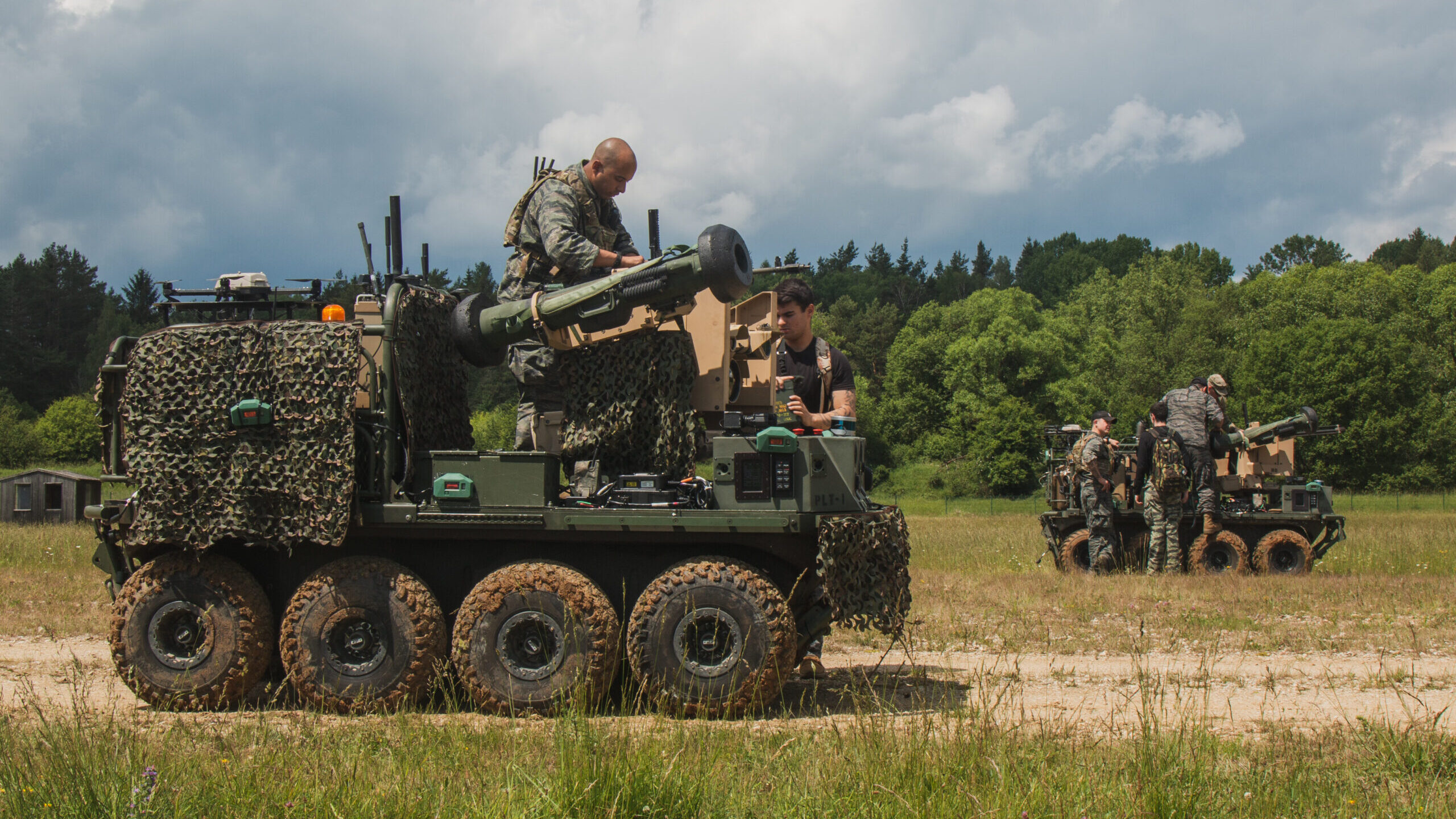
DETROIT — Earlier this year, the Army stood up the Capability Program Executive Office for Mission Autonomy (CPE Mission Autonomy) to interconnect all unmanned operations in the Army from drones to robots.
The new office won’t build or acquire them but will integrate such systems into “packages of capability” that can be tasked by commanders depending on the mission, CPE Mission Autonomy’s leader Brig. Gen. Anthony Gibbs said here at the joint Xponential/MDEX conference.
The initial focus will be to develop such autonomy packages in three areas: combat engineering, where sappers traditionally have been called upon to shape the terrain in the breach prior to ground assault, considered one of the most dangerous jobs in the military and ripe for autonomy; as well as fires and logistics.
These “packages of capability,” as described by Gibbs, will employ “a system of systems approach” that enables a commander to task them “much like he or she would a manned formation.”
CPE Mission Autonomy was cobbled together from existing pieces within the acquisition community: Program Executive Office Ground Combat Systems and Program Executive Office Combat Support & Combat Service Support in Michigan, Picatinny Arsenal in New Jersey, and Aberdeen Proving Ground in Maryland. It’s headquartered at Fort Belvoir, Va.
Its goal for these mission autonomy packages is to be able to interpret commander’s intent, plan, execute, and adjust as battlefield conditions change.
“When realized,” Gibbs said, “this capability will be able to understand and translate human intent into mission plans and mission execution, dynamically re-task as needed” based on factors such as terrain and the enemy situation.
RELATED: Frustrations mount over Army’s Robotic Combat Vehicle autonomy, acquisition
Because CPE Mission Autonomy’s charge cuts across so many mission areas and user communities in the Army, Gibbs acknowledged that prioritizing across the service is “a big challenge.” The answer, he said, is that Army Training and Doctrine Command is helping CPE Mission Autonomy look across user communities and determine where the new organization should focus.
As mentioned, autonomous combat engineering for mobility and counter-mobility operations, as well as replacing, displacing, and shaping obstacles, is at the top of the list.
Fires is second, starting with connecting systems the Army already has and fielding capabilities that have been demonstrated for years, including automated target recognition and call-for-fire algorithms, according to Gibbs.
“Those technologies are mature,” he said, “they’re just cross-cutting. No one owns them. We’re saying we own those spaces.”
Third is sustainment, especially resupply at echelon and casualty evacuation (CASEVAC). Gibbs pointed to multiple ongoing efforts, including the Autonomous Transport Vehicle System program and demonstrations of autonomous ship-to-shore resupply using unmanned surface vessels and ground robots.
RELATED: Lessons in combat medicine from the Ukraine conflict
In contested areas, he said, the Army can no longer assume it will always be able to move people and supplies the way it did in Iraq and Afghanistan.
“If you move exposed, you’re going to be targeted,” Gibbs said. For CASEVAC, he added that unmanned systems may not be the preferred answer, but the Army needs options when helicopters or other traditional assets cannot safely reach wounded soldiers.
Other mission areas will follow. Gibbs said launched effects are not in his portfolio, but CPE Mission Autonomy will help enable them. Counter-UAS and electronic warfare are also supporting efforts because “a lot of that mission can and should be done with unmanned and autonomous systems.”
Maneuver-related tasks such as intelligence, surveillance, and reconnaissance, as well as overwatch and maintaining contact with manned formations are still in the science-and-technology phase but could move to a higher priority later, he said.
A key enabler will be open architecture, and Gibbs prompted industry to build to open APIs and avoid proprietary interfaces, especially for counter-UAS, electronic warfare, and weapon payloads.
Ultimately, CPE Mission Autonomy will develop a reference architecture that lets the Army onboard new platforms, payloads, and enabling technologies “in a matter of weeks or even days,” rather than months or years.
