

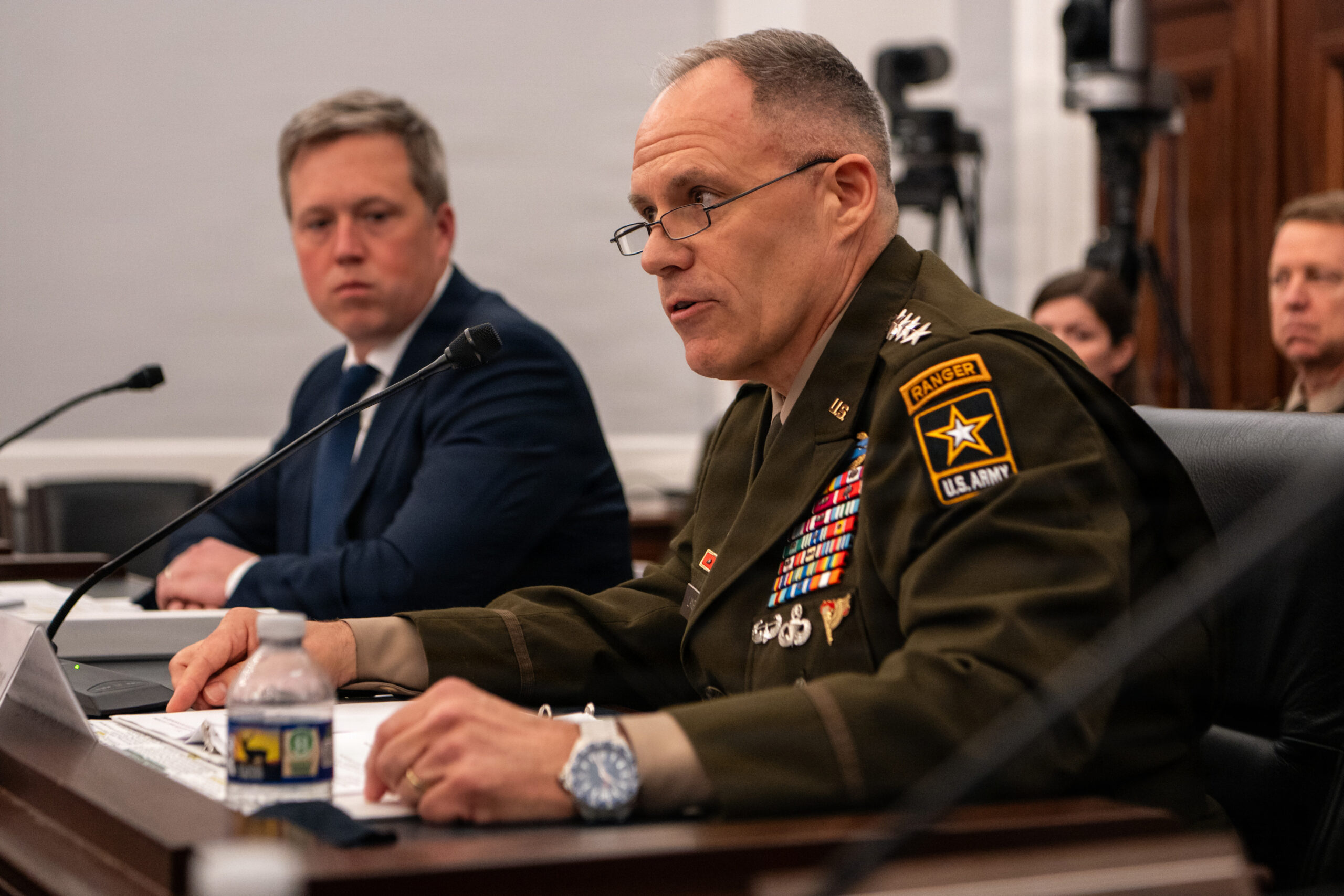
WASHINGTON — The Pentagon informed Army senior leadership “just a couple of days ago” that it would be pulling troops out of a scheduled deployment beginning in Poland, Army Secretary Dan Driscoll and Acting Chief of Staff of the Army Gen. Chrisopther LaNeve, told lawmakers today.
Earlier this week, reports began circulating that a memo from Defense Secretary Pete Hegseth blocked the planned deployment of the 2nd Armored Brigade Combat Team, 1st Cavalry Division to Eastern Europe. The decision not to send the 4,000 troops comes on the heels of the announced withdrawal of 5,000 troops from Germany, amidst ongoing tensions between the Trump administration and America’s European allies.
LaNeve told members of the House Armed Services Committee today that he was in conversations over the last two weeks with US European Command head, Gen. Alexus Grynkewich on the situation, but ultimately the order came from the Defense Department to pull the brigade.
“This was all relatively recent, and we worked back and forth on what those recommendations would be, and the order came down,” LaNeve said, later adding that department officials thought pulling that brigade from deployment “made the most sense.”
Though the decision-making time was relatively condensed, Driscoll contended that it was “not that unusual” for the Army to have to pivot in such a way, as “the Army is always ready to move people and things based off combatant commander and Secretary of War preferences.” Later on, LaNeve confirmed that equipment for the brigade was already in transit before the decision was made.
Further, Acting Pentagon Press Secretary Joe Valdez said in a statement that the “decision to withdraw troops follows a comprehensive, multilayered process that incorporates perspectives from key leaders in EUCOM and across the chain of command. He added that it “was not an unexpected, last-minute decision, and it would be false to report it as such.”
Throughout their testimony, LaNeve and Driscoll were constantly asked by lawmakers why the decision was made to pull the 2nd ABCT. Neither man provided a direct answer, with LaNeve saying he “wasn’t on the policy side” of the equation.
Lawmakers from both sides of the aisle exhibited their aversion to the decision. Rep. Don Bacon, R-Neb., said the decision was “an embarrassment” to the US, adding “I just want to say this is a slap in the face to Poland. It’s a slap in the face to our Baltic friends. I think it’s a slap to the face in this committee.”
Bacon added that Polish officials called him after finding out about the cancelled deployment, saying they had not heard from Hegseth about it and that “they were blindsided.”
Democratic Rep. Joe Courtney of Connecticut also expressed his displeasure with the decision, saying that it sends a message to US adversaries that the US is scaling back its ready-combat power in the region.
“Frankly, it’s not just our adversaries that are paying attention. It’s our allies. Poland, which is apparently where the deployment was at least going to begin and originate, is an ally that’s spending 4.8 percent of GDP in terms of their defense budgets, and all the other Baltic countries are up in that range as well,” Courtney said.
