

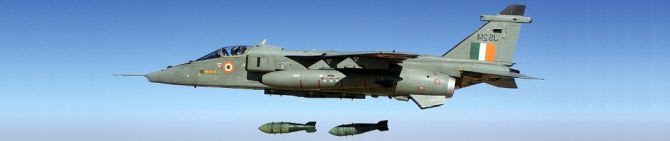
The Indian Air Force has taken a significant step in enhancing the combat
effectiveness of its veteran SEPECAT Jaguar deep penetration strike aircraft
by integrating the Israeli Rampage air-to-surface missile.
This pairing represents a fusion of a proven strike platform with a modern,
high-precision weapon system, thereby extending the operational relevance of
the Jaguar fleet in contemporary contested environments.
The Rampage missile, designed for pinpoint accuracy against high-value targets
such as radars and command centres, provides the Jaguars with a formidable
stand-off strike capability, allowing them to engage critical infrastructure
without entering dense enemy air defence zones.
The Jaguar, long regarded as a reliable deep penetration strike aircraft,
gains a new lease of life through this integration. The Rampage missile itself
is supersonic, long-range, and hardened against GPS jamming, ensuring
resilience in electronic warfare environments.
With a 150 kg warhead optimised for deep structural penetration or
blast-fragmentation, it is tailored to neutralise hardened fortifications,
terror headquarters, and reinforced bunkers. Its operational range of 150 to
250 kilometres allows the aircraft to release the weapon from a safe distance,
while its steep terminal dive at supersonic speeds makes interception by
modern air defence systems extremely difficult.
The Rampage acts as a low-cost alternative to cruise missiles, bridging the
operational gap between heavy, high-end cruise missiles and shorter-range
precision-guided munitions:
| Weapon System | Range | Target Profile | Speed Class | Key Distinction Vs Rampage |
|---|---|---|---|---|
| Rampage | 150 – 250 km | Fixed infrastructure, radars, bunkers | Supersonic (Mach 1.0–1.6) | Affordable air-launched ballistic trajectory; multi-platform fit (Jaguar/Su-30/MiG-29). |
| BrahMos-A | ~290 – 450+ km | High-value strategic targets, warship denial | Supersonic / Hypersonic (Mach 2.8+) | Massive, highly destructive, but significantly heavier; restricted primarily to modified Su-30 MKIs. |
| SCALP EG/Storm Shadow | ~250 – 500+ km | Hardened deep-bunkers, strategic infrastructure | Subsonic (Low-observable stealth) | Highly sophisticated stealth cruise missile; vastly more expensive and exclusive to the Rafale fleet. |
| Crystal Maze (Popeye) | ~70 – 80 km | High-value command complexes, buildings | Subsonic (Man-in-the-loop TV/IR) | Shorter range; requires continuous pilot data-link guidance up to impact. |
| Spice 2000/1000 | ~60 – 70 km | Hardened buildings, underground shelters | Subsonic (Autonomous Glide Kit) | Purely a glide bomb; lacks propulsion, meaning range depends entirely on high-altitude/high-speed launch. |
During Operation Sindoor, the Israeli-made Rampage air-to-surface missile
demonstrated high effectiveness for the Indian Air Force (IAF), utilizing
its Mach 1.6 speed and sub-10 meter CEP to destroy terror infrastructure and
suppress air defences.
The weapon, deployed by Su-30MKI and SEPECAT Jaguar aircraft, showed high
electronic immunity and successfully penetrated reinforced targets using a
150 kg warhead, leading the IAF to move toward large-scale acquisition.
The optimised target sets for the Jaguar-Rampage combination include airfield
infrastructure such as control towers and reinforced facilities, air defence
networks including stationary radar installations and SAM batteries, strategic
logistics hubs like weapons storage and fuel infrastructure, and hardened
fortifications.
This versatility ensures that the IAF can employ the system across a wide
spectrum of missions, from suppression of enemy air defences to precision
strikes against strategic assets. The missile’s launch envelope, ranging from
altitudes of 3,000 to 40,000 feet at aircraft speeds of Mach 0.7 to 0.95,
provides flexibility in operational deployment, while its terminal velocity of
Mach 1.0 to 1.6 maximises penetration effectiveness.
The significance of this upgrade lies in the IAF’s broader strategy of
modernising legacy platforms with advanced weapon systems rather than retiring
them prematurely. By equipping the Jaguar with Rampage missiles, the IAF
ensures that the aircraft remains a potent strike asset capable of
contributing meaningfully to future conflicts.
This approach also reflects a cost-effective strategy, leveraging existing
airframes while integrating cutting-edge munitions to maintain combat
relevance. The Rampage’s ability to deliver precision strikes against critical
enemy infrastructure without exposing the aircraft to high-threat zones
underscores its value as a force multiplier.
Globally, the integration of glide and stand-off precision weapons with legacy
aircraft has become a trend, as seen with systems like the American JDAM-ER,
Russian UMPK kits, Israeli SPICE, and Chinese LS-6 series. India’s adoption of
the Rampage missile for its Jaguars places the IAF firmly within this modern
warfare paradigm, ensuring that its strike capabilities remain competitive
against regional adversaries.
The Jaguar-Rampage combination is particularly relevant in scenarios involving
Pakistan and China, where the need for high-volume precision strikes,
suppression of air defences, and deep strike capability is paramount. In such
contexts, the Rampage-equipped Jaguars could serve as reliable workhorses,
complementing more expensive systems like BrahMos and SCALP which are reserved
for high-value targets.
This integration also highlights the adaptability of the Jaguar platform,
which has already seen upgrades in avionics, sensors, and weapon systems over
the years. By incorporating the Rampage missile, the aircraft’s role as a deep
penetration strike asset is reinforced, ensuring its continued relevance in
the IAF’s order of battle.
The combination of proven airframe and advanced missile technology exemplifies
the IAF’s pragmatic approach to force modernisation, balancing
cost-effectiveness with operational capability. It demonstrates a clear intent
to maximise the utility of existing assets while progressively integrating
advanced systems to meet evolving threats.
Agencies
