

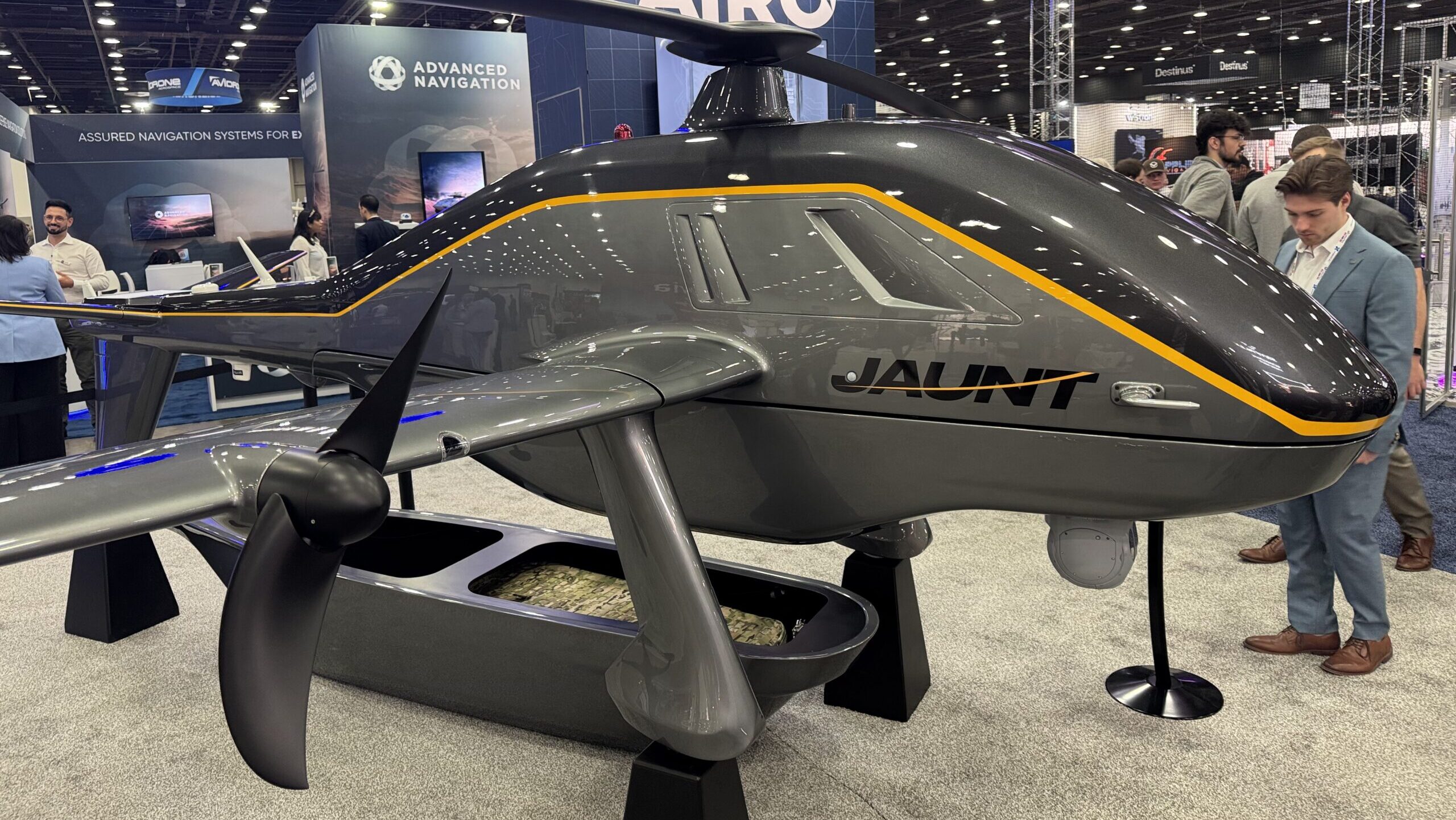
DETROIT — Aerospace firm AIRO, along with its brand Jaunt Air Mobility, unveiled new dual-use vertical-takeoff-and landing (VTOL) drones — the JC250 cargo variant and the JX250 ISR variant — with “slowed-rotor” architecture and hybrid-electric propulsion, at the Xponential/MDEX conference here.
“Hybrid provides us capabilities, not only for range, but also for going to remote areas where there may not be electrical charging available,” John Uczekaj, president and COO of AIRO Group, told Breaking Defense. “That provides a lot of flexibility going into rural areas or battlefield conditions.”
The JC250 cargo variant and JX250 ISR variant were developed as a dual-use platform for defense, government, and commercial missions. The aircraft is being developed and manufactured in Canada, with first flight expected by the end of the year and certification to follow, Uczekaj said. As a mid-size cargo aircraft, Uczekaj described the range as roughly 300-500 nautical miles, with the potential to stretch to 1,000 nautical miles because of its hybrid-electric propulsion.
A key to the drones is what the company calls “slowed rotor technology,” a patented design intended to combine helicopter-like vertical lift with more efficient forward flight, according to Uczekaj. Martin Peryea, AIRO’s senior vice president and general manager of electric air mobility, put the difference in operational terms.
“One of the big issues with vertical takeoff and landing is the amount of power required to get the aircraft off the ground,” he said. A helicopter’s large rotor is efficient for vertical lift, but “very inefficient in terms of flying forward.” Peryea added that with AIRO’s design, the rotor does the heavy lifting for takeoff and landing, then slows in forward flight and acts more like a second wing to improve lift and efficiency.
Peryea said the architecture enables “15 to 18 hours of endurance on this aircraft for ISR missions,” adding that “there’s not a single aircraft today that can lift vertically and fly 15, 18 hours. It doesn’t exist.”
For military uses, that could mean a runway-independent aircraft that can deliver cargo over long distances or remain on station for surveillance. The aircraft displayed at Xponential sported an ISR camera mounted underneath, while the cargo version uses a removable pod on the belly.
For military logistics, the drone focuses on delivering cargo to what’s called the “middle mile,” which covers the transport of goods between major distribution hubs and the final delivery point. In military terms, that is the space between rear-area stockpiles and forward or remote units, where trucks may be slow or vulnerable and manned helicopters may be scarce, costly, or overtasked.
Dual-use is also central to the aircraft’s value proposition, according to Peryea, with roles envisioned for not only the military but in areas like medical transport, law enforcement, commercial logistics, and resupply to remote communities. He added that the company is working to make the aircraft “Blue UAS compatible,” which means it will be able to be purchased by US forces.
Hybrid-electric battery propulsion is the other major differentiator. Uczekaj said the aircraft uses an electric motor along with an internal-combustion engine, giving operators range, onboard charging, and flexibility in places where charging infrastructure may not exist.
“When you’re in a military situation, you’re going into uncontrolled areas and areas that you don’t know what the infrastructure is or not,” Uczekaj said. “By having a gas-powered part of it, you can use the electric to get the efficiency that you [need] to go longer ranges and use the gas to provide charging, as well as additional range.”
