

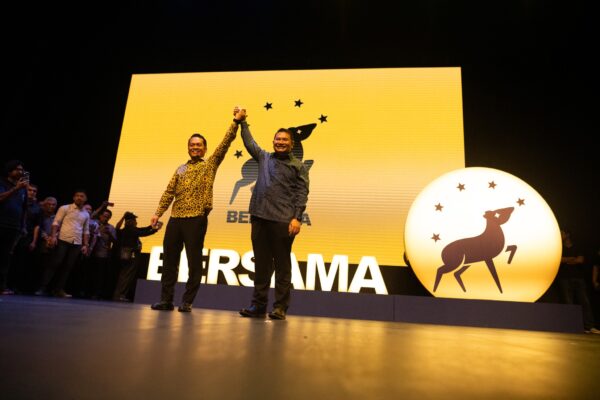
Two prominent former Malaysian ministers yesterday announced that they would vacate their parliamentary seats and resign from Prime Minister Anwar Ibrahim’s People’s Justice Party (PKR) to take over the leadership of a minor political party.
Former Economy Minister Rafizi Ramli and former Natural Resources and Environmental Sustainability Minister Nik Nazmi Nik Ahmad announced yesterday that they planned to take over the leadership of the fringe Malaysian United Party and took part in a symbolic handover ceremony involving the party’s founder, Tan Gin Theam.
Speaking at a press conference later yesterday, Rafizi said that he and Nik Nazmi had decided to vacate their seats in order to avoid accusations of “party-hopping,” which was previously rife in Malaysian politics before being made illegal in late 2022. With the current parliamentary term already more than three years in, their seats – in the Pandan and Setiawangsa constituencies in peninsular Malaysia – are set to remain vacant until the next general election and will be filled via by-elections.
While the vacating of the seats will not impact Anwar’s parliamentary majority, the departure of the two leaders could pose a political challenge for the Malaysian leader further down the road. Rafizi had formerly served as deputy president under Anwar, and was seen for a time as a potential successor. However, he became sharply critical of Anwar’s leadership since he and Nik Nazmi lost their PKR leadership positions in an internal party vote in May of last year – an event that prompted the pair to resign from Anwar’s cabinet.
As Channel News Asia reported, Rafizi has “since accused Anwar of surrounding himself with ‘yes-men,’ protecting vested interests, and failing to deliver on the reforms that once defined PKR.”
At yesterday’s event, Rafizi said the duo made the decision to jump ship because they believed that the current existing political parties could no longer respond to the most pressing issues facing Malaysians, such as the high cost of living.
“Our aspiration is to offer a political platform to like-minded citizens who believe that political power belongs to the people, not to politicians,” Rafizi said during the event.
Nik Nazmi also criticized the ruling Pakatan Harapan (PH) coalition, of which the P)KR is the leading component, accusing it of fearmongering by warning voters that the Islamist party PAS may gain power if urban voters abandon PH at the next election.
“What concerns the people, especially the youngsters, is that leaders are always circumventing and delaying their promises of reform,” he said, as per the Straits Times.
The two leaders now say they plan to build up the Malaysian United Party, also known as Parti Bersama Malaysia (Bersama for short), and prepare to contest the next general election. Rafizi said that he believed other MPs would eventually consider similar moves once the party is properly established, although he acknowledged that the Anti-Party Hopping Law could create complications. Present at yesterday’s event were what the Straits Times described as six “renegade” lawmakers from the PKR, although they have not decided – at least as yet – to join Bersama.
Bersama was founded in Penang in 2016, as a breakaway from the Chinese-majority Malaysian Chinese Association. It took part in the general election of 2018, but lost all five parliamentary seats and 20 state seats that it contested in Penang. As the Straits Times noted, Bersama’s party logo is a blue kancil, or mousedeer, which “is known in Malay folk tales for its cunning.”
The defections of Rafizi and Nik Nazmi are likely to amplify talk of an early election, which has been swirling in Malaysian political circles for some time. The next general election is not due until 2028, but Reuters reported in March that it could be called as early as July, when there are several state elections scheduled.
In an address yesterday to a PH leadership convention, Anwar said he would consider calling for a snap general election if the undermining of relationships within the unity government continues. “The date (of a general election) is the prime minister’s decision but I must listen to the advice and (the views) of friends,” he said, according to Reuters.
