

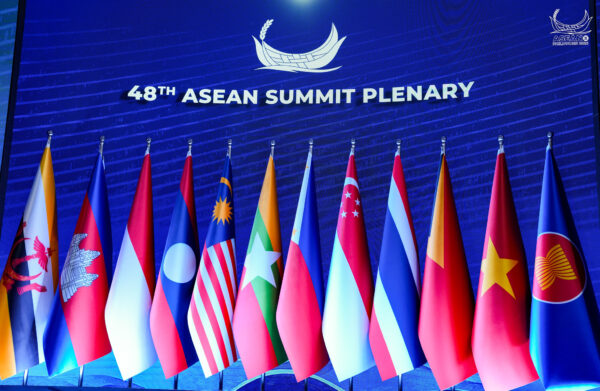
As ASEAN leaders were prepping for last weekend’s annual summit in Cebu, French President Emmanuel Macron was filing away a letter from Kim Aris, the son of Myanmar’s ousted leader Aung San Suu Kyi. It was a plea for help. Forty-eight-year-old Aris just wants proof that his mother is still alive.
He wants Macron to at least encourage the junta and its newly anointed president, Min Aung Hlaing, to offer a bit more than glib statements regarding his mother after her apparent move from prison to a “designated residence” somewhere in Naypyidaw.
One would think that Suu Kyi’s son would be entitled to an address. Her treatment is unnecessarily nasty and indicative of a junta in dire need of a reality check. That was evident when it cried foul, and played victim, claiming “discriminatory measures” were locking it out of ASEAN.
It also said from the sidelines of the 48th ASEAN Summit that positive developments were taking place in Myanmar and that this had been “well recognized” by the majority of ASEAN states since it held elections in January – polls that were widely regarded elsewhere as a sham.
True, Cambodia and Laos – rarely on the right side of history of late – and neighboring Thailand did congratulate Min Aung Hlaing on his appointment as “president.” But that’s hardly a majority.
Vietnam and Brunei remain quiet. But Timor-Leste has initiated a war crimes investigation, while Indonesia, Malaysia, Singapore, and the Philippines are ensuring the regime from Naypyidaw remains on the outside.
Despite five years of dithering by the bloc, ASEAN leaders did maintain their blacklisting of the country’s military leadership as host Philippine President Ferdinand Marcos complained there had not been “any progress in Myanmar.”
Malaysian Foreign Minister Mohamad Hasan was blunt: “We still feel uncomfortable, because oppression is still taking place, atrocities towards their own citizens are still occurring.”
To add some clarity to Hlaing’s civil war, as of early 2026, the Armed Conflict Location & Event Data Project (ACLED) had recorded around 95,000 total fatalities resulting from political violence in Myanmar since the February 2021 military coup.
It also said that the conflict has intensified, with an estimated average of around 1,550 people killed every month and more than 28.6 million people exposed to violence in the past year.
Suu Kyi is 80 years of age, and her son and the international community have a right to know how she is coping. She has a right to medical treatment and she more than deserves this given her standing, and despite the controversies she faced when in power over the military’s treatment of the Rohingya.
On that note, judges at the International Court of Justice (ICJ) in The Hague are still deliberating over whether Min Aung Hlaing and his senior generals committed a genocide during their 2017-18 crackdown on the Muslim Rohingya. A verdict is expected within months.
But still, Min Aung Hlaing’s administration had the gall to issue a statement saying “it is observed that a few Member States continue to maintain restrictions, discriminatory measures, and the exclusion of the Myanmar Government from equal representation.”
That’s the least ASEAN can and should do.
It even claimed “Myanmar has exercised patience” despite “non-constructive engagement with the new government of Myanmar,” but forgot to mention it could only be formed by a junta that ousted Suu Kyi just after she won a landslide election in late 2020.
That election was considered free and fair by ASEAN and the international community, but somehow the military thinks that a continuation of its present treatment would “disregard the genuine will of the Myanmar people, who exercised their democratic rights.”
Min Aung Hlaing and his cohorts live in a world of their own. Obviously, any form of recognition can only legitimize the barbarity they have inflicted on their own people. Still, it is an issue that will require further revision, but not until the ICJ has delivered its verdict and Kim Aris hears from his Mum.
