

A new defense architecture is taking shape across the Indo-Pacific. It bears little resemblance to the Cold War geometry of bilateral treaties and concentrated forward bases that defined the region for half a century.
What is actually emerging is an allied security web: distributed, resilient, co-invented, and built on the premise that chaos is the baseline condition of twenty-first-century conflict, rather than a failure of deterrence to be corrected.
The United States and Australia are central nodes in that architecture, but they are not solitary. Guam’s transformation into a network hub; the trilateral amphibious partnership taking shape among the United States, Australia, and Indonesia; the integrated maritime deterrence architecture developing at the Strait of Malacca; the porcupine defense being assembled across the Philippine archipelago; and the industrial redesign of Philippine supply chains through the Luzon Economic Corridor are not disconnected experiments.
They are the connective tissue of a new way of operating, one that seeks advantage not by preventing disruption but by surviving it better than the adversary and continuing to generate combat power on the far side of the opening blow.
To understand how this new network works together, we first must consider each node by itself.
From Forward Base to Network Hub: Guam and the Three Webs
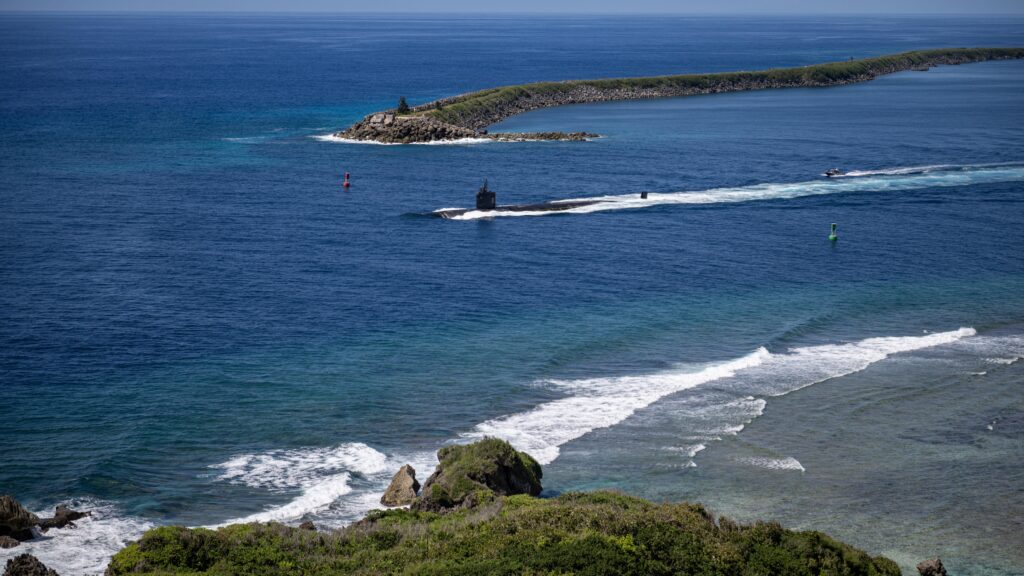
For decades, Guam sat at one vertex of a strategic triangle. The mental picture was straightforward: a large, heavily defended base from which the United States could surge power in a crisis.
That picture no longer holds, however. The maturation of Chinese intermediate-range precision strike has converted concentrated infrastructure into what operators describe as sitting ducks. Massed forces on predictable, fixed infrastructure will not survive the opening phase of a peer conflict.
Out of that recognition has emerged a fundamentally different conception of Guam and the surrounding Marianas, re-engineered as an anchor node in a distributed network organized around three interlocking architectures: security webs, deterrence webs, and kill webs. Each addresses a different layer of the operational problem — survivability, signaling, and lethality — but they only make strategic sense as a mutually reinforcing whole.
Security webs are about surviving under attack. At Guam, this has meant distributed munitions magazines, dispersed fuel storage, an integrated air and missile defense system spread across 16 sites, and expansion of the security footprint to encompass Saipan, Tinian, and Rota. When the Northern Marianas are knitted into the same defensive architecture, operational space to absorb blows and reconstitute capability expands dramatically. The adversary must now plan against multiple dispersed nodes rather than a single island fortress.
Where security webs are fundamentally about survivability, dispersing forces and supplies so that an adversary cannot achieve decisive effects with a first strike, deterrence webs work by imposing costs and manufacturing uncertainty. A deterrence web is not simply having forces forward or showing resolve. It is an integrated architecture of capabilities, partnerships, and operational concepts that forces adversaries to confront escalation risks, alliance cohesion, and operational complexity before they act.
The critical variable is not any single capability, but the integrated uncertainty the web generates: an adversary considering aggression must now calculate not just whether it can strike successfully, but what escalatory responses will follow, how distributed allied capabilities will respond, and whether tactical success will translate into strategic advantage or strategic disaster. A deterrence web functions precisely because it cannot be decapitated at a single point, because its allied nodes have genuine operational agency, and because adversary planners can never fully map its edges.
Kill webs are the most dynamic and least understood element. The traditional kill chain was linear: find, fix, track, target, engage, assess. Kill webs dissolve that linearity. They prioritize the network’s overall capacity to sense, decide, and strike faster than the adversary over the individual performance of any single asset.
Indo-Pacific Command head Adm. Samuel Paparo’s April 2026 posture statement frames this with unusual clarity. What he identifies as three converging meta-trends — the growing strategic effect of information and cognitive operations, the commoditization of cheap massed autonomous systems, and the commoditization of long-range precision strike — drive a single imperative: achieving information and decision superiority. The language differs from kill web vocabulary, but the operational logic is identical.
Co-inventing Littoral Power: The US–Australia–Indonesia Triangle
If Guam shows how web logic is transforming a legacy forward base, the emerging amphibious partnership among the US, Australia, and Indonesia shows how it is transforming the way security partners conceive and practice littoral power. The Australia-Indonesia Defence Cooperation Agreement and the expansion of Exercise Keris Woomera are formally a bilateral story. But that framing leaves out the unspoken third leg of the triangle.
The United States Marine Corps is woven through nearly every aspect of what Australia brings to the littoral. Marine Rotational Force–Darwin has made northern Australia a sustained laboratory for US and Australian experimentation in Expeditionary Advanced Base Operations, stand-in forces, land-based anti-ship fires, and the logistics of dispersing small lethal units across austere island locations. The November 2024 amphibious landing at Banongan Beach in East Java, the largest and most complex joint drill Australia and Indonesia had ever conducted, carried that intellectual and operational DNA directly into a bilateral framework where no American flag appeared on the beach.
The deeper structure is a three-lane co-invention cycle, not formally intersecting but running parallel to each other. In the US–Australia lane, Marine and Australian units develop and refine the conceptual grammar of littoral maneuver. In the US–Indonesia lane, Indonesian officers encounter those concepts directly through exercises like Super Garuda Shield. In the Australia–Indonesia lane, exercises like Keris Woomera lift selected elements into a deliberately non-US-led framework, allowing Jakarta and Canberra to adapt the concepts to their own political constraints. American concepts travel furthest when local security partners can genuinely adapt and own them.
The Malacca Chessboard: Architecture as Strategy
The Strait of Malacca carries roughly a quarter of global trade and close to 30 percent of seaborne oil. For China, this geographic fact is a structural vulnerability, what Hu Jintao famously named the “Malacca dilemma.” Beijing has spent two decades attempting to mitigate that exposure through overland pipelines and port investments. The US-Indonesia Major Defense Cooperation Partnership, unveiled in April 2026, is now changing that calculus.
What is emerging at Malacca is an application of the same three-web architecture visible at Guam, adapted for a chokepoint context. The security web consists of persistent ISR across the strait, mesh fleets of unmanned surface and undersea vehicles, and networked sensor grids that support counter-smuggling and anti-piracy in peacetime while generating the continuous contact picture that crisis management requires.
The deterrence web leverages that same infrastructure to expose and impose friction on coercive behavior. The kill web integrates those sensors with effectors. Indonesia is not simply a convenient partner in this architecture; it is structurally indispensable. Jakarta’s “free and active” foreign policy tradition allows it to deepen operational relationships with Washington in precisely the domains that matter for crisis operations without incurring the political costs of formal alliance membership.
The Philippine Porcupine: MARTAC Boats and Distributed Kill Webs
In the West Philippine Sea, the intersection of Marine special operations expertise, maritime autonomous systems, and Philippine archipelagic geography is generating a new model of deterrence. MARTAC unmanned surface vessels are at the center of this effort. The first tranche for Manila included MANTAS T-12 USVs and Devil Ray T-38 platforms, now operational with the Philippine Navy and deployed for frontline use in Palawan. The T-12 can operate in a semi-submersible “gator mode” to reduce radar and visual signatures; the T-38 carries up to roughly 4,000 pounds of payload at speeds exceeding 70 knots, readily reconfigured for ISR, anti-mining, anti-surface warfare, or logistics support.
Marine Raiders are working alongside the Armed Forces of the Philippines to operationalize these systems within an emerging SOF-enabled porcupine defense construct at sea. T-12s operating singly or in swarms patrol reef complexes, straits, and approaches to key bases, feeding a fused maritime domain awareness picture shared among Philippine Navy, Coast Guard, and Marine units and, where politically acceptable, with US and allied forces. The Philippines is becoming a test case for a new alliance approach to defense transformation: one in which US SOF and Marines help partners leap directly into the era of distributed, autonomous, and attritable systems.
Rewiring the Economic Base and Australia’s Camel Train
The security web is not purely military. Nowhere is that more visible than in the evolving US–Philippines–Japan collaboration around the Luzon Economic Corridor and the Pax Silica initiative.
In April 2026, the Philippines became the 13th member of Pax Silica, a US-led framework established in December 2025 to build secure supply chains for semiconductors, AI technology, and critical minerals among trusted allies. The accession triggered the announcement of a 4,000-acre industrial hub in New Clark City designated as the first “Golden Node” in the Pax Silica network. Trade policy has been folded directly into the deterrence web; for practitioners who have spent decades watching economic and security policy talk past each other in Washington, this integration represents a meaningful structural shift.
Australia’s Camel Train project illuminates how a middle power can leverage its existing civilian ecosystem to become a critical node in the kill web’s logistics and ISR layers. The problem is operationally straightforward: Australia has only a handful of permanently manned air bases, all of which would be priority targets in a high-intensity conflict. Camel Train addresses this by turning general aviation itself into a defense asset, a prototype Jabiru 400 retrofitted with a wholly Australian autonomous avionics stack moved from conception to flight testing within two years.
The foundational design decision is that the avionics stack is aircraft-agnostic: the same package can be pulled and installed in a Cessna 152, a King Air, or a Gipps Aero GA8. A “boring old logistics drone” hauling jerry cans can, with a small optical sensor package, become a persistent ISR collector over the same routes. Australia has approximately 30,000 licensed drone operators certified under CASA standards; in a mobilization phase, this represents a potential operational reserve that has never existed before in this form.
From Hub-and-Spoke to Allied Security Web
Taken together, Guam’s three webs, the amphibious co-invention triangle, the Malacca deterrence architecture, the Philippine porcupine, Luzon’s industrial pivot, and Australia’s Camel Train describe a strategic shift that is more than the sum of its parts.
The Cold War Indo-Pacific was organized around an American hub-and-spoke system. Washington dealt bilaterally with allies. Reassurance flowed outward from a central American node. Regional security rested on a small number of heavily defended bases and carrier strike groups. That architecture no longer suits the era we are entering.
The emerging order operates on different principles. Distribution replaces concentration, not just operationally but strategically. Security partners like Australia, Japan, the Philippines, and Indonesia are no longer simply consumers of American reassurance. They are producers of regional stability, and the architecture explicitly depends on their capacity to act with initiative and at times without a visible American presence. Resilience replaces the pursuit of invulnerability. Co-invention replaces one-way transfer.
While these partners and allies are stepping up, make no mistake: the US remains indispensable. Only Washington can underwrite the munitions stockpiles, space architectures, large-platform fleets, and global industrial alliances that a theater-wide kill web requires.
But the character of American leadership is changing. Rather than acting as the single central hub through which all alliance relationships run, the US is becoming the largest node in a multi-node web, a first among partners whose strength lies not only in what it can do alone but in what it enables others to do with it, and at times without it visibly present.
For Australia, this is simultaneously an opportunity and a serious demand. Canberra must invest in the niche capabilities — autonomy, sensing, amphibious maneuver, resilient dispersed logistics — where it can genuinely lead rather than merely participate. It must also accept that some of the most strategically significant work it will do with regional partners, particularly Indonesia, will occur outside the visible embrace of American power, even as it draws deeply on American concepts and technologies.
The 1999 East Timor intervention is instructive here. Australia could lead that operation with international legitimacy precisely because it assembled a coalition that included ASEAN member states willing to follow an Australian-flagged lead who would not have followed a US-flagged one. That logic is more relevant than ever. The security web Australia is helping to build will be most effective not when it is visibly American-sponsored, but when Australia can stand in it credibly on its own terms.
That is the price and the privilege of operating as a co-architect of the security web rather than a spoke in someone else’s wheel.
Note: I discuss in greater detail the evolving Pacific defense architecture in my recent book, Lessons from the Drone Wars: Maritime Autonomous Systems and Maritime Operations. I wrote this article while I was in Australia in my function as a Research Fellow with the Sir Richard Williams Foundation, Canberra.
