

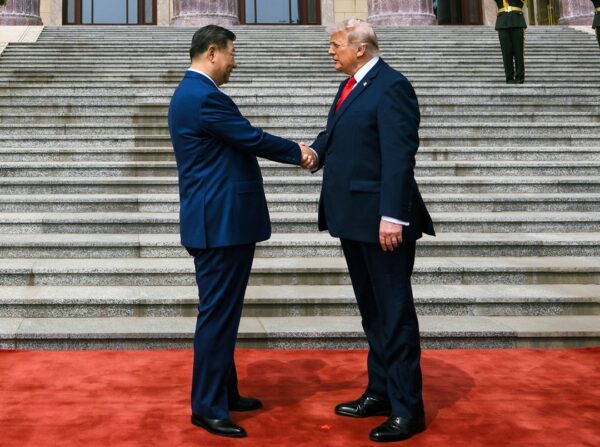
Xi Jinping’s supreme confidence in hosting U.S. President Donald Trump reflected Beijing’s conviction that time and strategic momentum are on China’s side.
The summit’s language about “constructive strategic stability” echoed earlier Chinese diplomatic formulations under Jiang Zemin and Hu Jintao. Xi’s more salient message was that more stable relations require Washington to avoid “mishandling” Taiwan. Beneath the summit optics lies the reality that China’s rapid nuclear transformation is increasingly straining extended deterrence and unsettling the United States’ Asian allies.
China’s Nuclear Transformation
For decades, China maintained a relatively modest nuclear deterrent built around assured retaliation. That era is over. China is no longer content with a minimalist deterrent. It is building a larger, more flexible nuclear force at “breakneck speed,” designed not simply to retaliate, but to coerce. In any direct conflict, conventional combat could quickly acquire nuclear overtones, bringing escalation into view from the opening salvo.
U.S. intelligence and defense assessments show China building a full-spectrum nuclear force encompassing vast missile fields, more survivable submarines, improved bombers, and theater nuclear options that increase flexibility and risk. The issue is less modernization than the emergence of a coercive nuclear posture designed to raise doubts about U.S. resolve.
China’s expansion of the Lop Nur test site, alongside infrastructure growth at Pingtong and Zitong in Sichuan, suggests Beijing seeks the option to field a significantly larger nuclear force and, when combined with other indicators, may point to the People’s Liberation Army (PLA) moving toward a launch-on-warning posture. Its interest in early warning, counterforce capabilities, and AI-enabled decision support raises even deeper concerns. Shorter decision timelines, reduced transparency, and machine-assisted escalation dynamics could make crises less stable and miscalculation more likely.
Beijing has created a self-reinforcing cycle of technological innovation, military firepower, and economic reward. China’s missile buildup is generating windfall profits for dozens of firms in its opaque defense supply chain, with roughly 80 companies benefiting from procurement linked to missile production and Xi Jinping’s sweeping military modernization campaign. Combined with China’s expanding nuclear arsenal this surge in strike capacity poses a growing challenge to the United States’ defense posture in the Indo-Pacific. Beijing’s leaders may be risk-averse today, but future leaders could wrongly conclude that technological superiority escalation control when it may do precisely the opposite.
As suggested by Trump’s proposal that China enter three-power strategic arms talks, the strategic problem extends beyond China alone. Washington must simultaneously deter Russia, reassure NATO, sustain extended deterrence in Asia, and prepare for a far more capable Chinese nuclear force. U.S. allies see this challenge clearly and are beginning to adjust accordingly. The National Defense Strategy’s reference to a “critical but limited” U.S. force posture is not enough to reassure Japan and South Korea or fully restrain them from going nuclear in the long run.
That is why recent regional diplomacy matters. The first Japan and South Korea two-plus-two vice-ministerial meeting on May 7 in Seoul reflected a shared concern over who will fill the “power vacuum” and deterrence gap in Asia, if U.S. attention is consumed elsewhere. China does not need nuclear parity with the United States to alter strategic calculations. A larger, more survivable Chinese arsenal could make U.S. leaders more cautious in a Taiwan contingency while weakening allied confidence in Washington’s commitments.
The war with Iran will likely reinforce Beijing’s determination to expand both conventional and nuclear capabilities. Chinese strategists are unlikely to conclude that restraint buys security. The opposite lesson is more probable; hardened infrastructure, deeper missile inventories, robust drone capabilities, layered air defenses, and escalation options are essential in prolonged confrontation with the United States.
But the Iran conflict is affecting more than Chinese military thinking. It is also unsettling U.S. allies.
The Iran Warning for U.S. Asian Allies
The summit’s six-week delay, brought about by the Iran conflict, allowed Xi to accrue more leverage, underscoring for the United States’ Asian allies a persistent strategic contradiction between Washington’s words and deeds. The Trump administration has declared the Indo-Pacific a priority theater, yet crises in the Middle East repeatedly consume American attention, military assets, and political bandwidth.
This credibility question is especially acute in Japan. Tokyo faces a deteriorating regional environment marked by Chinese military expansion, North Korean nuclear advances, and continued Russian activity in Northeast Asia. Washington is right to encourage Japan to assume greater defense responsibilities. But that argument becomes harder to sustain when U.S. assets appear to be shifting away from the region.
Redeployments from the Indo-Pacific, even if operationally necessary, carry political consequences. Moving Marines from Okinawa, shifting USS Tripoli away from Sasebo, or relocating THAAD interceptors from South Korea may be temporary military decisions, but allies interpret them strategically. The United States may require consolidation, but burden sharing cannot look like strategic retrenchment.
Nor is Japan alone in its concerns. South Korea, Australia, and the Philippines are also asking whether the United States can sustain simultaneous deterrence commitments.
To its credit, Japan has not remained passive. The Takaichi government has taken Trump’s demands for greater allied burden sharing seriously, increasing defense spending, easing export restrictions, and investing and integrating defense production and economic security.
But political signaling is not enough. Japan must now convert strategic intent into operational capability.
Its procurement of Tomahawk missiles marked a significant psychological and strategic shift, demonstrating Tokyo’s willingness to embrace counterstrike capabilities once considered politically taboo. Tomahawks are a strategic signal, not a complete deterrent architecture. Credible defense requires the fully panoply of ISR, resilient command and control, hardened facilities, electronic warfare, missile defense, cyber resilience, space-based capabilities, and sufficient munitions stockpiles.
If deterrence credibility depends on wartime endurance rather than declaratory policy alone, the answer lies not only in force posture but in allied industrial integration.
From Reassurance to Allied Industrial Deterrence
Rather than merely expressing concern about U.S. force posture, Tokyo should present itself as an indispensable partner in rebuilding the allied defense industrial base. The United States cannot rapidly scale defense production without capital, labor, infrastructure, supply chains, and reliable partners. Japan can help provide all five.
The Iran war exposed the critical cost asymmetry in modern warfare. The U.S. needs more cheap offensive drones and interceptors to support a sustainable model for prolonged competition.
Iran has launched about at least 2,000 drones, and some of them are cheap, one-way attack Shahed-type drones. Though the United States is also countering hundreds of Iranian ballistic missiles, CENTCOM has used Patriot missiles to counter these cheap drones. Army Secretary Dan Driscoll revealed that the Army plans to launch a project to develop more affordable interceptors rather than relying on merely Patriot missiles, which cost about $3 million to $4 million to shoot down $4,000 Iranian drones.
CENTCOM has already used LUCAS (Low-Cost Uncrewed Combat Attack System) drones, and the war revealed the Pentagon’s increased interest in productions of drones and counter-drones. Japan should support the United States on these challenges.
Japan can help close this gap. Joint Japan-U.S. production of drones, counter-drone systems, interceptors, and layered air defense capabilities would strengthen deterrence while aligning with Tokyo’s evolving defense industrial reforms. Japan’s loosening of defense export restrictions creates a rare strategic opening. Further, officials in Japan and South Korea need to press for deeper integration with each other and the United States, rather than settling simply for a division of labor that leaves wide seams to be exploited by adversaries. Projects such as the South Korea-U.S. nuclear-powered submarine, joint shipbuilding efforts, and upgraded missile and drone defenses need to make tangible progress.
This should be framed not merely as alliance policy, but as industrial strategy. A deeper Japan-U.S. defense production ecosystem would create jobs, expand manufacturing capacity, strengthen supply-chain resilience, and improve wartime sustainability. The allies need the same degree of strategic integration between technology, production, logistics, and military readiness that Beijing has pursued.
Japan should also widen its regional defense network. Its growing security ties with Australia and the Philippines, including his inaugural participation in Exercise Balikatan, show meaningful momentum. Reciprocal access agreements, defense exports, and operational integration should continue.
Building on recent progress, Tokyo should continue to deepen communication with Seoul. The Iran conflict has created similar anxieties in both capitals, creating an opportunity for pragmatic diplomacy. Stronger Japan-South Korea coordination would reassure Washington, reduce strategic drift, and help prevent Beijing from exploiting allied uncertainty. This week’s summit between Japan’s Prime Minister Takaichi Sanae and South Korea’s President Lee Jae-myung bears close watching.
Amid an expanding Chinese nuclear force, the Iran war has demonstrated anew how quickly U.S. attention and resources can be pulled elsewhere. Once diverted, U.S. strategic focus cannot instantly return to Asia. Japan is willing to do more, but reassurance cannot rest on burden sharing rhetoric alone. Japan and South Korea need to know that the United States is committed, too.
The strategic imperative is to build a visible, durable, and operational allied defense ecosystem.
