

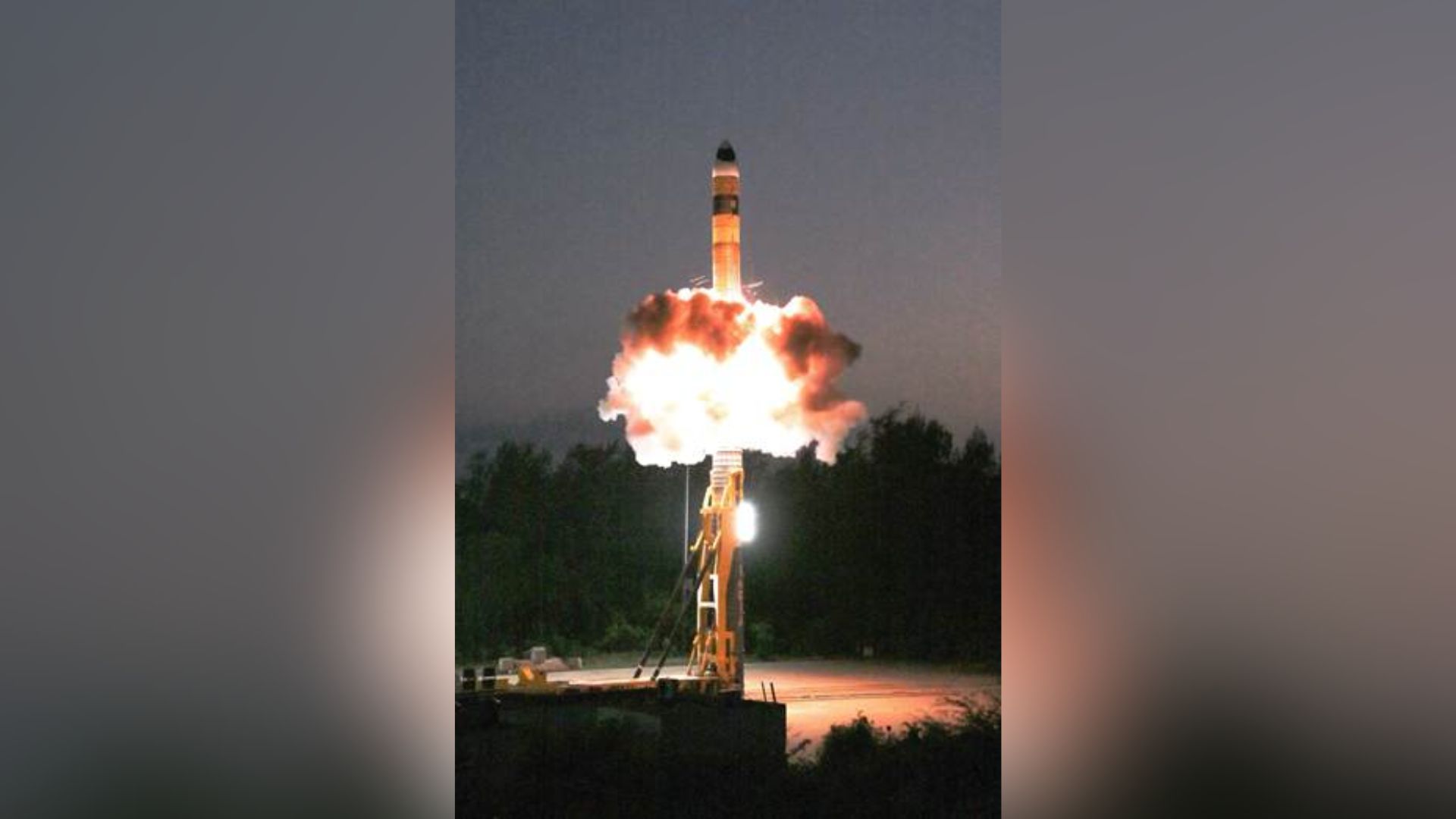
India conducted the successful flight trial of an Advanced Agni missile equipped with a Multiple Independently Targeted Re-Entry Vehicle (MIRV) system from Dr APJ Abdul Kalam Island, Odisha on 8 May, according to a Press Information Bureau (PIB) release.
The PIB stated the missile was “flight-tested with multiple payloads, targeted to different targets spatially distributed over a large geographical area in the Indian Ocean Region.”
Defence Minister Rajnath Singh said the test “will add an incredible capability to the country’s defence preparedness against the growing threat perceptions.”
The PIB release stated that telemetry and tracking was carried out by multiple ground and ship-based stations, which “tracked the entire missile trajectory from lift-off till the impact of all payloads,” and confirmed that “all mission objectives were met during the trial.”
The release added that “India once again demonstrated the capability to target multiple strategic targets using a single missile system” – language that explicitly references the first MIRV test conducted in March 2024 under Mission Divyastra, which DRDO described as the “first flight test of indigenously developed Agni-5 missile with Multiple Independently Targetable Re-Entry Vehicle (MIRV) technology.”
The PIB stated the missile was “developed by DRDO laboratories with the support of Industries across the country,” and that the trial was witnessed by senior scientists of DRDO and Indian Army personnel – the Army’s presence consistent with the Strategic Forces Command’s (SFC) role in managing India’s nuclear arsenal.
The PIB described the system as an “Advanced Agni missile” without assigning a specific variant designator – a deliberate ambiguity that defence analysts have noted across all three MIRV-related Agni tests to date.
The test sequence as documented in official sources is as follows: the first MIRV-capable Agni-5 test took place on 11 March 2024 under Mission Divyastra, which Prime Minister Modi publicly hailed and which the PIB explicitly identified as an Agni-5, followed by a user validation trial conducted by the Strategic Forces Command on 20 August 2025, and then the 8 May 2026 test.
GK365 identified the system as an “advanced variant of the Agni-5, unofficially referred to as Agni-5 Mk2,” incorporating both MIRV and a Hypersonic Glide Vehicle (HGV) payload – an assessment based on the reported manoeuvring characteristics of the re-entry vehicles. The Agni-5’s operational range is widely estimated to exceed 5,000 km.
India’s Defence Strategy, Capabilities, and Procurement Patterns
Analysis of India’s defence posture, including doctrine, acquisitions, and industrial integration.
Notes and Comments
The May 8 test is distinct from the standard Agni-5 that India has tested multiple times since 2012, and the distinction lies in two technologies the PIB does not name directly but which the test profile and external assessments confirm: MIRV and, potentially, a Hypersonic Glide Vehicle (HGV) payload.
The standard Agni-5 carries a single re-entry vehicle on a ballistic trajectory – it goes up, follows a predictable arc, and comes down on one target. A MIRV-equipped variant carries multiple re-entry vehicles on a post-boost vehicle (the ‘bus’), which separates from the booster stages in the vacuum of space and then orients, stabilizes, and releases each warhead on an independent trajectory toward a different target. The bus must time each release precisely to place warheads on diverging paths that reach geographically separated impact points – a task that demands guidance accuracy, attitude control, and propulsion at a level the single-warhead Agni-5 did not require.
If the GK365 assessment is correct that the May 2026 test also incorporated an HGV payload – re-entry vehicles that manoeuvre at Mach 5+ during descent along a non-ballistic flight path – then the bus must also account for releasing a gliding payload, which follows a trajectory profile that differs from a conventional ballistic re-entry vehicle falling on a fixed arc.
The PIB’s deliberate avoidance of a specific designator is itself informative. Mission Divyastra in March 2024 was explicitly identified as an “Agni-5 missile with MIRV technology,” but the May 2026 release refers only to an “Advanced Agni missile.” One can read this shift as either a deliberate effort to preserve ambiguity, or an indication that the system has evolved sufficiently from the baseline Agni-5 – through the addition of HGV-type re-entry vehicles, an upgraded bus, or extended range – to warrant a distinct identity that India has chosen not to disclose.
The development track is worth tracing in sequence. India’s ballistic missile program began with the Agni technology demonstrator in 1989, drawing on solid-fuel motor technology developed for ISRO’s SLV-3 civilian space launcher – a crossover between India’s space and defence establishments that has shaped every subsequent Agni variant. The program progressed through Agni-1 (700 km), Agni-2 (2,000 km), Agni-3 (3,500 km), and Agni-4 (4,000 km) before the Agni-5 extended the envelope beyond 5,000 km with its first test in 2012. In parallel, the canisterized Agni-P introduced a new-generation road-mobile architecture with a range between 1,000 and 2,000 km, completing its pre-induction night launch by the Strategic Forces Command (SFC) in June 2023 and a rail-based mobile launcher test in late 2025.
MIRV development followed a distinct track within the Agni-5 program: Mission Divyastra (11 March 2024) as the first flight test, an SFC user validation trial on 20 August 2025, and the 8 May 2026 test that the PIB frames with “once again demonstrated” – confirmatory language that suggests DRDO considers the technology proven. As the Manohar Parrikar Institute for Defence Studies and Analyses (MP-IDSA) assessed, “with two successful tests, DRDO could be operationalising this system in the near future.”
This three-test sequence tracks closely with how India brought the Agni-P to pre-induction readiness – developmental flights in 2021 and 2022, followed by an SFC night launch in 2023, followed by the rail-mobile launcher test in 2025. If the MIRV-equipped Agni follows the same pattern, the next step would be a user-conducted test under operational conditions – at night, from a canisterized launcher, with minimal preparation time – to confirm the system is ready for service entry.
The canisterization element matters because it determines how the missile is stored, transported, and launched. A canisterized missile sits inside a sealed container that protects it from the environment and allows it to be launched directly from the canister on a road-mobile or rail-mobile transporter-erector-launcher (TEL). This gives the SFC the ability to disperse its missiles across a wide geographic area, move them between pre-surveyed launch sites, and fire from locations an adversary has not identified – all of which strengthen the survivability of the force in a second-strike scenario.
India’s stated nuclear doctrine, as articulated in the 2003 Cabinet Committee on Security statement, rests on “credible minimum deterrence” and a “No First Use” (NFU) posture, with the promise of “massive retaliation” in response to a nuclear attack. The operational logic of that doctrine depends on India’s ability to absorb a first strike and still deliver a retaliatory response – which means the survivability of the missile force is the foundation on which the entire posture rests. MIRV strengthens that foundation because it allows each surviving launcher to hold multiple targets at risk, so that even a depleted post-strike force retains sufficient warhead coverage to execute a retaliatory mission.
Thus, one can see the MIRV-equipped Agni as India’s effort to ensure that its declared second-strike posture remains credible as adversary missile defence and counterforce capabilities improve – and the pace of the development track, combined with the Indian government’s consistent use of confirmatory language, suggests the system is on a path toward operational deployment within the next one to two years.
Quwa Pro
India’s Military-Industrial Trajectory, Explained
Monitoring India’s defence planning, procurement cycles, and military technology adoption.
Featured & Trusted By
