

Situated at the heart of Eurasia, Kazakhstan has cultivated political and economic relationships with Russia, China, Western countries, and its Central Asian neighbors, enabling it to adopt what scholars term a “multivector foreign policy.” This approach allows the country to engage cooperatively with diverse geopolitical actors without firmly aligning with any single bloc, while also positioning Astana to support mediation initiatives and help ease tensions among competing powers.
Indeed, since the end of the Cold War, Kazakh leaders have consistently emphasized the importance of maintaining balanced relations with major global powers. This approach was on display during at the most recent U.N. General Assembly debate, where Kazakh President Kassym-Jomart Tokayev described middle powers such as Kazakhstan as potential “bridges” capable of fostering cooperation when major powers are unable or unwilling to work together.
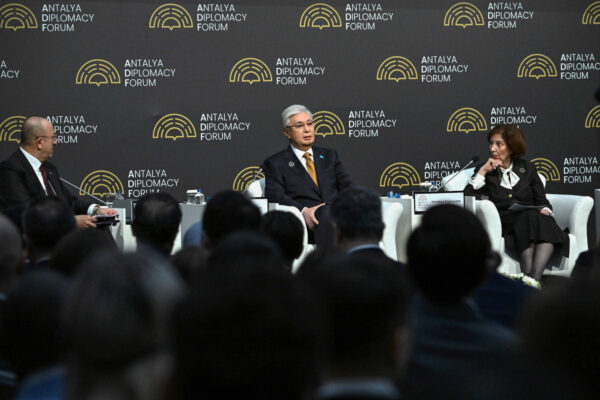
Kazakhstan’s commitment to this foreign policy approach was evident during the most recent round of Antalya Diplomacy Forum. Tokayev expressed concern that many international organizations are no longer functioning as effectively as they once did. While reaffirming his confidence in the U.N., he noted that many critical negotiations increasingly take place outside the organization, weakening its ability to mediate international disputes.
“Today, regional conflicts are extending far beyond their original boundaries and have already taken on a global dimension,” Tokayev said. “Of course, the United Nations remains an indispensable and universal organization, and every state bears a certain responsibility. There is broad consensus on the need to support the U.N. This is a fact. At the same time, there is also agreement that the organization must not only be supported but also reformed. This is true.”
A seasoned diplomat who once served as the director-general of the United Nations Office at Geneva, Tokayev argued that the U.N. Security Council’s inability to respond effectively to major crises has contributed to diplomatic paralysis and declining trust in the international system.
“For many years, we have spoken about reform, transformation and restructuring of the U.N., yet little progress has been achieved. We must honestly acknowledge that the Security Council is the central element in the reform of the United Nations,” Tokayev said during a panel session at the forum.
Countries such as India, Japan, Germany, and Brazil have long advanced similar calls for a more representative and inclusive Security Council to align the U.N. system with contemporary global power dynamics.
The broader message of Tokayev’s remarks in Antalya focused on the need to return to diplomacy, mutual understanding, and inclusive cooperation in order to prevent further weakening of the international order. In this context, Tokayev emphasized the importance of preventive diplomacy, stressing that international actors must focus not only on managing conflicts once they emerge, but also on anticipating and preventing them before they escalate into broader regional or global crises.
Within this increasingly fragmented international environment, Tokayev presented middle powers such as Kazakhstan and Turkiye as potentially important stabilizing actors, arguing that although they lack the influence of major powers, they may be better positioned to sustain dialogue across geopolitical divides because they are often less constrained by bloc politics and strategic rivalry.
“I would also like to emphasize the important and positive role of the so-called middle powers, including Kazakhstan, Turkiye and other countries,” Tokayev said. “Of course, I am not claiming that we are the best in the world. However, we demonstrate a high level of responsibility in addressing global processes, both in practice and in diplomacy. Therefore, it would not be an exaggeration to say that today middle powers often demonstrate a greater degree of responsibility than major powers represented in the Security Council, which, regrettably, often obstruct the resolution of key global issues.”
Indeed, Kazakhstan has taken several important steps to establish itself as a stable and impartial middle power. Kazakhstan now hosts the U.N. Regional Center for Sustainable Development Goals for Central Asia and Afghanistan in Almaty, reinforcing its ambition to serve as a stabilizing force in the region. The country has also expanded its regional diplomatic footprint through initiatives such as the Kazakhstan Agency of International Development (KazAID), which has participated in numerous humanitarian missions across the region.
In short, Tokayev suggested that Kazakhstan can contribute to international peace and cooperation by serving as a diplomatic bridge capable of engaging all sides in a dispute simultaneously. More broadly, Kazakhstan’s diplomatic strategy reflects a broader commitment to strengthening multilateralism at a time of intensifying global polarization.
