

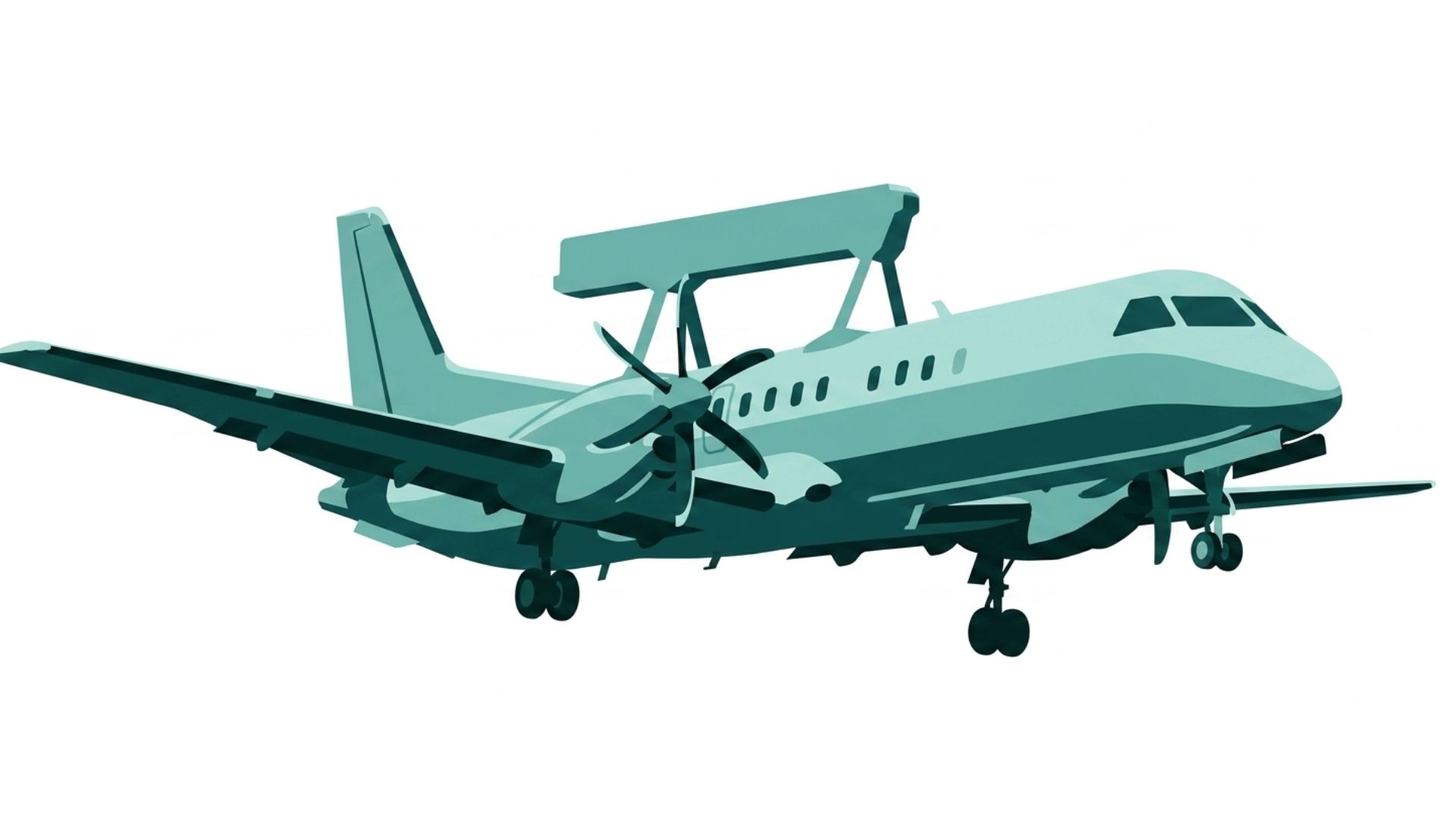
Between 2007 and 2026, the Pakistan Air Force (PAF) grew its special mission fleet from a handful of legacy reconnaissance and electronic warfare (EW) platforms into an integrated architecture spanning over seven airborne early warning and control (AEW&C) aircraft, stand-off electronic attack (EA) systems, persistent intelligence, surveillance, and reconnaissance (ISR) via unmanned aerial vehicles (UAVs), and fighter-borne photo-reconnaissance and target-acquisition.
In the process, the PAF built the world’s largest Saab 2000-based Erieye AEW&C fleet, validated its electronic warfare (EW) capabilities in two significant combat operations – i.e., Operation Swift Retort (February 2019) and Operation Bunyan-un-Marsoos (May 2025) – and laid the groundwork for a highly extensive network-enabled warfare stack integrating manned aircraft, drones, and space-based assets under a single command authority.
A Brief History of the PAF’s Special Mission Fleets
The PAF’s adoption of special mission aircraft predates this review period (2007-2026), but understanding the platforms that came before 2007 – and the gaps they left – will help explain why PAF Air Headquarters (AHQ) made the investments it did between 2007 and 2026.
The service’s first dedicated photo-reconnaissance aircraft was the Lockheed RT-33A. Six RT-33As were delivered in 1957 under United States military assistance or aid, with serials 53-5090, 53-5491, 53-5517, 53-5533, and 53-5335 among those identified in PAF records. They were assigned to No. 20 Squadron at Mauripur (now Masroor) Air Base, Karachi.
The RT-33A was a derivative of the T-33 Shooting Star trainer, fitted with cameras in the nose section for tactical imagery collection. Its utility was limited by short range, modest sensor capability, and the aircraft’s vulnerability at operational altitudes. By the 1965 war with India, the RT-33A was already being phased out of the reconnaissance role, and by 1971, it played no meaningful part in operations.
A more capable platform arrived in December 1962, when the Martin RB-57B Canberra entered PAF service with No. 24 Squadron at Peshawar. The RB-57Bs were tasked with specialist surveillance and electronic intelligence (ELINT) roles – a significant step beyond the RT-33A’s purely photographic function.
The base at Peshawar also hosted Central Intelligence Agency (CIA) U-2 and RB-57 aircraft conducting overflights of the Soviet Union, and the PAF’s own RB-57Bs operated along Pakistan’s northern borders in a complementary intelligence-gathering capacity. This ELINT mission at Peshawar would set into motion No.24 Squadron’s longstanding role in the special mission domain, with the same unit eventually inducting the Dassault Falcon DA-20 in the EW/EA space from the late 1980s.
Neither the RT-33A nor the RB-57B survived the disruption of U.S.-Pakistan defence relations after 1965. The American arms embargo imposed following the September 1965 war cut off spares and replacements for both types. The RT-33As had already been phased out by then; the RB-57B fleet was not replenished and progressively attrited through the late 1960s and early 1970s.
The gap left by the RT-33A’s retirement was filled by the Dassault Mirage IIIRP, which became the PAF’s primary photo-reconnaissance platform for over a quarter century. Ten Mirage IIIRPs were delivered and assigned to No. 20 Tactical and Recce Squadron – the same unit number that had operated the RT-33A.
The Mirage IIIRP carried OMERA cameras in an elongated nose section for tactical and strategic imagery collection. It served through the aftermath of 1971, the 1980s Afghan War period, and the Kargil crisis of 1999, providing the PAF its sole dedicated airborne imagery capability across that entire span.
The Mirage IIIRP was eventually supplanted by the Goodrich (now Collins Aerospace) DB-110 dual-band electro-optical/infrared photo-reconnaissance pod, which arrived in January 2009 for the new forthcoming F-16C/D Block-52+ fleet. By that point, the Mirage IIIRP airframes were nearly four decades old.
In parallel with the reconnaissance lineage, the PAF spent the 1980s attempting to acquire an airborne early warning (AEW) capability. During the Afghan War, with significant U.S. and Saudi military aid flowing into Pakistan, AHQ explored procuring the Grumman E-2 Hawkeye, i.e., the U.S. Navy’s carrier-borne AEW platform. The E-2 procurement did not materialize. Cost constraints, U.S. technology transfer restrictions on the advanced APS-138 radar system, and the looming imposition of Pressler Amendment sanctions in 1990 collectively killed the program before a contract was signed.
