

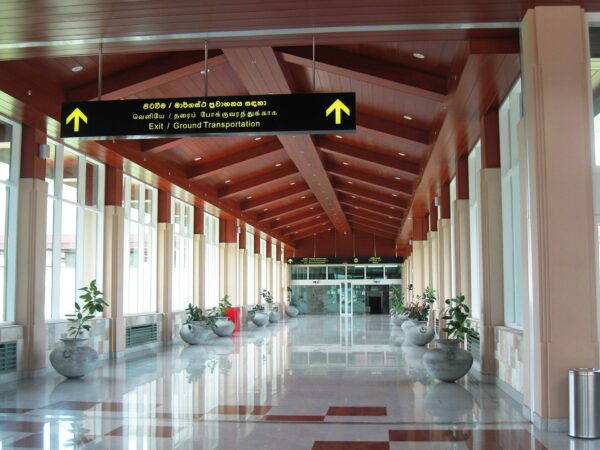
Mattala Rajapaksa International Airport (MRIA) is probably the clearest symbol of Rajapaksa-era excesses. It was built to be Sri Lanka’s second international airport, but became better known as one of the world’s emptiest.
Successive governments have tried to revive it. Now it is the National People’s Power (NPP) government’s turn. The government recently invited domestic and foreign investors to take over the airport under a 30-year build-operate-transfer model.
The airport at Mattala was built as part of the Mahinda Rajapaksa government’s Hambantota development plan and was not designed as a small regional facility. It was promoted as an alternative to Bandaranaike International Airport, and its first phase cost $209 million, of which $190 million was from China Exim Bank. When it was built, the Rajapaksas said the airport would have the capacity to handle a million passengers, 50,000 tons of cargo and 6,250 air traffic operations a year by 2028. However, it soon became apparent that such targets would not be met, despite the best efforts of the Rajapaksa government.
In 2013, Mattala expected more than 160,000 passengers but handled about 36,000. In 2014, it was expected to draw over 171,000 passengers, but it handled about 40,000. By June 2015, passenger movement had fallen below 5,000, after the Maithripala Sirisena-Ranil Wickremesinghe government stopped artificial attempts to boost passenger numbers. Its income was about $300,000 in 2013 and about $830,000 the following year. About $13.28 million and $17.6 million went towards salary, maintenance, electricity and water in 2014 and 2015, respectively. The airport had to remain open day and night, although the business had collapsed.
The airport also carried environmental costs. It was built in an elephant habitat. The access road from Mattala to Lunugamvehera worsened human-elephant conflict. It was also in the path of migratory birds.
Sri Lanka has tried to rescue Mattala before. In 2018, the Airport Authority of India expressed interest in taking a majority stake. The debate quickly became political. Sri Lankan critics raised sovereignty and security concerns. Indian analysts asked whether New Delhi wanted the airport for commercial reasons or to prevent China from gaining more influence around Hambantota.
In 2024, Sri Lanka tried to hand the airport’s management to India’s Shaurya Aeronautics and Russia’s Airports of Regions Management Company for 30 years. That plan appears to have fallen through. The latest offer should therefore not be treated as a breakthrough. Sri Lanka has been here before.
To their credit, the NPP government is making a different pitch. Earlier efforts were attempts to make Mattala a major passenger gateway – the original promise of the Rajapaksas.
The NPP’s offer separates airside operations from landside development, and asks investors to look at the runway, land, port access and possible industrial uses together. The landside offer reportedly covers 238 hectares for maintenance, repair and overhaul facilities, logistics, industrial parks, solar projects, aviation training and hospitality. Mattala could become an aviation-services and logistics estate built around a runway.
The Hindustan Times has reported that the Modi government is closely monitoring the process because Mattala sits near Hambantota Port, operated by a Chinese company. India has long worried that Chinese-financed infrastructure around Hambantota could allow Beijing to influence key Indian Ocean sea lanes. India has also shown interest in Mattala before. That history makes it likely that New Delhi will try to shape the outcome, even if it does not directly run the airport.
The thriving Hambantota Port gives investors a reason to look at Mattala again. If linked with the port, the airport does not have to depend only on scheduled passenger traffic. Investors can be attracted for cargo, maintenance, warehousing, training, renewable energy and logistics.
But that argument assumes the port and airport can work together. If the port is operated by a Chinese company and the airport is run by an Indian-linked investor, proximity will not produce integration. The two assets could sit side by side without working as one system.
That is Colombo’s real problem. The new Mattala pitch depends on commercial links with Hambantota Port, but the geopolitics of Hambantota may prevent those links from forming. If India’s main interest is to prevent another power from gaining the airport, and if China’s port operator has little incentive to support an Indian-run facility next door, the logistics case weakens. Mattala may gain a geopolitical sponsor without gaining cargo, airlines or port-linked business.
If Mattala is leased mainly to satisfy strategic anxieties, Sri Lanka risks repeating its old mistake: treating geopolitical value as a substitute for commercial viability. The result could be a port and airport in the same district, run by actors in different strategic camps, unable to create the integration that gives Mattala its strongest commercial case.
