

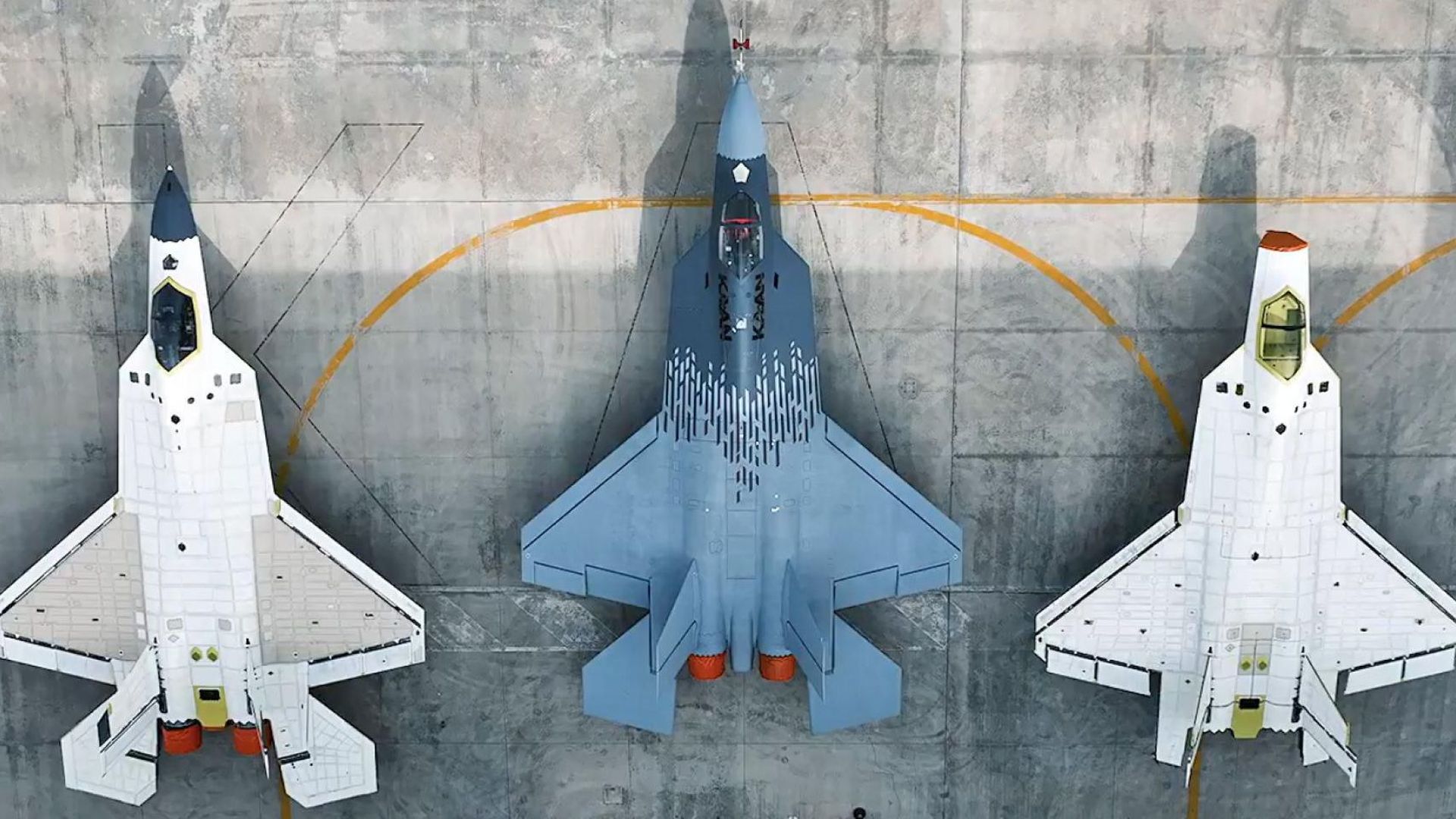
TAI CEO confirmed at SAHA 2026 that Spain and Türkiye have entered preliminary government-to-government discussions on a potential Spanish acquisition of the KAAN – driven by aging Hornets, suspended F-35 plans, and repeated FCAS delays.
Turkish Aerospace Industries (TAI) CEO Mehmet Demiroğlu confirmed at the SAHA 2026 defence exhibition in Istanbul that Spain and Türkiye have entered preliminary government-to-government discussions regarding a potential Spanish acquisition of the KAAN fifth-generation stealth fighter.
The disclosure, first reported by Infodefensa on 7 May, follows the formal signing of Spain’s Hürjet-based SAETA II advanced jet trainer programme on 28 April at Airbus facilities in Getafe, Madrid – a deal valued at approximately €2.6 billion ($3.04 billion) for 30 aircraft.
The KAAN talks appear to be driven by a convergence of four simultaneous pressures on Madrid’s combat aviation planning. Spain’s EF-18 Hornet fleet is ageing. The AV-8B Harrier force is approaching retirement. Madrid suspended its F-35 procurement plans in August 2025. And the Franco-German-Spanish Future Combat Air System (FCAS) programme has experienced repeated delays – most recently a mediation collapse between Paris and Berlin on 18 April 2026, with the file now handed back to both countries’ defence ministries for further work.
In a February 2026 parliamentary reply, Spain indicated that the EF-18 fleet could remain in service until 2040, well beyond the original 2030 retirement target.
Given these timelines, Spanish Air and Space Force planners face a widening capability gap between the eventual retirement of legacy platforms and the arrival of any FCAS successor – assuming the latter programme survives its current structural difficulties.
Türkiye appears to be positioning the KAAN not as a conventional off-the-shelf fighter sale, but as a sovereign procurement model. Turkish officials at SAHA 2026 framed the KAAN around software sovereignty, industrial participation, and reduced dependence on US-controlled sustainment infrastructure – themes that resonate with Madrid’s own stated objective of “strategic autonomy.”
Track Türkiye’s Defence Expansion Across Emerging Markets
Monitor the rise of Turkish defence exports in regions traditionally dominated by Western, Russian, and Chinese suppliers.
In this vein, one can see why the SAETA II programme is structurally significant as a precursor. The Hürjet deal established an industrial bridge: Airbus serves as prime contractor while TAI manufactures the aircraft, with 60% Spanish industry participation – including Indra, GMV, Sener, AERTEC, Grupo Oesía, Orbital, and ITP. Those same companies could, in principle, form the nucleus of a Spanish industrial participation framework for the KAAN.
Presidency of Defence Industries (SSB) head Haluk Görgün described the SAETA II as “not an end but a beginning,” adding that it “could be marketed to other countries and third nations, paving the way for joint development of next-generation products.”
However, significant caveats apply. The KAAN remains in prototype and developmental testing following its maiden flight on 21 February 2024. TAI has confirmed that additional prototypes are planned during 2026 and 2027 to expand testing of avionics, stealth management, mission integration, and aerodynamic performance.
Current prototypes are powered by two General Electric F110-GE-129 engines – the same engine family used by Turkish F-16s. Türkiye intends to replace these with the indigenous TF35000 engine from the Block-30 variant onwards, targeted for approximately 2032. The separate Güçhan turbofan programme – a 42,000 lbf-class engine unveiled at SAHA 2026 by the Ministry of National Defence (MoND) R&D Centre – adds a second propulsion track whose relationship to the KAAN has not been officially clarified.
The KAAN Block-10 production contract – covering 20 fighters for delivery between 2028 and 2030 – was signed between the SSB and TAI at SAHA 2026, providing the programme with its first firm procurement commitment.
It is too early to assess the probability of a Spanish KAAN order. The talks are preliminary, and Madrid’s naval aviation requirement – which depends on short takeoff and vertical landing (STOVL) capability that neither the KAAN nor any non-F-35B platform currently offers – remains a separate and unresolved constraint.
That said, the broader trajectory is notable. Spain is the first European Union member state to engage in government-level discussions on acquiring a non-Western, non-US fifth-generation fighter aircraft. Defence24 described the SAETA II programme as evidence that “Türkiye is increasingly entering the European security architecture not only as a NATO ally but also as a supplier of advanced military technologies.”
If the KAAN matures on its current trajectory, and if FCAS continues to stall, one could see Madrid treating the Turkish fighter not as a replacement for the F-35 or FCAS, but as a bridge capability – one that fills the operational gap while preserving industrial participation and software sovereignty that Spain would not obtain through an American programme.
For Ankara, the strategic calculus is equally clear. Every European customer that enters the KAAN ecosystem spreads R&D overhead, validates the programme internationally, and creates an export constituency that strengthens the KAAN’s long-term commercial viability – a dynamic that Türkiye has already established with Indonesia’s 48-unit order and is now actively cultivating in the Gulf.
Quwa Pro
Turkish Defence Market Intelligence for Emerging Markets
Track Türkiye’s defence positioning across emerging markets in Asia, the Middle East, and beyond.
Featured & Trusted By
