

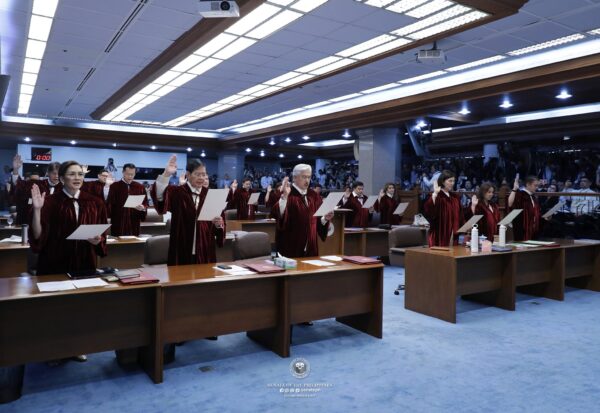
The Philippine Senate yesterday began the impeachment trial of Vice President Sara Duterte, following a week of chaos in which the feud between the Duterte and Marcos families reached a high pitch of tension.
Last week, the House of Representatives voted overwhelmingly to impeach Duterte for a range of transgressions, including corruption, misuse of government funds, and plotting to kill her former ally, President Ferdinand Marcos Jr.
If convicted, which requires a two-thirds vote in the 24-seat chamber, the 47-year-old would lose her post and be banned from holding elected office for life.
Duterte, who has announced her plan to seek the presidency in 2028, has denied the charges. Her lawyers said that they are “fully prepared to defend the vice president before the Senate,” and that it would be “incumbent upon the prosecution to discharge the burden of proof.”
Dressed in red robes, the senators yesterday were sworn in as senator-judges, while Senate President Alan Peter Cayetano, an ally of Duterte who was elevated to the Senate presidency in a leadership coup last week, assumed the role as the court’s presider.
“The trial of Vice President Sara Zimmerman Duterte is hereby open,” Cayetano declared.
As Rappler lays out, the trial process involves a number of steps. Cayetano yesterday issued a writ of summons, directing Duterte to file an answer to allegations within 10 calendar days of receiving the document. After receiving Duterte’s reply, a team of prosecutors from the House of Representatives will file their reply within five calendar days. There will then be a pre-trial period in which both sides will present their evidence to the Senate, followed by the trial proper, although the court did not say when this would take place.
The impeachment stems from two complaints, filed in February, which allege that Duterte misused 612.5 million pesos ($10 million) in confidential funds in her capacity as vice president and education secretary. The complaints also reference her unexplained wealth, accuse her of bribery when she was education secretary, and take aim at her public threat to have Marcos, his wife, and the president’s cousin Martin Romualdez, the then-House speaker, assassinated in the event of her own killing.
Duterte was previously impeached in February 2025, for a similar suite of transgressions, including “violation of the constitution, betrayal of public trust, graft and corruption, and other high crimes.” In July, Duterte earned a reprieve when the Supreme Court dismissed the complaint on the grounds that it violated a constitutional ban on having multiple impeachment proceedings in a single year.
The impeachment drama is one subplot of the political feud that has raged between Duterte and President Ferdinand Marcos Jr. for much of the past two years. The two leaders teamed up to great political effect ahead of the 2022 presidential election, when they both were elected with decisive majorities, but have since fallen out over a mix of personal and political disagreements.
The feud led Marcos’ allies to begin investigations into Duterte’s conduct as education secretary, prior to her resignation in mid-2024. It also led Marcos last year to approve the arrest of Duterte’s father, former President Rodrigo Duterte, on an arrest warrant from the International Criminal Court (ICC). The 81-year-old is now awaiting trial at The Hague-based court on charges of crimes against humanity related to his bloody anti-drug campaign.
The outcome of the Senate trial remains uncertain.
The Dutertes have more allies in the Senate than they do in the House, and it may be difficult for the chamber to muster the two-thirds vote necessary to convict the vice president. On the same day that Duterte was impeached in the House, allies of the Dutertes in the Senate ousted the body’s president, Vicente Sotto III, and replaced him with Senator Cayetano in a bid to sway or frustrate the impeachment trial.
This spawned a new subplot of the Marcos-Duterte drama. Among the senators who showed up to vote was Ronald “Bato” Dela Rosa, a former chief of the Philippine National Police who led the first phase of Duterte’s “war on drugs.” The ICC has named Dela Rosa as a co-conspirator of Duterte and issued a warrant for his arrest in November. Having been in hiding since, he was forced to show up to cast the crucial deciding vote for the leadership change.
However, Dela Rosa also confronted officers from the National Bureau of Investigation who showed up to execute the ICC warrant, which the court officially unsealed a few hours later. He then fled behind the locked door of his Senate office, where Cayetano and other allies subsequently declared that they had placed him under the Senate’s “protective custody.”
The ensuing standoff erupted into violence on Wednesday night as Senate security personnel and government agents attempting to apprehend Dela Rosa briefly exchanged fire within the Senate building. In the chaos, Dela Rosa managed to slip out of the building, and his current whereabouts are unknown.
The question now is whether Duterte’s allies in the Senate have the numbers to stymie Sara Duterte’s conviction. Only nine votes in the 24-seat chamber are needed to acquit the vice-president, and 13 pro-Duterte senators voted to execute last week’s leadership “coup.” With Cayetano now in charge, it seems likely that Duterte will survive and press on toward the potentially decisive electoral showdown in 2028.
However, it is hard to predict with certainty. Dela Rosa’s presence during the trial is no foregone conclusion, given the threat of arrest hanging over him, and as the Associated Press notes, several among the 13 senators who voted for last week’s leadership change have been implicated by witnesses in the ongoing corruption scandal involving flood control projects. They could face possible arrest if indicted, which would remove more votes from the pro-Duterte column.
Whatever happens during the Senate trial, the political war between the Dutertes and Marcoses is unlikely to come to a conclusive end. The past two years have shown that both sides are willing quite shamelessly to wield the power of the country’s institutions behind professions of high-minded principle, in order to ensure that they come out on top. Indeed, it seems almost inevitable that the conflict will run on, in zero-sum fashion, until the next presidential election, and possibly beyond.
