

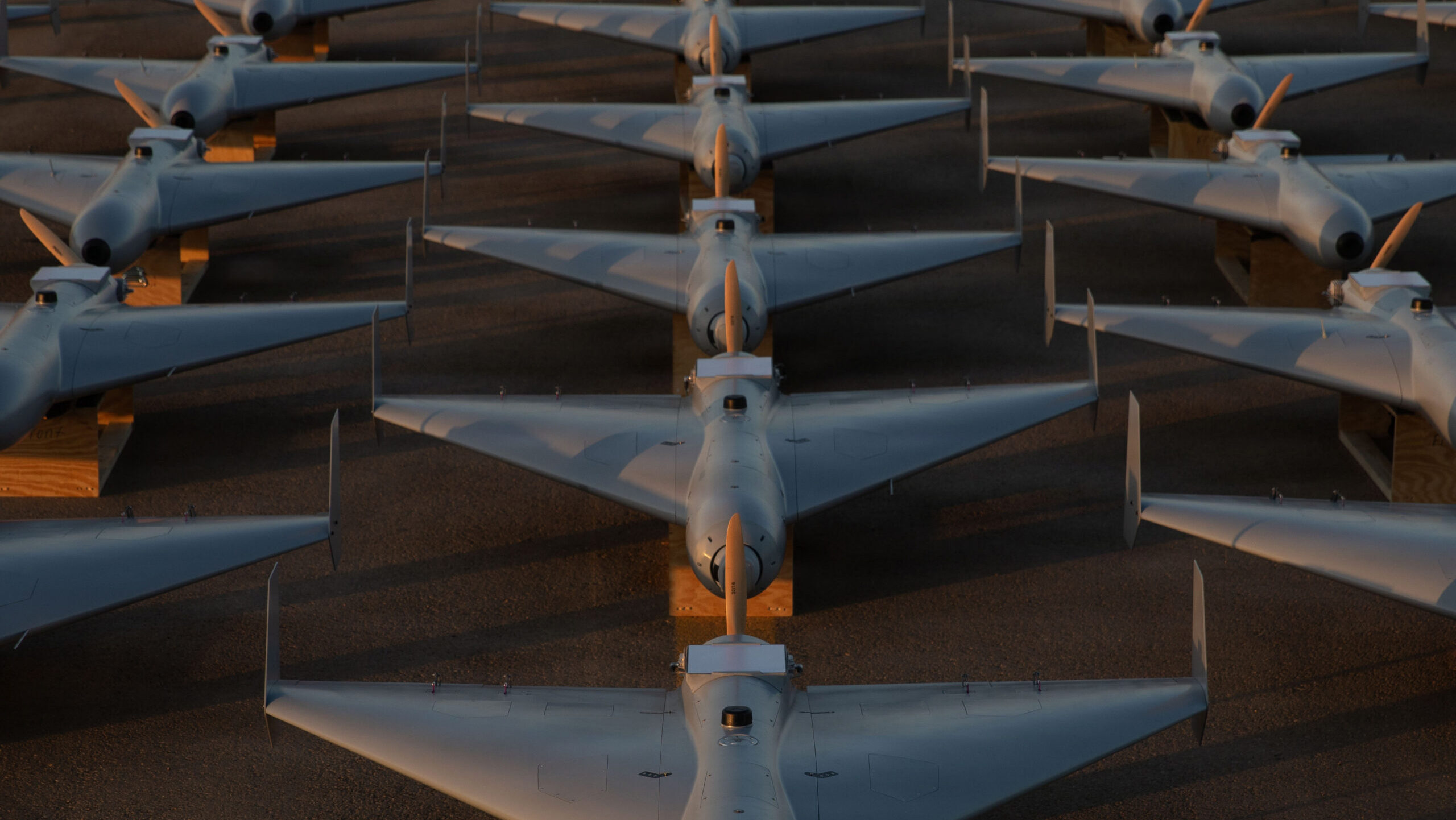
WASHINGTON — Shield AI has secured a Pentagon contract to integrate its Hivemind autonomy software onto the new Low-Cost Uncrewed Combat Attack System (LUCAS) as part of a pilot program to field drone swarms, the company announced today.
“Hivemind will serve as the AI pilot for the LUCAS program, enabling groups of drones to coordinate, maneuver, and adapt together to changing conditions in real time, based on warfighter input,” the company wrote in a press release.
Once the Hivemind software is integrated into the LUCAS drones, the platforms are expected to be able to coordinate and maneuver together “independently [and] without human intervention,” the company added. However, a single human operator will be in control of any decision to strike targets.
“The result shortens the time from detection to action across the kill chain,” Shield AI wrote.
“The effort marks a major step toward operationalizing collaborative autonomy: teams of autonomous systems working together in dynamic and communications-constrained environments under the supervision of a single operator,” it further noted.
The Undersecretary of Defense for Research and Engineering’s shop, which is spearheading the pilot program, did not respond to questions about the effort’s timetable or if any additional companies are participating in the pilot program as of press time. Shield AI, though, said in the release that it is expecting to participate in an operational demonstration of this swarm capability this fall.
The LUCAS, which the Hivemind software will be integrated on, is a newer drone reverse-engineered from an Iranian Shahed 136. It carries a roughly $35,000 price tag, is about 10-feet in length and can carry an explosive payload that detonates on impact. CENTCOM confirmed the use of a new one-way attack drone after the initial wave of strikes on Iran.
The move to create a pathway for LUCAS swarms comes at a time when Pentagon leaders are eyeing a host of ways to ramp up drone production and fielding as part of the Defense Secretary Pete Hegseth’s Drone Dominance initiative.
That plan includes a focus on autonomy, and in fiscal 2027 alone, the department has detailed plans to spend nearly $55 billion on drone and autonomy development under the Defense Autonomous Warfare Group (DAWG) umbrella.
The DAWG essentially absorbed the Biden-era Replicator initiative to acquire thousands of low-cost “attritable” drones, particularly for use in the Pacific. In its latest iteration, Pentagon leaders are looking to supercharge development investments across an array of platforms and collaborative autonomy efforts.
“I think of the DAWG as a pathfinder, they’re out there finding the best technology for us and working on integration,” Jules “Jay” Hurst, who is performing the duties of the Pentagon comptroller, told reporters last month. “They’re with these companies, live right now, testing different systems and orchestration tools for autonomy, and they’re giving them live feedback.”
