

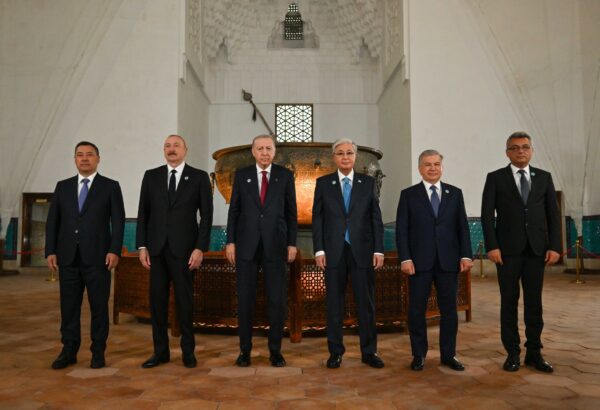
The informal summit of the Organization of Turkic States (OTS) held in Turkistan, Kazakhstan on May 15 offered a revealing glimpse into how Astana sees the future of Turkic cooperation. Outside observers have often viewed the OTS through one of two narrow lenses: either as a symbolic cultural project built around shared linguistic identity, or as the early foundations of a more geopolitical pan-Turkic bloc led by Turkiye.
Both interpretations are increasingly incomplete. The summit in Turkistan suggested something far more pragmatic is taking shape, and Kazakhstan is looking to play a central role in shaping it.
Hosted under the theme of “Artificial Intelligence and Digital Development,” the summit was notable for what it prioritized. Rather than focusing on ideological rhetoric or hard security cooperation, discussions centered on artificial intelligence, digital infrastructure, cybersecurity, transport connectivity, satellite cooperation and technological competitiveness. The summit concluded with the signing of the Turkistan Declaration, while President Kassym-Jomart Tokayev used the platform to present a series of proposals aimed at transforming the OTS into a more functional platform for modernization.
Among those proposals were the creation of a network of artificial intelligence centers across OTS member states, the establishment of a joint “Turkic AI” hub within Kazakhstan’s Alem.ai center, cooperation on cybersecurity, mutual recognition of digital signatures and electronic documentation, expanded satellite collaboration, and the creation of a unified digital platform dedicated to Turkic history and culture.
This suggests a broader Kazakh calculation that the OTS should evolve into a mechanism that helps member states remain competitive in an increasingly fragmented global economy.
Tokayev made this logic explicit during the summit when he warned that countries that fail to adapt to technological transformation risk being left behind. In an era increasingly defined by competition between the United States, China, and the European Union over artificial intelligence, semiconductor supply chains, digital governance standards and critical technologies, middle powers face a growing risk of becoming passive consumers of foreign technologies rather than active participants in shaping technological ecosystems.
For Kazakhstan and many of its regional partners, digitalization is increasingly tied to sovereignty. This helps explain why Astana is attempting to push the OTS beyond cultural symbolism. Shared identity may provide political cohesion, but it does little on its own to help member states compete in artificial intelligence, improve logistics efficiency, modernize customs systems, or build digital resilience.
Kazakhstan itself has spent the past several years aggressively trying to position itself as a regional technology hub. The government has declared 2026 the Year of Digitalization and Artificial Intelligence, launched new supercomputing infrastructure, opened the Alem.ai platform in Astana, and announced plans for a new Data Center Valley project aimed at attracting international investment into digital infrastructure. Astana has also introduced legal reforms related to artificial intelligence and digital governance while promoting initiatives such as the Digital Nomad Residency program to attract foreign talent.
The OTS summit allowed Kazakhstan to export part of this domestic modernization agenda into a broader regional framework.
This highlights Kazakhstan’s wider foreign policy logic. Since independence, Astana has largely pursued a multi-vector foreign policy aimed at avoiding overdependence on any single major power. It has sought strong relations simultaneously with Russia, China, the West, the Gulf states, and regional partners. The OTS increasingly fits into this broader strategy by providing Kazakhstan with another platform through which it can diversify economic partnerships without entering rigid geopolitical alignments.
That is precisely why Tokayev moved quickly during the summit to reject growing speculation that the OTS could evolve into a military alliance. “The OTS is neither a geopolitical project nor a military organization,” he said in Turkistan. “It is a unique platform aimed at strengthening trade, economic, technological, digital and cultural-humanitarian cooperation among brotherly nations.”
The statement appeared carefully calibrated. In recent years, the growing profile of the OTS has generated speculation that it could eventually develop into a more overt geopolitical bloc, particularly as Turkiye expands its regional influence and defense exports, while Azerbaijan has emerged with greater regional confidence following the Second Karabakh War. Some outside commentators have exaggerated these trends into narratives about a future “Turkic NATO.”
Kazakhstan is pushing back against such outcomes. Astana understands that transforming the OTS into a hard-security bloc would create unnecessary friction with Russia, raise concerns in China – particularly given Beijing’s sensitivities surrounding Xinjiang – and potentially create divisions within Central Asia itself. Kazakhstan’s strategic geography leaves little room for ideological adventurism.
Instead, Astana appears to be advocating a softer but potentially more durable model of regional integration: one built around trade corridors, digital platforms, investment, education, innovation and technological coordination.
This approach also aligns with the growing strategic importance of the Trans-Caspian International Transport Route, also known as the Middle Corridor, linking China to Europe via Central Asia, the Caspian Sea, the South Caucasus, and Turkiye. As global supply chains become more fragmented following the ongoing conflict and instability in the Middle East, as well as the war in Ukraine, regional states increasingly see opportunities to strengthen alternative trade routes. Digital integration can make those physical corridors more efficient through harmonized customs systems, logistics platforms and shared infrastructure.
The symbolism of the summit venue was also important. Turkistan, home to the mausoleum of Khoja Ahmed Yasawi, remains one of the most important spiritual centers of the Turkic world. Leaders visited the site and launched a new Center of Turkic Civilization. Yet even this symbolism was paired with discussions about artificial intelligence, digital governance and future technologies. That contrast captured Kazakhstan’s broader vision for the OTS: preserving cultural heritage while ensuring that Turkic cooperation remains focused on future competitiveness rather than nostalgic identity politics.
The real significance of the Turkistan summit is that it showed the OTS evolving beyond simplistic labels. It is no longer merely a cultural club, but neither is it becoming a military alliance. Kazakhstan appears determined to steer it toward a platform that helps middle powers navigate technological disruption, economic fragmentation, and growing geopolitical uncertainty without sacrificing strategic autonomy.
For Astana, that may prove far more valuable than grand geopolitical ambitions.
