

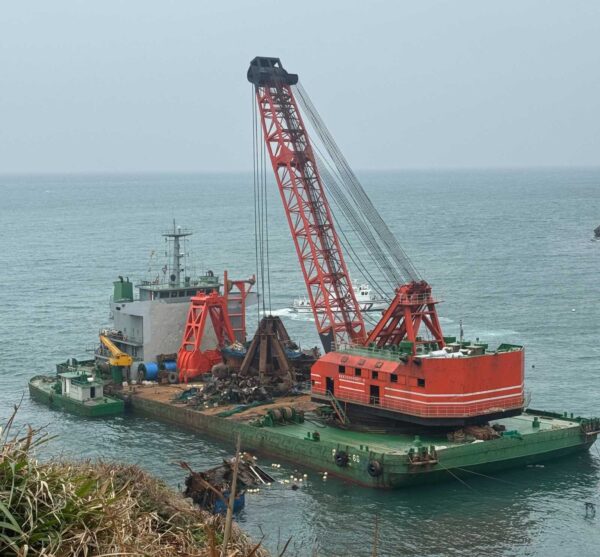
In late April, submarine cables to Taiwan’s outlying island of Matsu were once again cut – something that has happened more than 20 times in the last five years.
The most notable incident was in 2023, when Matsu’s primary two submarine cables were both cut. As a result, residents of Matsu were left without internet access for over 50 days, while the island waited for repair vessels to fix the cut cables. Though emergency microwave transmitters were activated, sending a text message took around 20 minutes. Crowds seeking a signal gathered around Chunghwa Telecom stores with stronger connection even in the cold night.
The April 2026 incident marked the third time in the past four years that the No. 3 cable connecting Beigan and Dongyin in Matsu has been cut. The cut impacted the 1,500 residents of Dongyin Township, who can continue to access mobile, voice, and data services, but will be impacted by reduced connectivity.
Amid the repeated disruptions, China has increasingly come under criticism. Some allege that Chinese vessels are deliberately cutting submarine cables as a means of sabotaging communication infrastructure in Taiwan. Although alarm has been raised in the past regarding Chinese patents for technology that could be used to cut submarine cables, most allegations are that China cuts cables through a simpler method: by having ships drag anchors over them. This tactic costs little, allows for plausible deniability, and can be accomplished by a wide range of ships.
A cable does not necessarily need to be cut by an anchor for this tactic to work. Damage occurs after salt water seeps into the wire, allowing the responsible vessel to leave the area before damage is discovered. This is why when vessels cut submarine wires, it involves repeatedly dragging an anchor over an area.
The Latest Incident: A Shipwreck and Salvage
The April submarine cable cut, however, has largely been attributed in international news reporting to a more benign factor: weather conditions causing a shipwreck to shift position. Some reports stated that this was an “old” shipwreck. In reality, however, the shipwreck was that of the Min Lian Yu 63896, which was reported abandoned at sea on March 21 of this year.
The Min Lian Yu 63896 is a Chinese vessel previously known to have participated in civilian-military fusion exercises, including the unusual amassing of thousands of civilians vessels in December and January. That drill was largely thought to be the Chinese Maritime Militia testing China’s capacities to execute future quarantine maneuvers.
In sharp contrast to international reporting, Taiwanese domestic media has largely attributed the cable cut to the actions of the Hai Hong Gong 66, which was commissioned by the owner of the shipwrecked Min Lian Yu 63896. Over the years, the Hai Hong Gong 66 has operated around Matsu from its home port there.
In March 2026, the Hai Hong Gong 66 took an unusual meandering pattern around the Matsu islands rather than head directly for the wreck, as it would be expected to do in a salvage operation in which time is of the essence. Indeed, when Chinese vessels have been accused of cutting submarine wires in the past, an unusual meandering pattern has also been observed. The Hai Hong Gong 66’s path would have taken it near submarine cable infrastructure that connect the Matsu Islands to the island of Taiwan.
The movement of the Hai Hong Gong 66 from Mar. 19, 2026, 09:00 p.m UTC to Mar. 31, 2026, 04:00 a.m. UTC. Data is from Protomaps, OpenStreetMap contributors, Global Fishing Watch, TeleGeography.
As such, it is possible that the Hai Hong Gong 66 cut submarine cables under the pretenses of a salvage operation.
It is notable that despite the wrecked fishing vessel’s history of participating in civilian military fusion exercises, additional precautions were not taken. Though the Coast Guard is known to be present during the purported salvage operation, it is unclear how and when they accompanied the dredger.
The Hai Hong Gong 66’s captain and crew were later questioned by the Coast Guard after the submarine cable cut was detected.
Before the Min Lian Yu 63896 was reported abandoned, likewise, there was an unusual pattern of movements from another, similarly named vessel, the Min Lian Yu 68999. It is possible that the Min Lian Yu 68999 retrieved the crew of the Min Lian Yu 63896 before it was declared abandoned. A ship named the Min Lian Yu 61986 also assisted.

Selected ship movements from Mar. 19, 2026, 11:00 p.m. UTC to Mar. 20, 2026, 9:00 p.m. UTC. Data is from Protomaps, OpenStreetMap contributors, Global Fishing Watch, TeleGeography.
International Comparisons
The Diplomat spoke to national security experts at ingeniSPACE, a geospatial intelligence company that specializes in monitoring the irregular warfare around the global. When it comes to deliberate cuts of submarine cables, analysts pointed to several patterns of plausible deniability. For example, submarine wire cuts in the Baltic Sea involved vessels dragging anchors, including China and Russia-flagged vessels. When the damage is attributed to a specific vessel, the captain and crew always claim it was an accident.
“China and Russia continue to innovate and blur the lines of modern warfare,” said the source, who asked to remain anonymous. “China prefers ‘invisible hybrid warfare’ (隐形混合战) over kinetic warfare. Covert irregular warfare enables China the means to quietly overwhelm its targets not only physically but economically and politically as well – all without firing a shot. The use of civilian fishing vessels not only provide plausible deniability but legitimizes China’s claims and salami-slicing tactics as lawful and just.”
As such, it has generally been difficult to take action on the issue of cut submarine cables. More often than not, captains and crew receive minimal to no punishment. There has only been one case to date of a Chinese ship captain being jailed for submarine cable cuts. That being said, efforts have been made to stiffen legal punishments for damaging submarine cable infrastructure, with changes to laws passed by the legislature in December last year.
With the recent incident, it is to be seen if the involvement of a shipwreck becomes a new model of disrupting submarine cables. Indeed, images of the salvage operation seem to show the destruction rather than the recovery of the wreckage of the Min Lian Yu 63896.
Where Was the Coast Guard?
The April cable cut incident shows the relative lack of maritime domain awareness by the Taiwanese Coast Guard. The shipwreck should have been refloated – and the wreck treated as evidence – given the vessel’s participation in the previous Maritime Militia exercise. Instead, a foreign dredger was able to come in not to recover but destroy the ship, all with Taiwan’s Coast Guard present. Not only that, but a submarine cable in the area was damaged at some point during the process – whether intentionally or not.
In part, this is a consequence of budget shortfalls, forcing constrained priorities and overwork. Since 2025, there has been gridlock in the legislature between the ruling Democratic Progressive Party and opposition Kuomintang over government spending – including Taiwan’s defense budget.
There may also be a lack of information sharing and coordination between government agencies, such that a Chinese dredger was allowed into Taiwanese waters to conduct operations near a submarine cable. The Taiwanese Coast Guard’s work has been historically limited to combating smuggling, and coping with new security threats in a highly politicized environment has proved challenging.
The Taiwanese Coast Guard has emphasized its effort to avoid submarine cable cuts in the last year through 24/7 patrols and radio warnings to ships that get too close to submarine cables. Some 96 vessels have also been blacklisted, with information sharing between Taiwan and other governments on suspicious vessels. The government has also touted new mechanisms to enhance cooperation between local governments, state-supported service provider Chunghwa Telecom, and the Taiwanese Coast Guard. However, the impact has been marginal, due to insufficient patrol vessels and crews to actually control access to these waters.
Carrying out patrols stretches thin the resources of the Coast Guard, which is not enforcing no-go zones. The government has been unable to get laws on the books to operate unmanned surface drones and aerial drones, like Japan does. Taiwan may lack sufficient analytic capability to make the best used of these unmanned vehicles in any case.
A blacklist of only 96 vessels may not be enough when civilian military fusion exercises by the People’s Liberation Army may involve thousands of vessels. The monitoring of vessels primarily relies on AIS data rather than real-time data through SAR, which is useful when transponders can be spoofed or shut off.
Compartmentalized information sharing between different government bureaus may be contributing to the problem, if the civilian Coast Guard does not have access to the information that the Ministry of National Defense does, and there are limited analytic capacity for satellite images.
It may be that such efforts are still not enough to prevent submarine cable cuts. But, by contrast, the latest incident may signal that Taiwan is making such sabotage harder. This may be why Chinese vessels would resort to more elaborate forms of subterfuge – such as cutting submarine cables under the pretense of a salvage operation.
Looking Ahead
Taiwan continues to cope with the challenges to communication infrastructure posed by cut submarine cables. When submarine cables are cut, with only 63 aging repair vessels worldwide, it may be months before a full restoration of services. It takes months to simply book a repair vessels, with costs running between $1 million and $3 million.
Meanwhile, Taiwan is looking to reduce its reliance on submarine cables. The Taiwanese government has increased microwave transmitter capacity to Matsu in past years, and efforts continue to pursue satellite internet using low earth orbit satellites. Satellite internet would not be affected by submarine cable cuts, but it would be slower.
Maritime domain experts say that existing technologies – monitoring satellites, mature USV/UAVs, and submarine cable tech – can provide sufficient ISR capabilities that could help Taiwan to identify, catalogue, and prosecute bad actors such as Chinese ones. Distributed acoustic sensing, for instance, could provide real-time monitoring of whenever a cable starts to be dragged, and allow for the Coast Guard to interdict the vessels responsible.
Given the recurrent submarine cable cuts, Taiwan cannot continue to do more of the same.
