

On May 20, Kazakh President Kassym-Jomart Tokayev welcomed Kenyan President William Ruto to Astana, marking the first-ever official visit by a Kenyan president to the country.
Kenya doesn’t have an embassy in Kazakhstan – though it now plans to open one – and Kazakhstan opened its embassy in Nairobi, the Kenyan capital, only last year.
Of the Central Asian states, Kazakhstan has the largest diplomatic footprint in Africa, with embassies now in six countries (Algeria, Egypt, Ethiopia, Kenya, Morocco, and South Africa). Kyrgyzstan, Uzbekistan, and Tajikistan all have a single mission each in Africa. The latter two are in Egypt, while Kyrgyzstan opened an embassy in Ethiopia last year. Turkmenistan does not have an embassy anywhere in Africa.
Kazakhstan has had observer status in the African Union since 2013 and earlier this year Kyrgyzstan received that status.
It’s been an unusually busy 2026 in Central Asia-Africa relations, with Kyrgyzstan the most active player by far.
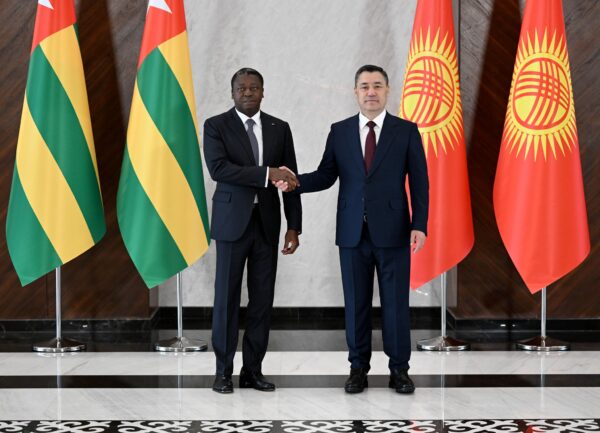
In March, Ghanaian Foreign Minister Samuel Okudzeto Ablakwa traveled to Bishkek, the first-ever African foreign minister to make an official visit to the country. In late April, Togolese President Faure Gnassingbé became the first-ever African head of state to be welcomed officially in Kyrgyzstan. In early May, Minister for Foreign Affairs and the Diaspora of Seychelles Barry Faure touched down in Bishkek.
Meanwhile, Kyrgyz Foreign Minister Jeenbek Kulubayev is making the first-ever official visits by a Kyrgyz foreign minister to Mozambique and Namibia this week.
In late April, Kyrgyz analyst Zamirbek Minbaev penned an article for The Times of Central Asia honing in on the geopolitical factors undergirding Kyrgyzstan’s suddenly active Africa policy: namely sanctions, Russia, and China. While cautioning against an overly simplistic reading of every Kyrgyz initiative as directed by Moscow, Minbaev nevertheless argues that “Kyrgyzstan may be becoming part of a distributed sanctions-era infrastructure in which Russian, Chinese, Central Asian, and Global South interests increasingly overlap.”
This expands upon a phenomenon other analysts have noticed. For example, in June 2025, Brett Erickson argued in an article for The Diplomat that China was “laying the foundation for a durable, sanctions-resistant logistics corridor that supports not only Russia’s wartime economy but also China’s long-term geopolitical insulation from Western financial pressure.”
Africa fits in as a further expansion of this network, whether by deliberate design or by fact of circumstances aligning.
It’s a notable coincidence that the Togolese president’s historic visit to Kyrgyzstan came just days after the EU issued its 20th package of sanctions, including unleashing its “anti-circumvention tool” for the first time, with Kyrgyzstan in the crosshairs.
One of the reasons Bishkek ran so afoul of Europe in this regard is the emergence as a crypto corridor stretching through the country, linking sanctioned Russian flows with trade in Central Asia and supply chains from China. Last summer, reporting by the Financial Times exposed Kyrgyzstan as critical in the shadowy and shifting crypto world, particularly a ruble-pegged stablecoin issued by a Kyrgyz company – A7A5 – with ties to a sanctioned Russian company, A7.
Earlier in April, the Centre for Information Resilience published a report on the expansion of the A7 network in Africa. Among the report’s findings: “A delegation likely linked to A7… appears to have made undisclosed visits to Togo and Madagascar in January 2026… In late March A7 began advertising for a Country Manager for Togo.” Another coincidence is that Russia’s crypto kings are deepening ties in Africa at the same time Kyrgyzstan is.
Minbaev’s conclusion is worth repeating:
The central question is no longer whether Kyrgyzstan is participating in a larger geopolitical game. Increasingly, it appears that it is.
The real question is whether Bishkek can turn this role into a durable strategic agency – or whether it risks becoming an expendable proxy node in someone else’s architecture.
