

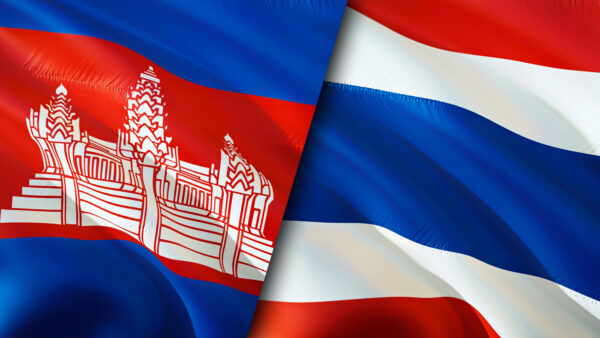
On Tuesday, Cambodia’s government announced that it had launched a compulsory conciliation process under international maritime law aimed at resolving a long-running maritime boundary dispute with Thailand.
The move came after Thailand’s government unilaterally cancelled a 2001 agreement with Cambodia over joint offshore energy exploration and the demarcation of maritime boundaries in the Gulf of Thailand.
In an address broadcast on state television, Prime Minister Hun Manet announced that his government had commenced the process of compulsory conciliation under the United Nations Convention on the Law of the Sea (UNCLOS), and had informed both the U.N. Secretary General and the Thai government about the decision.
“We have taken this step to protect Cambodia’s sovereignty and maritime rights in accordance with international law,” Hun Manet said, as per the government-aligned media outlet FreshNews.
“This is not unilateral action,” he added. “It is an effort to resolve the dispute peacefully, through international law, and in good faith.”
On Tuesday, Foreign Minister Prak Sokhonn also briefed foreign ambassadors about Cambodia’s decision, stating that Phnom Penh regretted Bangkok’s cancellation of the 2001 memorandum of understanding on the maritime border. He said that after “carefully considering” its available options, Cambodia “concluded that it had no alternative but to initiate compulsory conciliation proceedings under UNCLOS.”
According to Annex V of the Convention, compulsory conciliation is a process in which a panel of independent exports – known as conciliators – examine a dispute and help states parties reach an amicable settlement. However, its findings are not legally binding on either party.
The mechanism has been rarely used. The only other instance was Timor-Leste’s decision in 2016 to refer its maritime dispute with Australia to compulsory conciliation. In that instance, Australia accepted conciliation and the five conciliators were able to offer a compromise, which was accepted by both parties.
Cambodia said that it was appointing Foreign Minister Prak Sokhonn as its agent for the proceedings, Reuters reported, citing a government statement. It has also conscripted French academic Jean-Marc Thouvenin and Danish diplomat Peter Taksøe-Jensen, who chaired the Australia-Timor-Leste conciliation commission, to serve as conciliators.
“Thailand now has 21 days to appoint two of its own conciliators. The conciliators will then select a chair to finalize a conciliation commission, overseen by the U.N. secretary-general,” the statement added.
The maritime dispute relates to a 26,000-square-kilometer area in the Gulf of Thailand, known as the Overlapping Claims Area (OCA). The OCA is estimated to hold abundant reserves of oil and natural gas, the exploitation of which has become more pressing due to the current global oil supply crisis.
Offshore tensions have increased in parallel with the intensification of the dispute over the Thailand-Cambodia land border, which flared into conflict twice last year – for five days in July and then for nearly three weeks in December – killing nearly 150 people and displacing around a million on both sides of the border.
A ceasefire signed in late December has since kept the peace between Bangkok and Phnom Penh, but tensions remain high along both the land and maritime borders.
Cambodia’s move, while a justifiable response to Thailand’s cancellation of the 2001 MoU, is unlikely to push the dispute towards resolution. Thailand has previously resisted Cambodia’s attempts to internationalize the border conflict, including its decision last year to take its land border dispute to the International Court of Justice, preferring to deal with its smaller neighbor bilaterally.
Accordingly, the government has stated that it is willing to use UNCLOS as a legal framework for the resolution of the OCA issue, but only in the context of direct bilateral negotiations with Phnom Penh.
Thai Foreign Minister Sihasak Phuangketkeow said yesterday that the Cambodian move had undermined trust and complicated efforts to reach a negotiated settlement on the maritime border. “Resolving issues directly between neighboring countries is the best approach to achieving a constructive and mutually acceptable outcome,” he said, as per the Bangkok Post.
This suggests that Bangkok will likely refuse to participate in compulsory conciliation; doing so would hand Cambodia a “win” and agitate powerful nationalist constituencies stirred up by the recent border conflict.
A Thai refusal could generate international sympathy for Cambodia, allowing its government to contrast its own commitment to dialogue and international law with Thailand’s bullying unilateralism.
Whether this makes much difference to the situation on the ground remains to be seen.
During the recent election campaign in Thailand, Prime Minister Anutin Charnvirakul successfully harnessed the nationalistic sentiment that was stirred up by last year’s border conflicts. Whether this was the decisive factor in his strong election victory in February remains unclear, but refusing compulsory conciliation will not cost him much domestic support.
It is also unlikely that the outside world can force Thailand in any way to participate in the process. Distracted by crises in Gaza, Iran, and Ukraine, and the quickening erosion of the current international order, the “international community” has shown surprisingly little concern about the outbreak of an inter-state war in mainland Southeast Asia. Indeed, the overwhelming sense has been one of bewilderment about why the conflict erupted in the first place, and confusion about how to parse the two sides’ respective accusations against the other.
In these circumstances, it is more likely than not that Cambodia’s UNCLOS move will mark another milestone on a long road to nowhere.
