

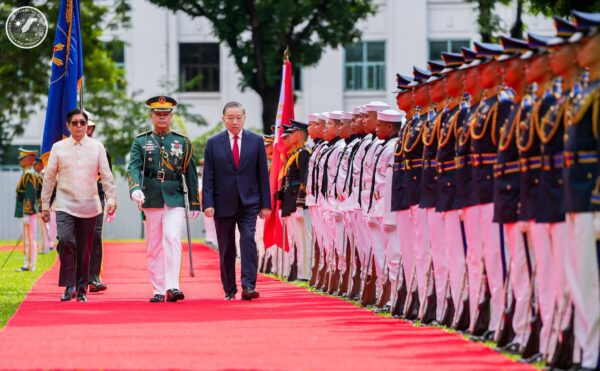
Vietnamese President To Lam, who also serves as general secretary of the Communist Party of Vietnam (CPV), has just concluded a three-nation Southeast Asian tour covering Thailand (May 27–28), Singapore (May 29–30), and the Philippines (May 31–June 1).
If neighboring Laos and Cambodia – Vietnam’s two traditional and special partners – are added to Lam’s recent tour, along with visits to Malaysia and Indonesia, this trip brings to seven the number of Association of Southeast Asian Nation (ASEAN) member states that Lam has visited since he was elected the CPV general secretary in August 2024. In Singapore last week, Lam also delivered a keynote address at the Shangri-La Dialogue, Asia’s largest annual security forum, making him the highest-ranking Vietnamese leader to speak at the event since former Prime Minister Nguyen Tan Dung did so in 2013.
This was Lam’s second foreign trip since being elected president in April. The number of Lam’s Southeast Asian stops indicate that under his leadership, Vietnam’s “bamboo diplomacy” is extending its reach and leaning more heavily toward ASEAN member states. This reflects not only the importance that Vietnam places on these countries’ roles and the need to strengthen bilateral ties of strategic significance to Vietnam, but also signals a new shift in Vietnam’s “neighborhood diplomacy” thinking.
ASEAN has always held an important place in Vietnam’s foreign policy and has carried strategic significance for the country since 1975, to come out of sanctions and blockades imposed by China and the West after the Vietnam War. This importance has been further underscored since Vietnam joined the bloc in 1995.
Nevertheless, Vietnam’s attention to individual ASEAN member states has been uneven and inconsistent. Vietnam assigns high priority to neighborhood diplomacy, yet for much of this period the concept of “neighbor” has implied only countries sharing a land border with Vietnam – namely China, Laos, and Cambodia – while the remaining ASEAN states have been more often viewed as “regional countries,” a broader term that can encompass not just countries in Southeast Asia but also those in Northeast Asia and South Asia.
Since Lam became CPV chief in August 2024 and took direct charge of external affairs work, this outlook and Vietnam’s approach toward ASEAN member states appear to have undergone a shift. Within just six months, from November 2024 to May 2025, Vietnam established Comprehensive Strategic Partnerships (CSPs) with four ASEAN countries, three of which were formalized during Lam’s visits to Malaysia (November 2024), Indonesia (March 2025), and Singapore (March 2025). The fourth upgrade, with Thailand, was announced during the visit of then Thai Prime Minister Paetongtarn Shinawatra to Vietnam that May.
During Lam’s visit to the Philippines this week, the two countries upgraded their relations to an Enhanced Strategic Partnership, a closer step to a CSP. Notably, Vietnam is the only country within ASEAN with which the Philippines has established a strategic relationship. The creation of enhanced strategic partnerships with all five founding members of ASEAN marks Vietnam’s graduation to the ranks of the six leading ASEAN nations and its departure from the secondary grouping of four less-developed states formerly known as CLMV (Cambodia, Laos, Myanmar, and Vietnam).
In addition, Vietnam currently maintains a Comprehensive Partnership with Brunei (2019) and a Comprehensive Cooperative Partnership with Myanmar (2017). It is quite possible that Timor-Leste, ASEAN’s newest and eleventh member, will also seek to upgrade its relationship with Vietnam during its prime minister’s attendance at the ASEAN Future Forum in Hanoi next week.
These developments in Vietnam’s relations with ASEAN member states since late 2024 signal a new geopolitical awareness in Vietnam’s foreign policy. In this framework, the concept of “neighborhood diplomacy” has been broadened to encompass countries that share maritime borders with Vietnam, like the Philippines and Indonesia. This notion draws on the Vietnamese folk expression that “distant relatives are worth less than close neighbors,” which emphasizes the importance of relationships rooted in geographic proximity.
This could reshape the direction of Vietnam’s diplomacy for decades to come. It could also help deepen the political and economic cohesion of ASEAN as a whole, enabling the bloc to better navigate turbulence in the external geopolitical environment, energy shocks stemming from the conflict in the Middle East, tariff pressures arising from unilateral protectionist policies, and intensifying great-power competition.
In his Shangri-La Dialogue keynote address, President Lam noted that Vietnam’s national interests are “closely tied to the peace, stability, and prosperity of the region.” The region referred to by Lam in this context encompasses both Southeast Asia and the broader Asia-Pacific – a region he mentioned repeatedly throughout his speech. In other words, the space covered by Vietnam’s “bamboo diplomacy” has expanded to cast its shadow across the Asia-Pacific region as a whole.
The outcomes of Lam’s “neighborhood bamboo diplomacy” tour to three ASEAN countries, along with earlier visits, include commitments to deepen political trust, raise trade volumes, strengthen defense and security cooperation, promote people-to-people and cultural exchanges as a foundation for closer ties, and enhance coordination on regional and international issues. In the area of trade alone, for instance, 2025 saw total two-way trade between Vietnam and ASEAN reach $91 billion, up from 84 billion in 2024, with the three markets of Thailand, Singapore, and the Philippines together accounting for approximately one-third of that figure, or around $36 billion.
These commitments will need time to translate into concrete, measurable figures, and may well be contested by competing national interests and great power strategic rivalry. Yet it is clear from President Lam’s Southeast Asian tour that Vietnam is not merely strengthening but actively expanding its “neighborhood bamboo diplomacy” while generating new hope and momentum for the development of Vietnam, individual ASEAN partners, and – potentially – the region as a whole.
