

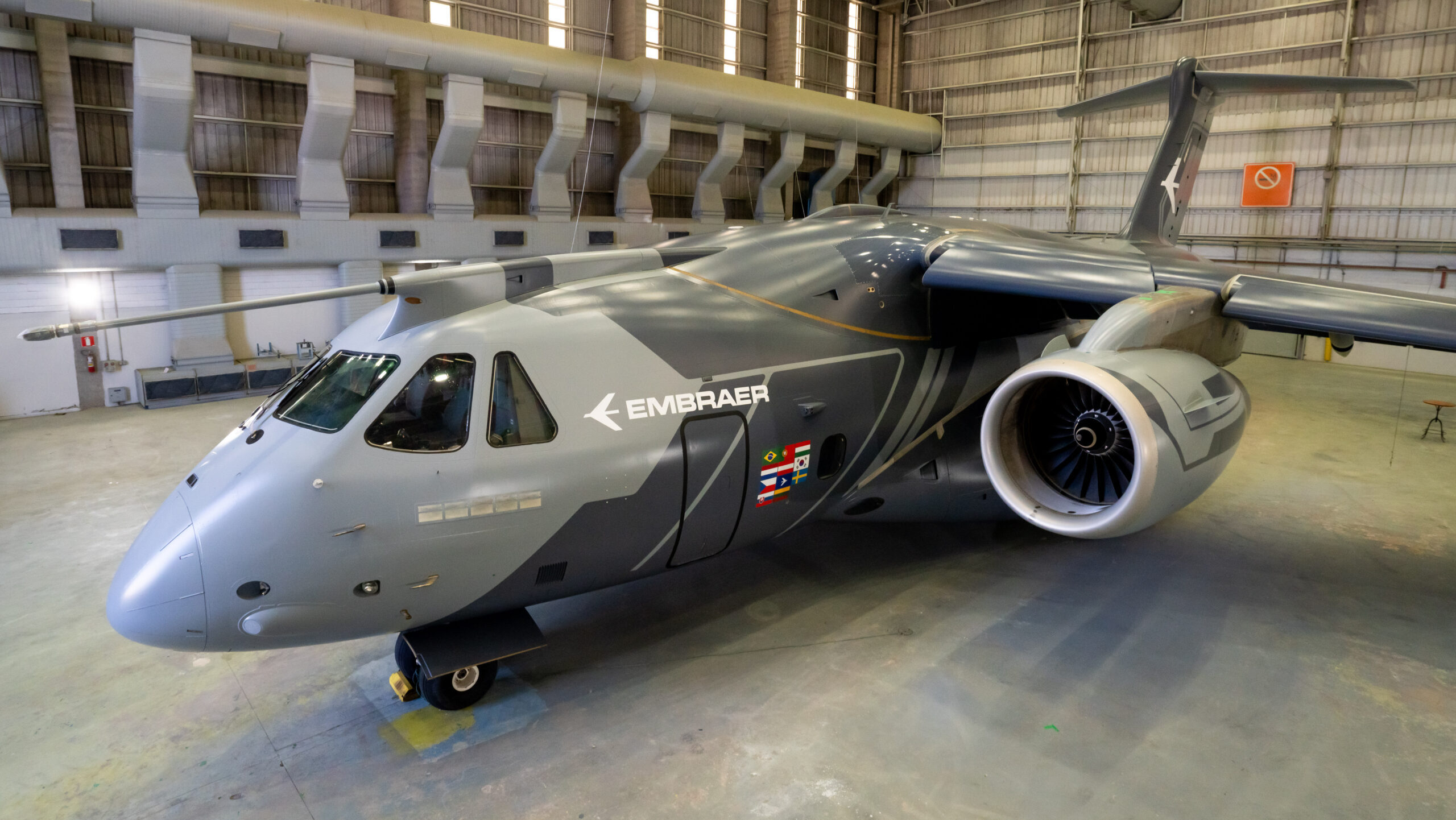
SÃO JOSÉ DOS CAMPOS, Brazil — Brazilian aerospace firm Embraer plans to nearly double its output of the KC-390 Millennium airlifter by the end of the decade, according to a company executive.
“As demand is growing, not only to meet the current commitments we have with customers, but also looking to the future, looking ahead [at] what’s coming, we are in ramping up mode,” Marcio Monteiro, the chief marketing officer of Embraer’s defense division, said in a June 10 briefing with reporters here.
Embraer this year anticipates building six aircraft. “Towards the end of the decade, we expect to reach 10 aircraft a year in terms of production,” Monteiro said. (Like other media, Breaking Defense accepted accommodations from Embraer for a media tour of the company’s facilities in Brazil.)
Embraer’s Millennium has been on something of a hot streak recently, scoring wins in a number of competitions like one in Sweden last year and another in the UAE in May. Looking ahead, Embraer anticipates the total addressable market for the airlifter — which often competes against Lockheed Martin’s C-130J Super Hercules and at times Airbus’s A400M Atlas — could number as many as 450 aircraft over the next two decades.
Further, one day after Monteiro’s remarks, Greek officials greenlit the procurement of three Millenniums, and a competition in India remains open.
“It’s truly a hot market now,” Monteiro said, noting that deliveries will take place this year for the Czech Republic, Uzbekistan and South Korea.
The KC-390 is a tactical airlifter, and can refuel other aircraft via a hose-and-drogue system. But through a new partnership with American defense giant Northrop Grumman, the company is studying plans to outfit the aircraft with a dedicated refueling boom. A new boom would enable the Millennium to gas up a wider range of aircraft.
Embraer also hopes its Northrop team-up could help break the KC-390 into the American market, with potential customers like the US Air Force and special forces. (The US is excluded from Embraer’s addressable market projection, which Monteiro called a “conservative” estimate.)
In a June 11 interview with Breaking Defense, Monteiro said the two firms are “drilling” into details like cost sharing for development of the boom system and technical assessments for its configuration. Ideally, Embraer would like to ensure the telescopic fuel rod doesn’t interfere with the aircraft’s multi-mission roles like moving cargo, and that it will be retrofittable for aircraft already delivered.
America would be a lucrative market for the KC-390, given the US’ demand would likely dwarf that of other customers. And in a bid to sweeten a prospective deal, Embraer has pledged to open a dedicated US assembly line for the aircraft if Washington moves forward with an order. However, a more immediate opportunity — an Air Force program to field a next-generation tanker — is somewhat in limbo.
When the partnership was announced, Embraer and Northrop officials emphasized that Millennium operators like those in Europe would benefit from a boom-equipped KC-390 to refuel their own fleets of F-35 stealth fighters. But asked recently whether demand outside the US alone would be sufficient to close a business case for investing in boom development, Monteiro acknowledged company officials don’t have a clear answer.
“I think that’s one of the questions we want to answer as part of that study we’re doing now with Northrop. I mean, how much dependence we have on the US market for this to happen,” he said.
An A-29 Line In Jacksonville
In partnership with SNC, Embraer also manufactures its A-29 Super Tucano light attack aircraft in Jacksonville, Fla.
For years, Embraer officials have warned that a lack of customers endangers the future of the Florida A-29 line. While the company projects a total addressable market of roughly 500 aircraft over the next two decades for the Super Tucano, those possibilities can’t be counted on to keep the Jacksonville facility open.
Embraer is still pursuing orders for the line, whether through expanding existing fleets or signing new customers, but “of course that facility cannot stay without any orders, I mean, forever,” Monteiro said June 10.
“Soon there will be a time when we will have to sit down and discuss with our American partners and the US government itself [about] what to do. That time has not come yet,” Monteiro continued. The facility, he said, is still “open and running.”
