

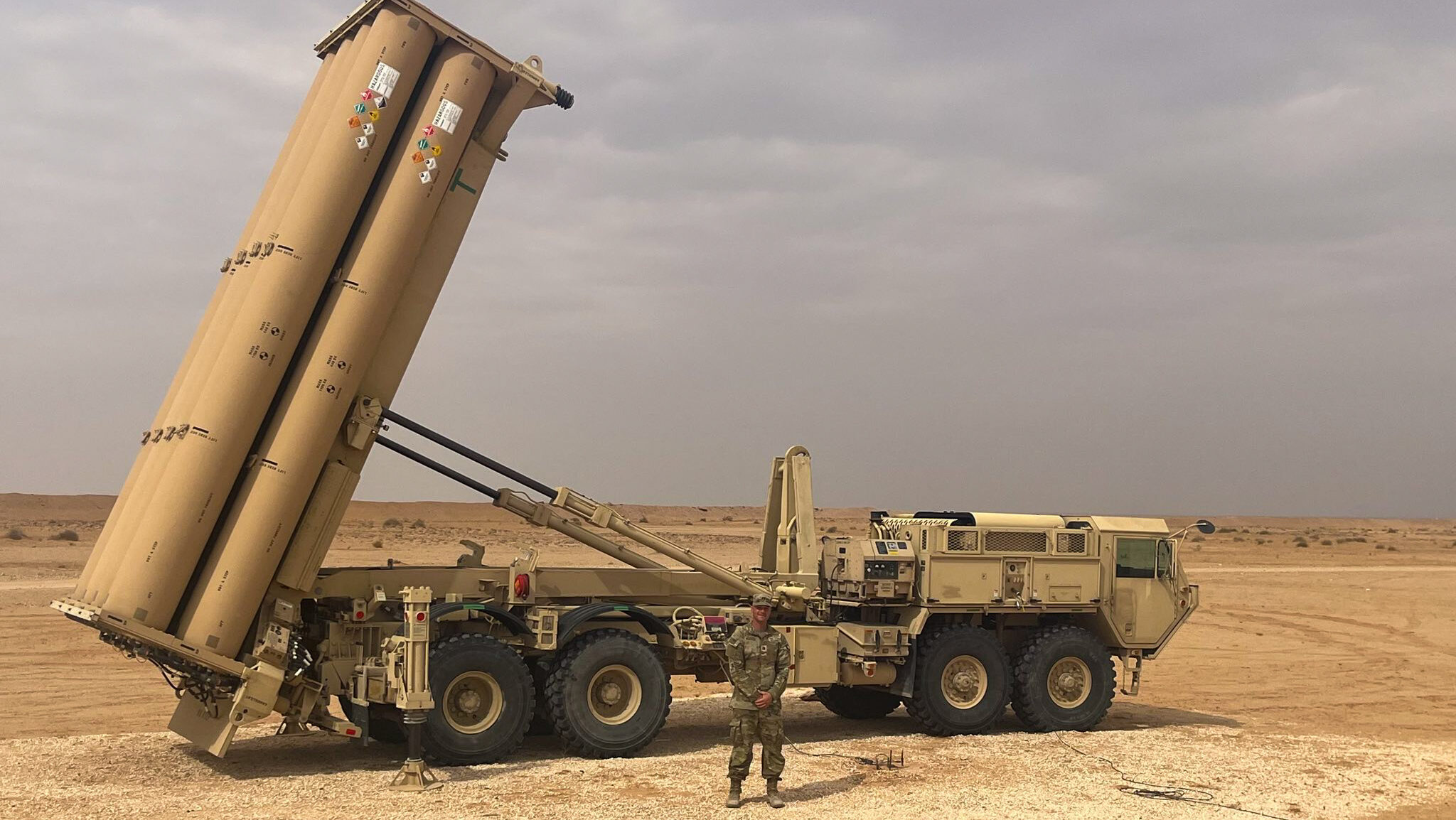
US air-and-missile-defense (AMD) systems have shown their worth in the Iran conflict, intercepting wave after wave of attacks from missiles and drones. But a number of costly TPY-2 radars have been damaged or destroyed, and stockpiles of munitions components such as solid rocket motors (SRMs) are dwindling, exacerbating concerns about the capability of AMD systems to maintain effectiveness.
Breaking Defense discussed the performance of AMD systems, munitions stockpile concerns and what needs to happen to ensure future deterrence capability with Tom Karako, director of the Missile Defense Project, Center for Strategic and International Studies (CSIS).
Breaking Defense: You’ve been publicly stating for some time that our stockpiles are not what they need to be, but has seeing how attacks have evolved from ballistic missiles to drones changed your thinking about what kinds of munitions we need?
Karako: I would not say it’s changed my mind as much as it’s simply confirmed the sort of things that we’ve been saying for years. It needs to be a high-low mix. There are those who will repeat the cliche that one shouldn’t use a $4 million missile to take out a $40,000 drone. Of course there’s a certain truth to that. It is not desirable to do so.
Having said that, no captain of a ship will pull out his slide rule and begin calculating whether the incoming threat costs more than the missile or the gun that they’re going to use to take it out. They’re going to defend the ship. Likewise, an air defender will defend the airbase and the lives on the base against an incoming threat with whatever means are at their disposal.
There is a distinction between cost and value, the value of the defended asset specifically, but it’s also just an operational reality. It’s to some extent about cost, but it’s really about affordability. The United States of America can afford more than North Korea can. The United States of America can afford more than Iran can. But it really comes down to the numbers that we’re able to buy and the industry is able to produce as well. I will caution that the lower-cost, lower-capability things are not going to be capable of doing what that $4 million PAC-3 is capable of doing.
When folks cast aspersions on the higher-end capability, they do so with a bit of abandon because there’s just no counter-UAS capability that can substitute. For the foreseeable future, the United States of America, the US government and the military, is going to demand capability as well as capacity. So it’s not an either/or, it’s a both/and.
The good news is that it’s not rocket surgery to bring these drones down. The hard part is detection and tracking and classification, and being in the right place at the right time and having sufficient capacity to shoot down that, basically, low and slow flying airplane coming at you. It’s a capacity problem, and it’s also a rules of engagement problem and a training problem.
One can’t attend an Army trade show without running into somebody’s counter-UAS effector. Everybody has a solution there, and that’s good. You can’t swing a tank turret at one of these conferences without running into somebody’s counterdrone system. That speaks to the relative ease of killing these things as opposed to being a technological challenge.
It comes down to capacity and training and rules of engagement. While many companies have different solutions in the near term, the emphasis is going to be on producing lots of them and frankly producing more of what the military is trained to use. There is a limitation on the introduction of many new things as opposed to lots of one thing that training and comfort with matter a lot.
Let’s talk about SRMs specifically, which were the subject of a recent report by CSIS. Is it harder to replace SRMs than it is to replace other components of AMD interceptors?
The answer is yes and no, and it just depends on the round. For some things it’s more the dependent variable and in other instances it’s not. It may be the seeker, it may be the avionics, it may be the electronics in some other manner. It just depends, but these relationships are also coupled. Expectations about SRM delivery may shape expectations about seeker delivery and vice versa. The short answer here is that everybody is kind of ramping up and everybody needs to ramp up together.
How has the inconsistency of the demand signals over the last couple decades led to challenges for the industrial base to quickly ramp up SRM production?
The defense industrial base for SRMs is the defense industrial base that we paid for. We also have the defense industrial base that the government has created and curated and shaped and incentivized and disincentivized in 17 different ways. We have the industrial base that was asked for and that was manufactured by the monopsony customer over several decades. When the customer decides on a dime that they want something completely different and now they’re wagging their finger at the defense industrial base that it created, it is not surprising that it creates some difficulty.
You mentioned that everybody needs to ramp manufacturing up together, but don’t SRMs have some additional manufacturing complexities due to considerations such as safety regulations?
Well, they do. From the study interviews and site visits that we did that I don’t think safety regulations are the thing to short. SRMs are dangerous. People do die from time to time and it’s okay to spread buildings around and to have berms between buildings. Safety matters because people matter. We can’t build these things without people. So it’s not the need for regulation or the need for safety by any means.
Having said that, there were some things that emerged during this process such as, for instance, the existence of redundant and contradictory regulations. In addition to the Pentagon’s fairly exhaustive and prudent regulations, there’s also the jurisdictional phenomenon that a lot of this is regulated by the Bureau of Alcohol, Tobacco, and Firearms. That’s interesting and this creates dilemmas where you’ve got various objects that are regulated by two different agencies, very different agencies, with different rules, which is not necessarily productive. Perhaps that’s something that a future NDAA or other legislative mechanism takes up. Aren’t the DoD’s regulations good enough? Do we really need a second regulatory organization for solid rocket motor things?
The question of redundancy is an interesting object of legislative scrutiny that efficiency and also just good government might be worth revisiting.
In the recent report CSIS released on SRMs for AMD, one interesting note is that the demise of the space shuttle program has created some unused manufacturing capacity for SRMs. Can you expand on that?
The shutdown on the shuttle is a part of why the demand went down. But many of the facilities exist for more capacity than they are producing today.
At a number of sites we visited, we would hear from industry and see facilities that are not functioning at their max capacity. The reason for that is not that they can’t. At one facility people pointed to a building with mixing bowls that are only used two days a week. Why are they only used two days a week? Because the government demand only necessitates they’re being used two days a week. Could they be used five days a week? Yes, they could, but the government contracts are not there to use them five days a week. Could they be? If they were, the answer is yes. It really comes down to “physician, heal thyself.” The customer with this collective existence needs to have and to communicate a clear demand signal.
Now that there has been some time to look back at everything that has happened during the Iran conflict, how would you evaluate the current effectiveness of US air and missile defense?
The effectiveness has been quite good, especially in terms of the ballistic missile defense engagements. It’s been so good that we are, unfortunately, beginning to deplete our inventory. As we’ve noted in a number of CSIS reports over the years, including late last year warning of this problem, this was a problem in the 12-day war last summer. I’m in print saying at the time that we couldn’t afford to do it again. Well, we did it again, and that’s kind of a problem.
It’s a problem because it is a depletion of our inventories. The good news is that few ballistic missiles have been hitting. Some have, to be sure, been getting through, but we’ve been engaging a lot. It used to be that certain folks would crow that you can’t hit a bullet with a bullet. That cottage industry has gone silent. Now the complaint is that we aren’t hitting bullets with bullets cheaply enough, and that we are running out of anti-bullet bullets.
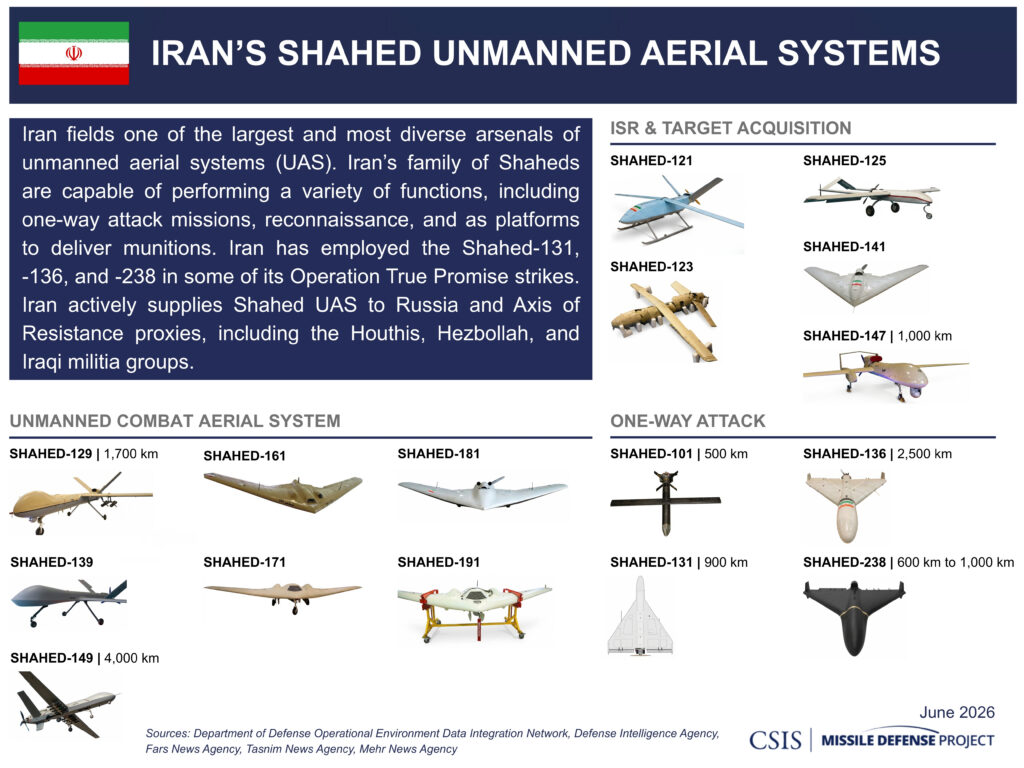
On the air defense side there’ve been hundreds and hundreds of engagements of drones, with lots of them being shot down. Unfortunately, there’s also a decent number of the Shaheds getting through. That’s not necessarily a strike on the capability of the defenses as much as it is a limitation of their capacity and the challenge of being everywhere all the time. Because these things are maneuverable on a certain trajectory, the defense problem is almost by its nature a point defense problem.
Ballistic missile defense, by contrast, is an area defense problem, and it’s able to do that because ballistics have a predictable trajectory. But in the same way that it’s hard to know where an airplane is going to go until it gets there, you need to have your point defense defenses co-located with your defended asset. The corollary to that is that some of these things may be getting through because we don’t have drone defenses in the right place at the right time and that’s just the nature of things.
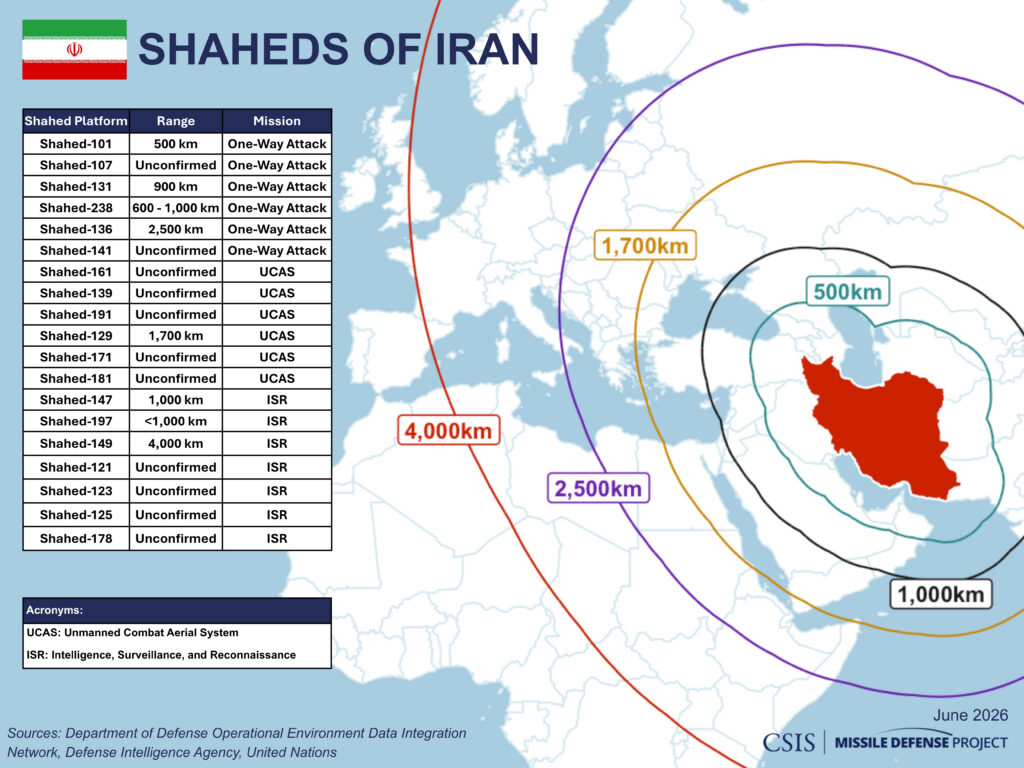
You say that some members of the Shahed family of drones should really be classified more as cruise missiles. What capabilities make you say that?
This is a bit of a pet peeve about what might be called a doctrinal or taxonomy problem. It wasn’t that long ago when the air defense taxonomy was fairly straightforward: it was ballistic missiles, cruise missiles and fixed- and rotary-wing aircraft. But as I’ve written on a number of occasions, the increasing and diversifying threat spectrum has become so proliferated and has so diffused that those easy distinctions are becoming blurred. In short, we need a new taxonomy, or way of describing the threat spectrum.
To take one example, there are these aircraft that we call drones or UAVs that may be either fixed-wing or rotary-wing. And some of them have substantial ranges: the Shahed-238 has a range that cannot be described as anything but a long-range cruise missile. The technological maturity, their reliability, and the availability of these things is blurring and challenging the taxonomies of the past. When something can go 2,000 kilometers and it’s got wings, one doesn’t really need to come up with fancy nomenclatures like “one-way attack UAV” or “loitering munition.” That thing deserves to be called a cruise missile.
As you said, drones are relatively easy to kill, but it’s harder to identify targets when there’s a swarm coming at you as opposed to a few missiles.
There is the large salvo problem. It’s the fact that they can hug the terrain or be below the horizon for most of their flight. That’s going to translate to shorter detection time. It’s not just detection, it’s also tracking and identification. You have to not just barely see a blip on the radar screen, but you have to have confidence that it’s not an American aircraft or an American drone.
A number of the powerful radars that support air and missile defense systems have been disabled or destroyed in the Middle East, and the US military has been relocating radars from other areas to provide coverage. How is that affecting our AMD capabilities not only in the Middle East, but also looking forward to a possible conflict in the Pacific?
That’s the big concern. You can’t operate a THAAD (Terminal High Altitude Area Defense) battery without a TPY-2 radar. Those are scarce strategic national assets and the country is already scrambling to piece together some replacements and we want to get them out there in the field.
The broader strategic context here is that the United States has been pulling stuff out of the Pacific and out of Europe to go to the Middle East. That’s an undeniable reality. It’s hard to argue that is not going to have some potential detrimental impact to our deterrence quotient. Capability is a fundamental component of deterrence. It’s not lost on our adversaries either: the number of interceptors, the number of strike missiles, and yes, the number of radars that have been expended or adversely impacted here.
If you were magically put in charge of air and missile defense and given an unlimited budget, what would be your number one priority? What would you do first and what would you do differently from what we’re doing now?
Well, an unlimited budget is quite the stipulation and thought experiment. But the first thing I would do is put on contract the things that we have said are going to be put on contract and that we know need to be put on contract. I would take a paintball gun and start tagging the companies to go to max production on each of the prioritized munitions, and then move to drone defenses, the Coyotes and the Merops and a handful of non-kinetic things so that the long-waited production ramp can begin. We have identified and admired the problem and even come up with the solutions. Now we need to implement the solutions and start to solve the problem.
