

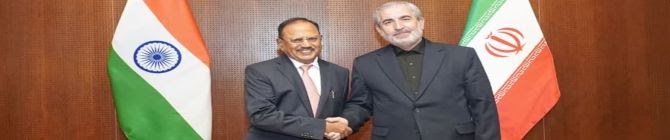
National Security Advisor Ajit Doval met Iran’s Deputy Secretary for Defence Affairs of the Supreme National Security Council, Ghadir Nezamipour, in New Delhi on Monday. The meeting took place on the sidelines of the 16th BRICS National Security Advisers’ Meeting being hosted by India on 22–23 June 2026.
Both sides held discussions on the ongoing situation in West Asia, a region facing heightened instability due to maritime security risks, energy infrastructure vulnerabilities, and escalating geopolitical tensions. The dialogue also covered India–Iran bilateral ties, with emphasis on strengthening cooperation under the BRICS framework.
The Ministry of External Affairs Spokesperson Randhir Jaiswal confirmed the meeting in a post on X, noting that the two officials reviewed regional developments and explored avenues for collaboration.
Nezamipour’s participation highlights Iran’s growing engagement within the expanded BRICS grouping, which now includes eleven major emerging markets and developing countries.
Ajit Doval also met Million Lema Tadesse, Executive Director of Analysis at Ethiopia’s National Intelligence and Security Service. Their talks focused on enhancing and deepening the India–Ethiopia Strategic Partnership, reflecting India’s broader outreach to Africa within the BRICS framework.
The BRICS NSA Meeting is centred on the theme “Non-traditional security challenges confronting the world today.” Discussions are addressing evolving threats such as cyber security, terrorism, and the disruptive impact of emerging technologies.
The agenda includes reviewing the outcomes of recent BRICS Joint Working Groups on Counter-Terrorism and on Security in the use of Information and Communication Technologies.
India’s Chairship of BRICS in 2026 marks its fourth time leading the grouping, having previously chaired in 2012, 2016, and 2021. The current Chairship is guided by the theme “Building for Resilience, Innovation, Cooperation and Sustainability,” articulated by Prime Minister Narendra Modi at the Rio Summit in 2025 as a people-centric and humanity-first approach.
BRICS has expanded considerably since its inception, evolving from a primarily economic forum to one structured around three pillars: political and security, economy and finance, and cultural and people-to-people exchanges.
The grouping now addresses a wide range of global issues, including terrorism, climate change, food and energy security, telecommunications, agriculture, labour and employment, international financial architecture, trade, and the World Trade Organisation.
India’s hosting of the NSA Meeting underscores its role as a key driver of multilateral cooperation within BRICS, while its bilateral engagements with Iran and Ethiopia highlight New Delhi’s strategic intent to strengthen ties across West Asia and Africa.
These meetings reinforce India’s position as a bridge between regions and as a proponent of collective security and stability.
ANI
