

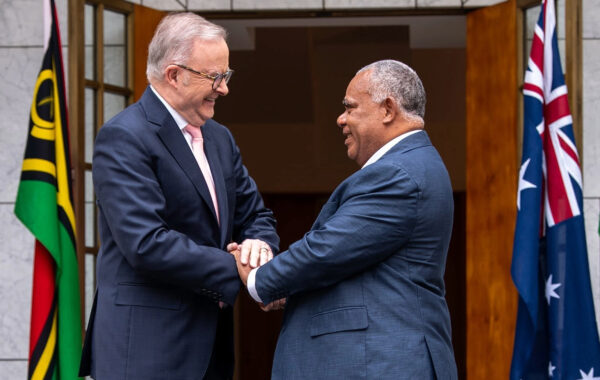
This week, Australian Prime Minister Anthony Albanese and his Vanuatu counterpart, Jotham Napat, signed the Nakamal Agreement, a new security relationship between the two countries. While this is the latest in a series of agreements that Canberra has struck with Pacific Island countries, it is noticeably weaker – in Australia’s eyes – than the others, given Vanuatu’s strong streak of independence and desire to remain open to potential opportunities with other major regional actors.
The motivating force behind Australia’s series of regional agreements is Canberra’s concern about Chinese influence in the Pacific. Australia has sought to formally entrench its position as the security partner of choice, and to give itself a veto over foreign (read Chinese) involvement in critical infrastructure projects in the region like ports, airports, and telecommunications systems that could potentially have dual-use purposes.
However, domestic resistance in Vanuatu to Australia’s agenda meant that the agreement was initially delayed, and then revised into one more palatable to Port Vila. The final version removes the proposed restraints on third-party investment in Vanuatu. Instead of requiring Australian approval for foreign participation in critical infrastructure, the agreement only requires consultation with Australia – although crucially there is a commitment for this infrastructure to be “free from militarization, any form of foreign interference or unauthorized access.”
Even if this may not entirely calm Canberra’s anxieties about Chinese investment in the region, it still provides Australia with significant input into sovereign decisions in Vanuatu.
Despite this softening, the agreement establishes Australia as Vanuatu’s primary security partner. This includes commitments to ongoing cooperation in policing, maritime security, disaster response, and institutional capacity-building – reinforcing Australia’s role as the main security provider and development partner in the Pacific. The agreement also includes provisions aimed at strengthening coordination on humanitarian assistance and crisis response, which are particularly important given Vanuatu’s vulnerability to cyclones, earthquakes, and other natural disasters.
Central to negotiations was the issue of labor mobility. Vanuatu citizens have access to Australia Pacific Australia Labor Mobility Scheme (PALM), but Port Vila had been keen to expand labor rights in Australia, seeing it a key opportunity for both skills enhancement and remittances. However, despite Australia still having a shortage of agricultural labor, Canberra remains cautious about expanding work rights outside of the PALM scheme.
Primarily, Australia was concerned about the potential effects of Vanuatu’s citizenship-by-investment scheme, and how this may create pathways to Australia for people not properly vetted if labor mobility were expanded. The Nakamal Agreement contains the provision that “Vanuatu shall develop effective mechanisms to differentiate citizenship-by-investment from other forms of citizenship.”
For Australia, the Nakamal Agreement is part of a broader strategy to maintain influence in the Pacific amid increasing competition with China. Canberra has been constructing a web of new security relationships in the region that are designed to maintain its primacy. Recent security agreements have been signed with Papua New Guinea, Tuvalu, and Nauru. An upgrade to the Vuvale Partnership with Fiji is being negotiated, and the Solomon Islands’ new prime minister, Matthew Wale, has signaled an intention to negotiate a new comprehensive strategic treaty.
Australia is increasingly combining security cooperation with development assistance, climate change resilience, and the PALM scheme into a comprehensive regional engagement strategy designed to build multifaceted habits of cooperation. The Nakamal Agreement includes long-term financial commitments from Australia, reportedly amounting to hundreds of millions of dollars over the coming decade, which are intended to support infrastructure, governance, and capacity-building in Vanuatu. This reflects a recognition that economic development and climate resilience are central to maintaining Australia’s influence in the region.
However, as the Nakamal Agreement demonstrated, there is a limit to how ideal in Canberra’s eyes these security pacts can be. Defending their sovereignty is paramount to Pacific Island countries. Although these may be small states, they have proved adept at being able to use strategic competition in the region to secure their interests. Australia may be a trusted partner keen to invest what it can in the region, but this doesn’t mean that Pacific Island countries should limit themselves to exclusivity with Canberra.
Negotiations are never going to produce optimal outcomes. It is likely that Canberra was aware going into negotiations that a veto over third-party investment in Vanuatu’s critical infrastructure was likely to be asking too much. The compromise of consultations on such investments remains a significant strategic win. While the Nakamal Agreement reaffirms Australia’s position as Vanuatu’s primary security partner, there is a need to be wary in Canberra that overplaying its hand may undermine its position as it continues to enhance its regional primacy.
