

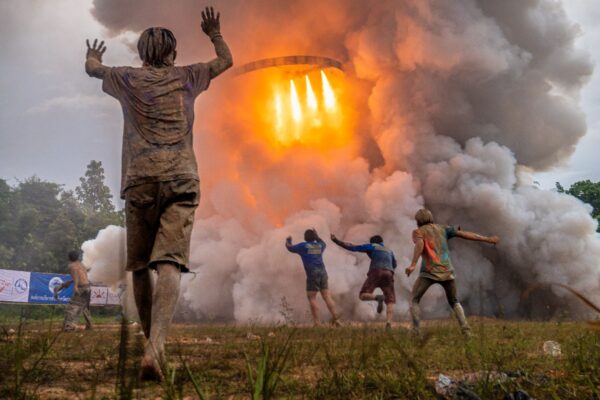
At the start of the rainy season a unique cultural practice takes place in northeastern Thailand and throughout Laos: the bung bang fai (merit fireworks) festival. The centuries old tradition has existed as a pre-Buddhist fertility ritual since before the 9th century CE, with the rocket element thought to have started when black powder was introduced to the region from China.
The rockets are launched to implore the god Phaya Thaen to bring rain at the start of the agricultural season. In its contemporary iteration, locals in small villages and regional cities put on numerous bun bang fai festivals in May and June as multi-day celebrations including parades and traditional music and dance performances, with the last day seeing the launching of rockets at a location near open area rice fields away from population centers.
The modern rockets are made from PVC pipes, with the different size classifications ranging from pan (1,000), muen (10,000), sen (100,000), lan (1,000,000), and the very large sip lan (10,000,000) and yii sip (20,000,000) class rockets which are usually only seen in Phanom Phrai and Ban Kut Wa due to safety concerns. The rockets are manually hoisted onto large angled launch platforms and then sent skyward by electric ignition.
In Ban Kut Wa, Kalasin province a unique version of bang fai is made: circular gondola shaped bang fai talai (firework pinwheel). Made with a central metal column filled with black powder with several holes drilled along the underside to release thrust, the rockets are ringed with bamboo and wood to create the circular outer structure. Placed onto launch stands with rotating tops, the rockets are lit with gas torches while being manually spun, resulting in a helix shaped smoke trail and oscillating roar as the rockets fly skyward.
