

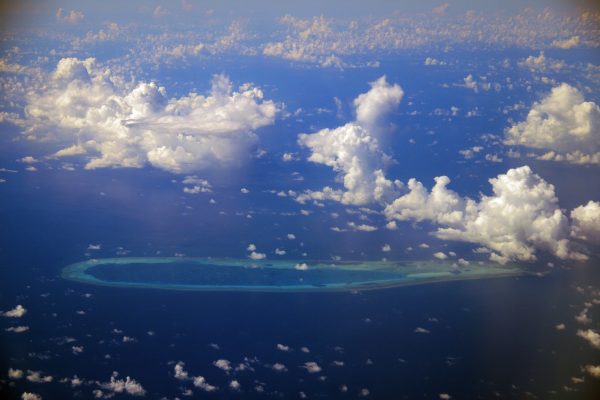
Ten years ago this month, the Permanent Court of Arbitration in The Hague rendered its decision in the case brought by the Philippines against China. The decision, which came down heavily in the Philippines’ favor, was one of the most important milestones in the South China Sea dispute because, among other things, the tribunal made it clear that Beijing’s expansive “nine dash line” was illegal under international law. But a decade on, the world’s geopolitical environment is very different from what it was in 2016. How will these changes impact the future of the South China Sea dispute?
There are at least three points on which the regional environment today differs from that of 2016. Those are the nature of U.S. leadership, Southeast Asia’s relationship with China, and the increased state of conflict across the world.
A decade ago, U.S. leadership seemed more predictable and stable. After the tribunal ruling, President Barack Obama expressed Washington’s support for the ruling and urged China to comply with it. Even though the U.S. is neither a party to the dispute nor a party to the United Nations Convention on the Law of the Sea (UNCLOS), it has always tried to position itself as the defender of the rule of law and freedom of navigation in the South China Sea.
Back then, the U.S. was widely regarded as a reliable partner for other ASEAN claimants, particularly the Philippines, against China’s bullying behavior in the disputed area. This behavior remained consistent into the first Trump and Biden administrations.
However, under the second Trump administration, the U.S. leadership has become less predictable and the country has become less reliable as a partner. Trump has openly criticized international law and even said he does not care about it. Even U.S. allies and partners have come to see the U.S. as less reliable. For instance, the Philippines, as the only South China Sea claimant state that is also a U.S. ally, has raised concerns about whether the U.S. will still be reliable if tensions between Manila and Beijing arise. Even Vietnam and Indonesia have raised concerns about a possible threat from the U.S.
Indeed, the recently released State of Southeast Asia survey by the ISEAS-Yusof Ishak Institute showed that one of the top concerns among Southeast Asian policymakers and experts was the uncertainty surrounding the direction of U.S. policymaking under Trump. This concern will influence how the other claimant states build their strategies, particularly in responding to China’s behavior. Some may even come to view the U.S. as a threat rather than a partner.
Secondly, China-Southeast Asia economic relations are stronger than they were in 2016. For instance, statistics show that over the past decade, China’s trade and investment ties with the region have grown considerably. On top of that, the second Trump administration has imposed significant tariffs on many Southeast Asian countries, which has further pushed the region to pursue closer economic ties with Beijing.
With Southeast Asia more economically integrated with Beijing, claimant countries may come to reconsider their South China Sea policy and to decide whether they want to have confrontational relations with China and risk its economic retaliation. Indonesia, for instance, has even chosen to adopt a softer approach to dealing with Beijing by recognizing for the first time an overlapping claim with China and proposing possible joint development in the North Natuna Sea.
Even though the arbitral award has benefited other Southeast Asian claimants in the South China Sea, by highlighting the unlawful nature of China’s “nine dash line,” the Center for Strategic and International Studies in Washington, D.C., has noted that, aside from the Philippines, none of the ASEAN countries have openly supported the tribunal’s decision. Indonesia, Malaysia, Singapore, Vietnam, and Myanmar have taken a more cautious approach by only positively acknowledging the ruling rather than openly supporting the tribunal.
Lastly, compared to 2016, there is now considerably more conflict and war around the world. From the wars between Ukraine and Russia and between Iran and the United States and Israel’s illegal occupation and genocide in Palestine, the world seems to be more fragile than ever before. This conflict shows that the current international order and institutions such as the United Nations are unable to prevent such conflicts and have even failed to deal with the humanitarian consequences of those wars.
This failure of the current world order to manage and address such conflict has created greater vulnerability and risk. Many countries are afraid that the law of the jungle will replace the rule of law, and, in Thucydides’ famous phrase, “the strong do what they can, and the weak suffer what they must”
This changed geopolitical environment will certainly influence and shape the future trajectory of the South China Sea dispute. Currently, claimant states have few options in dealing with China. Collectively, the never-ending negotiation over the ASEAN-China Code of Conduct for the South China Sea seems to be the only option for managing behavior and preventing conflict from escalating. However, these geopolitical changes have further increased the power imbalance between Beijing and other ASEAN claimants, while the growing unpredictability of the U.S.
That said, even though the 2016 tribunal will remain a legitimate legal document that clearly ruled the Chinese claim illegal under international law, it will in the future have to face political realities and challenges. Therefore, for Southeast Asian countries to commit to supporting the tribunal’s ruling and calling on China to adhere to it is more important than ever before.
