

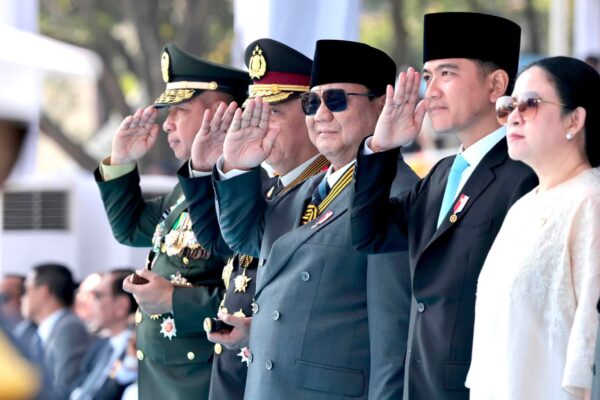
Five years ago, I wrote an article arguing that the Indonesian government’s response to the COVID-19 pandemic was undermined by its anti-expertise and anti-science attitude. Nowadays, such an attitude is rampant across all parts of the current government under President Prabowo Subianto.
The current “Red and White Cabinet” clearly demonstrates this anti-expertise sentiment. The cabinet is full of ministers without expertise in their respective portfolios, with a lack of relevant education and experience. Their lack of expertise has already had far-reaching consequences.
Take, for example, the current minister of foreign affairs, Sugiono. Before him, the Ministry of Foreign Affairs (MoFA) had been led by career diplomats for most of its history, especially in the last 20 years. The foreign ministers during this period – Hassan Wirajuda, Marty Natalegawa, and Retno Marsudi – all had academic degrees in international relations or international law, had served in MoFA for decades, and had led diplomatic missions to other countries as Indonesian ambassadors. Their education and experience had developed their capacity to become the country’s top diplomat.
Compare that to Sugiono. Before being appointed as minister, his previous career included a 2-year stint of military service during which he rose to the rank of first lieutenant, personal secretary to Prabowo, and member of Prabowo’s Gerindra political party. He has a bachelor’s degree in computer science and master’s degrees in business and management, neither of which is directly relevant to his work at the Foreign Ministry. His only encounter with foreign affairs was during his tenure as a member of parliament in 2019-2024, during which he was assigned to the first commission of the House of Representatives (DPR) that oversees foreign affairs.
Sugiono’s tenure as foreign minister has accordingly been disastrous. Just one month after his appointment, in November 2024, Indonesia published a joint statement with China in which both countries agreed on “joint development in areas of overlapping claims” in the South China Sea. This statement was widely considered a blunder because Indonesia had a long-standing status as a “non-claimant” state and had never acknowledged that overlapping maritime boundaries exist with China.
Sugiono’s other blunder was leaving the ambassadorial positions in several friendly countries and international organizations, such as the United Nations, vacant for months in mid-2025. It led to the detriment of Indonesia’s strategic bargaining power amid geopolitical tension at the time. Only after scrutiny from the DPR’s first commission did Sugiono promise to immediately fill the vacant ambassadorial positions.
His most recent blunder was delaying the process of receiving credentials from newly appointed foreign ambassadors for months in mid-2026. This has hindered these ambassadors from doing their official diplomatic work in Indonesia. Only after criticism from a former deputy foreign minister, Dino Patti Djalal, did the government hold an official ceremony to receive these envoys’ credentials.
Sugiono has committed many other blunders, but the lack of expertise extends far beyond him. Another blatant example is current Minister of Forestry Raja Juli Antoni, who does not have relevant education and experience related to forestry. His previous career was in a religious non-governmental organization called Muhammadiyah, the Indonesian Solidarity Party, and a tenure as deputy minister for agrarian affairs and spatial planning in 2022-2024. He has a doctoral degree in Political Science and International Studies, but not in any discipline relevant to forestry.
Just like Sugiono, Raja Juli’s lack of expertise has resulted in mistakes. The 2025 floods and landslides in northern Sumatra, which led to more than 1,000 deaths, 140 missing persons, and more than 1 million displaced, had been attributed to massive deforestation on company concession lands. Deforestation had been rampant since before Raja Juli became minister, but during his tenure the Ministry of Forestry has continued to liberally issue forest management permits to many companies. A member of parliament has criticized Raja Juli for not understanding forestry.
The list of cabinet-level officials in the current government with lack of expertise goes on, but the worst example is arguably the officials assigned to lead the National Nutrition Agency (BGN), the agency established to deliver Prabowo’s flagship free nutritious meals program for students.
When established in 2024, the officials appointed to lead the agency were Dadan Hindayana as the head of agency and Nanik Sudaryati Deyang, Lodewyk Pusung, and Sony Sanjaya as the deputy heads. None of them have a background in nutrition or food safety: Dadan is an entomologist; Nanik is a journalist; Lodewyk is a retired army general; Sony is a retired police general. This lack of expertise among BGN leadership has also resulted in disasters, as cases of food poisoning and mass hospitalization linked to the free meals program have been reported almost every week. Dadan, Lodewyk, and Sony were recently arrested due to allegations of corruption within BGN in mid-2026, leading to Nanik becoming head of the agency.
Why has Prabowo appointed so many non-experts to strategic positions? There is high probability that it is because he prizes loyalty and patronage. For example, let’s again take Sugiono, who has been dubbed as Prabowo’s “ideological child.” Since graduating from high school, Sugiono received a scholarship from Prabowo to study at military universities in the U.S. After his brief military service, Sugiono became personal secretary to Prabowo in the early 2000s, long before the Gerindra party was established in 2008.
Similarly, Dadan Hindayana was introduced to Prabowo when the latter was looking for a plant disease expert to treat the plants at his residence. That led to close relations between Dadan and Prabowo. Dadan admitted that he was expecting to be given a commissioner position at a state-owned enterprise, but he was instead appointed head of the BGN.
Meanwhile, Nanik Sudaryati Deyang, who recently replaced Dadan as head of BGN, has been a Prabowo loyalist since 2014. She became infamous for spreading misinformation about the persecution of Prabowo supporters during the 2019 presidential election.
The list of Prabowo’s appointees who received their positions from loyalty, not expertise, goes on. Some of those loyalty appointees are alumni of Taruna Nusantara High School – a prestigious high school managed by a foundation under the guidance of the Ministry of Defense that collaborates closely with the military – including Sugiono, Minister of State Secretariat Prasetyo Hadi, and Cabinet Secretary Teddy Indra Wijaya, among others. In the case of Teddy, in order to enable his appointment as cabinet secretary, Prabowo revised the position so that it was no longer at the ministerial level – something that is barred to active-duty military officers.
Aside from Taruna Nusantara alumni, some other loyalty appointees are military retirees. When Prabowo’s cabinet was formed in October 2024, it included four ministers, five deputy ministers, one head of agency, and five special advisors and agency officials who were retired military officers.
The phenomenon of the Indonesian government appointing ministers and other cabinet-level officials who do not have background relevant to their ministry or agency is not something new, but the scale has surely grown significantly under Prabowo.
Of course, it is true that a ministerial portfolio is a political position, and there is a debate to be had about whether a minister must have technical expertise related to their portfolio. Some argue that a minister must only be capable of leading and making strategic policies, while they can be supported by a team of professional technocrats. However, recent controversies have highlighted that some technical ministries and agencies require ministers and agency heads who have an understanding of their sectors.
To support ministers without relevant expertise, the government has established many new deputy minister positions. Some ministries now have up to three deputy ministers. The current government has 54 deputy ministers, compared with the previous cabinet which housed only 19.
The ministries with three deputy ministers include the ministries of Home Affairs, Foreign Affairs, and Finance, and the now-dissolved Ministry of State-Owned Enterprises. Does having many deputy ministers help in establishing expertise in those ministries? That is debatable, as Sugiono still makes blunder after blunder in his handling of foreign affairs. He has even joked that having three deputy ministers was not enough.
The above examples showcase how the current Indonesian government has disregarded evidence-based policy formulation by replacing technocrats and academics who have relevant education and experience with political appointees who do not have relevant competence regarding their portfolio and often ignore the advice of experts. This is a clear phenomenon of the “death of expertise” and the consequences have been disastrous. It has diminished bureaucratic effectiveness and weakened public trust in the government.
To restore bureaucratic effectiveness and public trust, the Indonesian government must return to upholding meritocracy in the appointment of public officials. Government officials must be appointed based on their scientific track records, expertise, and integrity. The government must also involve more academic institutions, research institutions, and technical bodies in policymaking.
