

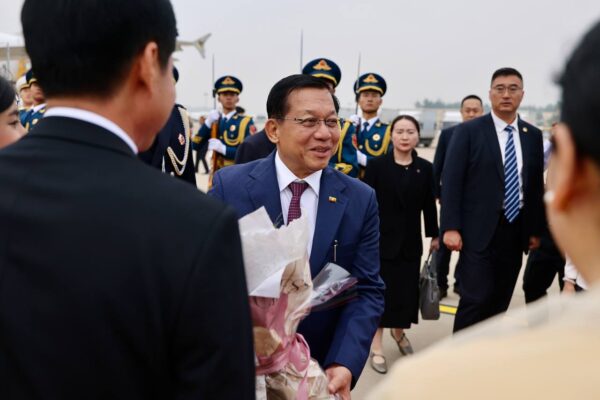
Shortly after the military-backed government in Myanmar thumbed its nose at the ASEAN chair and denied its request to meet with ousted leader Aung San Suu Kyi, the regime in Naypyidaw went one step further and announced that Laos was next on the agenda.
No date was given for the first official visit to an ASEAN country by self-anointed President Min Aung Hlaing in the Global New Light of Myanmar, which said on July 1 that the visit would take place over the “next few days.”
But official scribes across the border had a bit more to say.
The state-run Vientiane Times announced that Min Aung Hlaing would make the trip during July 3-5 “to mark the 70th anniversary of the establishment of diplomatic relations between Laos and Myanmar,” after an invitation was extended by Lao President Thongloun Sisoulith.
In denying access to Suu Kyi – and rejecting the proof of life campaign that has been launched by her son Kim Aris – and then traveling to Laos in an official capacity, Min Aung Hlaing has neatly driven a wedge into ASEAN, not unlike a lumberjack felling a tree.
The fault lines within ASEAN have only widened ever since mainland countries Cambodia, Laos, and Myanmar, known as the “CLM Club,” were granted entry into the regional bloc in the late 1990s.
Rifts with maritime ASEAN, including Vietnam, were often centered on the Code of Conduct in the South China Sea, where the CLM Club acted as a proxy and spoiler on China’s behalf.
ASEAN’s relations with Naypyidaw then all but collapsed with Min Aung Hlaing’s coup in early 2021, which ousted Suu Kyi and tipped the country into a civil war that to date has claimed almost 100,000 lives.
His stage-managed election that made him president has not been endorsed by ASEAN and a ban on his regime attending ASEAN summits remains in place.
But Laos and Cambodia have stuck by Myanmar as all three countries emerged as havens for organized crime, with their ruling elites profiting off the back of ubiquitous human trafficking networks and industrial-scale scam compounds.
Meanwhile, Thailand, by virtue of its geography, is stranded and squeezed by its mainland neighbors and has emerged as a flashpoint for ASEAN unity with its Cambodian border remaining closed.
That follows last year’s six-month Thai-Cambodian border war that had its origins in a decision by former Cambodian Prime Minister Hun Sen to flout ASEAN doctrine and leak what was supposed to be a private conversation with his then Thai counterpart Paetongtarn Shinawatra.
Unity within ASEAN is little more than an illusion but it is one to which ASEAN chairs, whether mainland or maritime, continue to cling, as the Philippines – the current chair – recently did with its resurrection of the Five-Point Consensus (5PC).
The 5PC was ASEAN’s way of finding a resolution for the civil war in Myanmar but had slipped from view as the toll mounted amid the bloody carnage and bombing of civilians as Min Aung Hlaing ignored all international efforts to deliver some respite to his own people.
In acknowledging the junta’s recent release of political prisoners and the transfer of Suu Kyi from jail to a “designated residence,” it was the Philippines’ foreign affairs spokesperson Dominic “Dax” Imperial who sounded optimistic, if out of date.
“As Myanmar takes steps in a positive direction, we reiterate the importance of releasing all other prisoners, particularly the elderly and infirm, including Daw Aung San Suu Kyi,” he said. “Such actions are essential to advancing meaningful political dialogue as envisioned in the 5PC.”
For more than five years the regime in Naypyidaw has ignored the 5PC and ASEAN attempts to end the conflict. That includes genuine efforts by Hun Sen, who once described Min Aung Hlaing as a “brother.”
The former general has few friends he can count on and that’s why his first “official” ASEAN tour as a self-made president is to Laos, another one-party state that, like the military regime in Myanmar and the government in Cambodia, is heavily dependent on China.
Min Aung Hlaing will continue his quest for legitimacy in defiance of most of ASEAN and much of the international community. But at the end of the day he can only return to a country where he is widely loathed for the carnage inflicted since his coup five years ago.
An official trip to Phnom Penh may well follow.
