

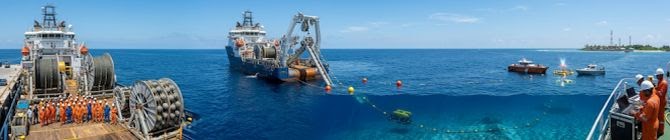
India’s DRDO has formally invited industry partners to act as Lead System Integrators for a turnkey fibre optic cable and subsea sensor node network in the Indian Ocean, with a shore station in Kochi.
This project under “Deep Ocean Watch” is designed to simultaneously strengthen maritime defence against Chinese submarine activity and enable advanced oceanographic research.
The Defence Research and Development Organisation has issued an Expression of Interest on 20 June 2026, with a submission deadline of 1 September 2026. The scope covers development, supply, transportation, deployment, and commissioning of fibre optic cables integrated with sensor nodes, alongside the establishment of a linked coastal shore station in Kochi, Kerala.
The chosen Lead System Integrator will be responsible for the entire lifecycle, from installation to commissioning, under a turnkey framework.
The fibre optic cable network will serve a dual role. On the defence side, it will act as a permanent underwater surveillance grid, detecting submarine activity across critical zones of the Indian Ocean.
This is particularly urgent given the sharp rise in Chinese submarine deployments, including Type 039 Yuan-class diesel-electric and Type 094 Jin-class nuclear ballistic missile submarines, which have been observed near Indian waters. On the civil and scientific side, the network will provide continuous deep-ocean environmental monitoring, supporting climate research, seismic studies, and marine biodiversity assessments.
The initiative is closely aligned with the Indian Navy’s “Deep Ocean Watch” programme. This programme integrates seabed-based active and passive sonar systems, towed array sonars on P‑8I Poseidon aircraft and Kolkata-class destroyers, and airborne Magnetic Anomaly Detectors.
The addition of superconducting quantum interference devices (SQUIDS) will allow detection of even faint electromagnetic signals from submarines. Fibre optic sensor nodes will act as the backbone, transmitting high-speed data to shore stations for real-time analysis.
The Naval Science and Technological Laboratory has already piloted seabed sensor suites, including hydrophones, pingers, and junction boxes, with fibre optic connectivity to shore-based control rooms.
These systems demonstrated the ability to track underwater vehicles over defined grids, providing proof of concept for larger deployments. The new DRDO project scales this capability to the Indian Ocean, covering strategic areas such as the Ninety East Ridge, Bay of Bengal, and waters around the Andaman and Nicobar Islands.
The shore station in Kochi will serve as the nerve centre. It will house integration bays, acoustic analysis systems, automated reporting tools, and secure data storage. The facility will be designed for both military and scientific users, ensuring interoperability between defence and civilian agencies.
The turnkey requirement means the selected industry partner must deliver not only hardware but also software, perpetual licences, training manuals, and long-term support.
The project reflects India’s recognition of the vulnerabilities of subsea infrastructure. Fibre optic cables carry 99% of global internet traffic, and any disruption could cripple financial transactions, cloud services, and government communications.
With limited cable-repair capacity, India is prioritising indigenous solutions to safeguard its digital lifelines. The integration of surveillance and environmental monitoring ensures that national security and scientific advancement are pursued in tandem.
This initiative also supports the Aatmanirbhar Bharat drive by mandating indigenous participation. Companies with proven expertise in defence manufacturing, system engineering, and naval integration are expected to compete.
Financial criteria include a minimum turnover threshold and prior experience with large-scale naval projects. The successful partner will act as the single point of contact for maintenance, upgrades, and user trials, ensuring accountability and continuity.
The Indian Ocean’s strategic importance cannot be overstated. It hosts vital shipping lanes, energy routes, and subsea cables connecting Asia to Europe.
With China expanding its submarine presence and conducting oceanographic surveys suspected to aid military navigation, India’s fibre optic sensor network represents a decisive step in securing its maritime domain. Simultaneously, it positions India as a leader in ocean science, contributing to global knowledge of climate change and deep-sea ecosystems.
Agencies
