

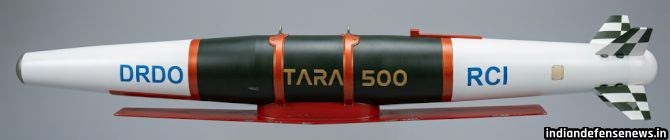
DRDO’s TARA sits in a unique position among global precision glide kits: it is cheaper and scalable compared to JDAM, SPICE, and AASM HAMMER, while offering competitive range and accuracy.
Its affordability and indigenous design make it a “workhorse” solution for India, though it lacks the advanced seeker diversity of SPICE or the rocket propulsion of HAMMER.
TARA is a modular glide kit developed by DRDO to convert unguided bombs into precision-guided munitions. It offers a stand-off range of 150–180 km depending on release altitude, with accuracy under 3–5 metres CEP.
It uses GPS/INS navigation with electro-optical or infrared seekers for terminal guidance. The system is designed for integration with Jaguar Deep-Penetration Strike Fighter, Su-30MKI Frontline Jet, TEJAS indigenous light jet, and advanced Rafale aircraft, enabling India to leverage its large stockpile of conventional bombs.
Its cost is estimated at around ₹25 lakh per kit, making it 6–12 times cheaper than imported SPICE kits and significantly more affordable than JDAM-ER or HAMMER.
The American JDAM is a tail-kit guidance system that converts bombs into smart weapons with GPS/INS navigation. Its baseline range is around 24 km, but the JDAM-ER variant extends this to 70–80 km using glide wings. JDAM is inexpensive at around $24,000 per kit, but its reliance on GPS makes it vulnerable to electronic warfare. It is optimised for mass deployment in permissive environments.
Israel’s SPICE family, particularly SPICE-1000, provides advanced electro-optical scene-matching guidance, GPS/INS, and man-in-the-loop capability.
It has a range of 100–125 km and accuracy of about 3 metres CEP. SPICE is highly effective in GPS-denied environments and against camouflaged or moving targets. However, it is expensive, costing several crores per kit, and is best reserved for high-value strikes.
France’s AASM HAMMER is a modular kit with rocket propulsion, giving it a range of over 70 km even from low altitudes. It offers multiple guidance options: GPS/INS, infrared, and laser, with accuracy down to 1 metre CEP. Its rocket booster allows survivable launches from low-level terrain-masked profiles, making it highly versatile. However, it is costly, at around €200,000–300,000 per kit, and is more complex than JDAM or TARA.
JDAM is mass-use, low-cost, GPS-dependent, and shorter range. SPICE is high-end, multi-mode guidance, expensive, and excellent in GPS-denied environments. HAMMER is rocket-propelled, versatile guidance, costly, and effective at low altitude. TARA is indigenous, ultra-low cost, scalable, competitive in range, but limited in seeker diversity compared to SPICE or HAMMER.
Comparative Assessment
JDAM: Mass-use, low-cost, GPS-dependent, shorter range.
SPICE: High-end, multi-mode guidance, expensive, excellent in GPS-denied environments.
HAMMER: Rocket-propelled, versatile guidance, costly, effective at low altitude.
TARA: Indigenous, ultra-low cost, scalable, competitive range, limited seeker diversity compared to Spice/Hammer.
TARA’s strength lies in affordability and scalability. It allows India to field thousands of precision weapons at a fraction of the cost of imports, sustaining prolonged conflicts and enabling high-volume strikes.
Capability-wise, it sits between JDAM and SPICE/HAMMER: more advanced than JDAM in range and accuracy, but less sophisticated than SPICE or HAMMER in seeker options and propulsion. For India, this balance of cost-effectiveness and indigenous production makes TARA strategically invaluable.
IDN (With Agency Inputs)
