

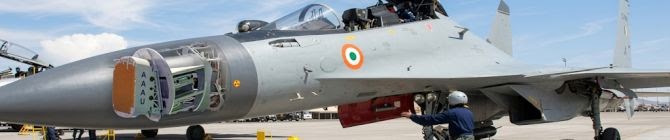
India’s ambitious Super Sukhoi modernisation program is progressing with steady momentum, marking a decisive step in the evolution of the Su-30MKI fleet. At the heart of this initiative lies the indigenous Virupaksha Active Electronically Scanned Array radar, which is now firmly on track for its first pre-production batch by late 2026.
This milestone reflects years of sustained research and development aimed at ensuring the Indian Air Force’s frontline fighters remain technologically competitive well into the coming decades.
The radar has been developed by the Defence Research and Development Organisation’s Electronics and Radar Development Establishment, a premier laboratory specialising in advanced sensor systems.
The Virupaksha has successfully passed its critical “First Light” evaluation, a process that validates the radar’s ability to transmit and receive signals effectively. This achievement confirms that the system is ready to move beyond laboratory trials and towards integration with operational platforms.
The Su-30MKI, which forms the backbone of the Indian Air Force’s combat fleet, has long been recognised for its versatility and endurance. However, the aircraft’s older Russian-origin Bars passive radar has increasingly struggled to meet the demands of modern aerial warfare.
The Virupaksha AESA radar is designed to overcome these limitations by offering extended detection ranges, enhanced resistance to jamming, and the ability to track multiple targets simultaneously. These capabilities will provide the aircraft with a decisive edge in contested airspaces.
The radar’s integration is expected to transform the Su-30MKI into a far more potent platform. With its advanced antenna repositioner, the Virupaksha can scan wide angles, effectively enabling the fighter to act as a mini-AWACS.
This will be particularly valuable in network-centric warfare environments, where real-time data sharing with airborne warning systems and ground-based radars is critical. The system’s ability to detect stealth aircraft at significant ranges will also bolster India’s defensive posture against emerging threats in the region.
The Super Sukhoi program itself encompasses a wide range of upgrades beyond the radar. These include new mission computers, digital cockpit displays, advanced electronic warfare suites, and integration of indigenous standoff weapons such as the Astra MK-III air-to-air missile and the BrahMos supersonic cruise missile.
Together, these enhancements will elevate the Su-30MKI to a 4.5-generation standard, ensuring its relevance in future combat scenarios dominated by drones, loyal wingmen, and sophisticated electronic warfare systems.
The successful progress of the Virupaksha radar underscores India’s growing self-reliance in defence technology. By reducing dependence on foreign suppliers and developing indigenous solutions, the country is strengthening its strategic autonomy.
The radar’s development also highlights the increasing role of Indian industry in producing cutting-edge systems, with private and public sector firms collaborating to meet ambitious timelines.
The completion of the First Light evaluation marks a turning point in the radar’s journey. As pre-production units are readied by late 2026, the focus will shift towards flight testing and eventual mass production.
Once integrated into the Su-30MKI fleet, the Virupaksha AESA radar will redefine the aircraft’s operational capabilities, ensuring that India’s air dominance strategy remains robust in the face of evolving challenges.
Agencies
