

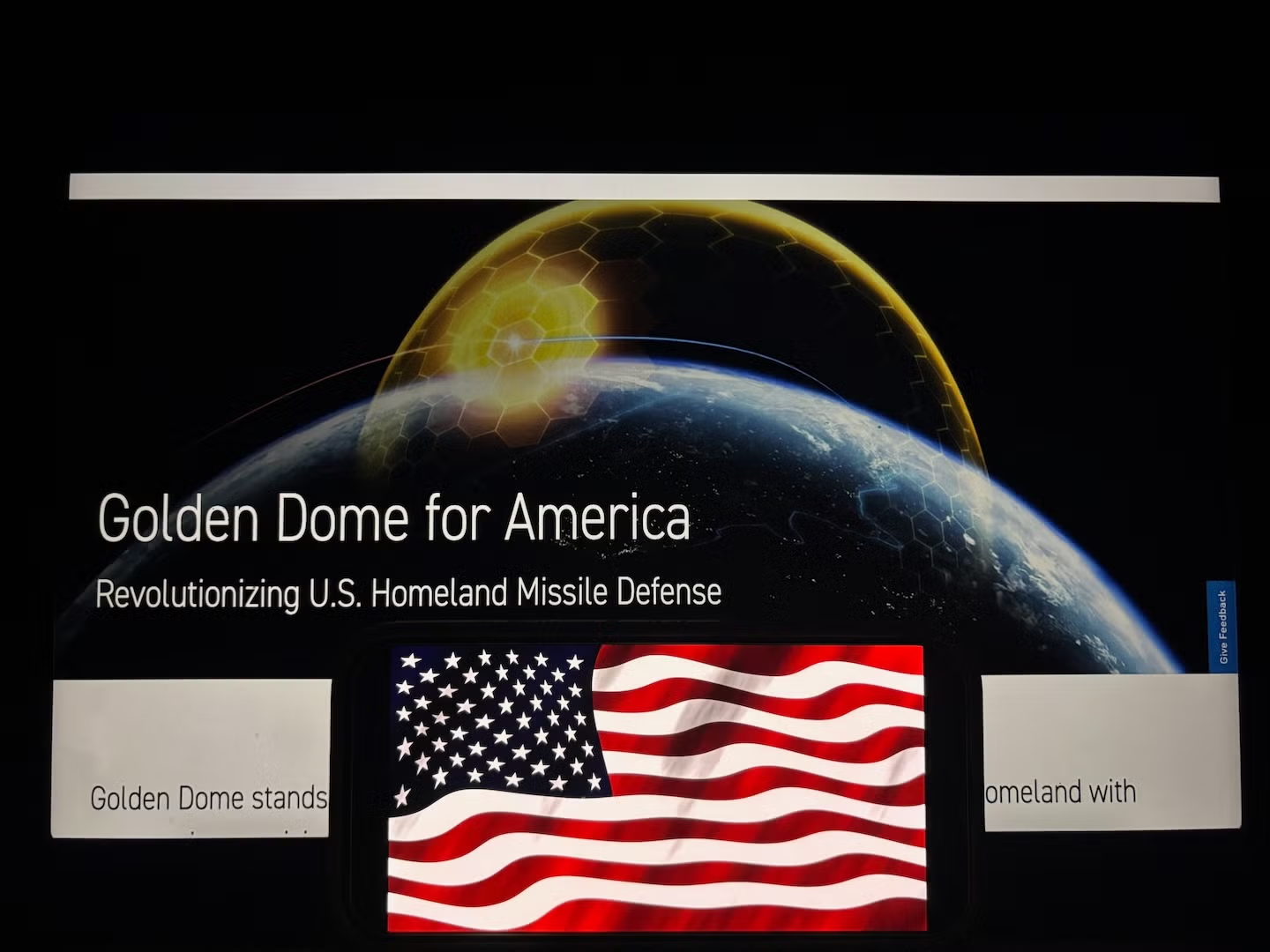
On 24 March 2026, James Obrien, a US Space Command official, was asked whether Golden Dome – America’s planned multi-layer missile defence system – could function without space-based computing. His response, “I don’t see it without it”, captures the often-overlooked importance of orbital AI computing in national security.
In January 2025, Donald Trump signed the executive order authorising America’s space-based “Golden Dome” – an orbital, multi-layered digital shield designed to detect, compute, and intercept advanced missile attacks within orbit – replacing the existing process of beaming raw radar data from space back down to ground stations on Earth, which wastes valuable seconds. Golden Dome’s core idea, intercepting threats before they reach American soil, is not a 2026 invention. It is the resurrection of a Cold War initiative that never fully died.
The Cold War blueprint
The military origin of orbital datacenters dates to the Cold War. Ronald Reagan announced, in March 1983, the Strategic Defense Initiative (SDI): a three-tiered system: space-based killers – satellites equipped with high-energy lasers, chemical lasers, neutral particle beams, and small kinetic missiles; global sensor mesh – ground, air, and space-based radar and infrared optical systems to track nuclear warheads; and terminal defence – ground-based interceptors located near American cities.
By 1986, physicist Lowell Wood and Edward Teller developed the idea of “Brilliant Pebbles” – thousands of small, autonomous satellites with onboard computing, as ground trips were too slow. This concept became a serious proposal to the Defense Acquisition Board by mid-1987 and shaped the framework for the current Golden Dome. After the collapse of the Soviet Union in 1991, “Brilliant Pebbles”/ SDI was cancelled.
From SDI to SDA
Elements of the concept re-emerged in 2019 after Mike Griffin, who previously worked on SDI/Brilliant Pebbles, established the Space Development Agency (SDA). Griffin’s rationale was that hypersonic weapons are “thermally dimmer” than ballistic missiles and can only be tracked by low-flying satellites.
Griffin’s argument was theoretical in 2019. Seven years on, China and Russia’s weapon enhancement has made this initiative a necessity.
The hypersonic problem
China, the US’s top global competitor, as of March 2026, increased its national defence budget by 7%, now exceeding $282bn for the 2026 fiscal year, and the direct investment into sea-skimming hypersonic missiles capable of flying at Mach 5+ just above the ocean surface – making early radar detection extremely difficult.
The DF-17 hypersonic missile was publicly demonstrated in June 2026, showing its ability to manoeuvre mid-flight, making it difficult for traditional missile defences to track and intercept. In parallel, the Kremlin announced, in April 2026, an industrial target for assembly lines to produce 1,000 hypersonic weapons annually. Western and Ukrainian intelligence estimate Russian factories will produce 10-15 Kinzhal hypersonic weapons monthly by mid-2025. The Kh-47M2 Kinzhal can reach Mach 10 and carry nuclear warheads. Increased international investment in national defence solidifies the importance of America’s orbital computing program.
The Golden Dome is split across three foundational layers, understanding the urgency requires defining what the shield is composed of.
Three layers, one system
The Golden Dome splits across three foundational layers: the sensor layer – core contractor proposals submitted to the Pentagon pitch a fleet of 400 – 1,000+ tracking satellites in low orbit; the interception layer – an addition of 200+ space-based attack satellites armed with missiles or lasers; and full scale expansion – the Congressional Budget Office (CBO) outlines that to intercept simultaneous, high-volume missile raids, it would require a constellation of up to 7,800 satellites.
The trillion dollar argument
Cost estimates vary widely, hinging on the cost of space-based computing and how often low-orbiting satellites need replacing due to atmospheric drag. On average, low-Earth orbit (LEO) satellites last five to seven years. The White House put the total at $175bn, completed by the end of Trump’s term; the CBO estimated $1.2tn over 20 years, approximately $1tn for acquisition, 70% of which builds the space-based interception layer (7,800 satellites), and the remaining $200bn is the estimated operating costs over 20 years. Michael Guetlein, Golden Dome program director, publicly disputed CBO’s estimated costs, saying “they’re not estimating what we are building”. Guetlein argued that CBO relied on outdated legacy architectural assumptions.
Industry takes the lead
The U.S. has decided to solve this issue through private industry rather than in-house. In late 2025 and early 2026, the Space Systems Command (SSC) awarded 12 companies 20 Other Transaction Authority (OTA) contracts worth $3.2bn to rapidly develop space-based missile defence systems. SpaceX alone has received an additional $6.45bn in direct Golden Dome development awards: $2.29bn, awarded in May 2026, for SpaceX to build the Space Data Network backbone – the shield’s communication layer – and $4.16bn, also in May 2026, for the Space-Based Airborne Moving Target indicator (SB-AMTI), which tracks foreign aircraft and missiles.
One company, every layer
SpaceX’s position is unusual even by Golden Dome’s already crowded contractor list. Other companies are each building only one part of the architecture; Northrop Grumman has committed to building 150 satellites for the Space Development Agency’s proliferated tracking architecture; Lockheed Martin, the world’s largest defence contractor by revenue, has tasked itself to build the space-based interceptor – the program’s hardest component – by 2028. While SpaceX is the only company building across the stack. It is building the space-based data network – communications backbone connecting every sensor and interceptor. It is constructing the SB-AMTI tracking layer. And through Starlink and Starshield, it already operates the largest constellation of satellites in orbit. No other contractor on the Golden Dome list touches the sensor layer, the interception layer, and the underlying commercial computing case simultaneously.
