

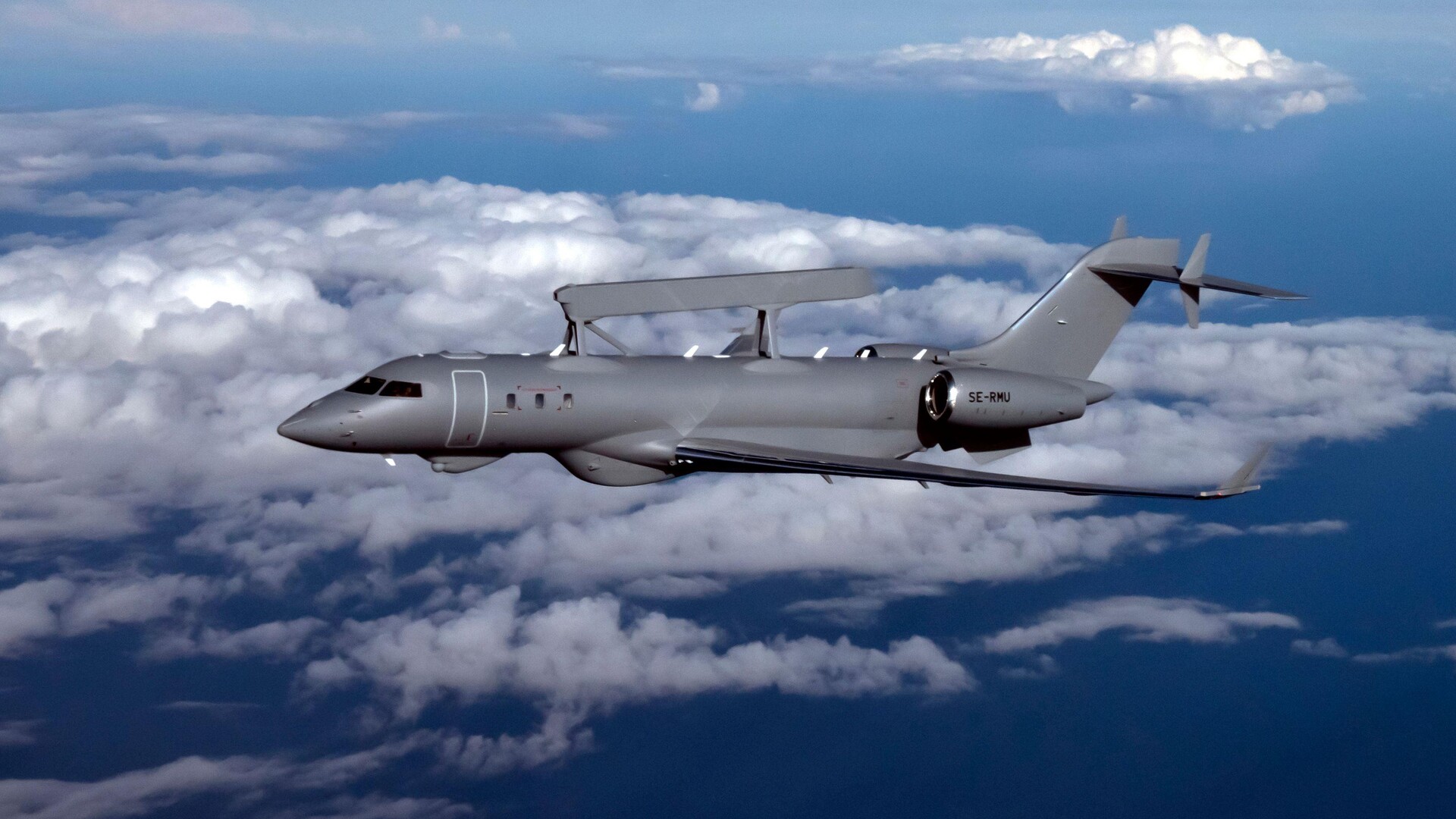
Saab delivered its first GlobalEye to the United Arab Emirates (UAE) in April 2020. The GlobalEye is the Swedish vendor’s airborne early warning and control (AEW&C) aircraft. Since then, Saab has worked through a growing list of new and prospective customers.
Sweden, the domestic user, has ordered three S106 GlobalEye aircraft under its 2025–2030 defence resolution. That order builds on an earlier pair already placed on contract. France followed with a December 2025 agreement for two aircraft, plus two options. The new French fleet will replace its ageing Boeing E-3F Sentry aircraft.
Canada has since entered formal negotiations for six systems of its own. Germany, Denmark, and Finland are each weighing the platform as well. Saab is also pitching the GlobalEye to its wider Erieye customer base. Should most of those operators convert, it will become the generation’s most widely deployed AEW&C system.
In an earlier analysis, Quwa discussed how Saab emerged as a leading defence integrator. Such an original equipment manufacturer (OEM) blends indigenous and foreign commercial-off-the-shelf (COTS) inputs into finished systems. Those inputs let Saab build cost-effective yet high-capability solutions at a competitive price. This piece examines how the GlobalEye became a preferred AEW&C choice across both markets.
Its Erieye ER radar sits at the centre of that story. The radar, like the original Erieye, reflects Sweden’s own radio-frequency (RF) development prowess. Saab’s integration expertise then turns that indigenous base into a finished, exportable product. Yet the platform’s success rests just as much on Sweden’s roots as a neutral power.
That neutrality fed a set of apt downstream features for the eventual end-user. These include proprietary tactical data links (TDLs) that a buyer can adopt nationally. They also include a design kept free of US International Traffic in Arms Regulations (ITAR). Both features, as the story below shows, have proven decisive in today’s market.
Solutions to Underserved, High-Demand Problems
When Saab developed the original Erieye, the AEW&C market was thin and underserved. For example, Western options ran almost entirely to the American E-2 Hawkeye and E-3 Sentry. Both platforms also came bundled with restrictive American export controls. Israel then followed with the IAI Phalcon, which widened the field somewhat.
That Phalcon let India, Chile, and Singapore each pursue an AEW&C capability. But the Erieye is what genuinely opened the wider export market. It drew NATO members such as Greece into the fold, while also reaching non-NATO operators in Brazil, the UAE, Pakistan, Thailand, and Saudi Arabia.
How Saab reached the Erieye is the more revealing part of the story. Two factors, above all, made that platform genuinely possible. The first is that Sweden already held a deep air-defence radar base, and that competence grew from decades of deliberate Swedish industrial strategy.
Ericsson Microwave Systems was founded in 1956 and later acquired by Saab in 2006. By then, it had supplied over 3,000 radar systems to more than 30 countries. Sweden’s Defence Materiel Administration (FMV) contracted that same house for the PS-890 Erieye in 1985. Saab’s phased-array airborne radar lineage now runs four decades deep.
