

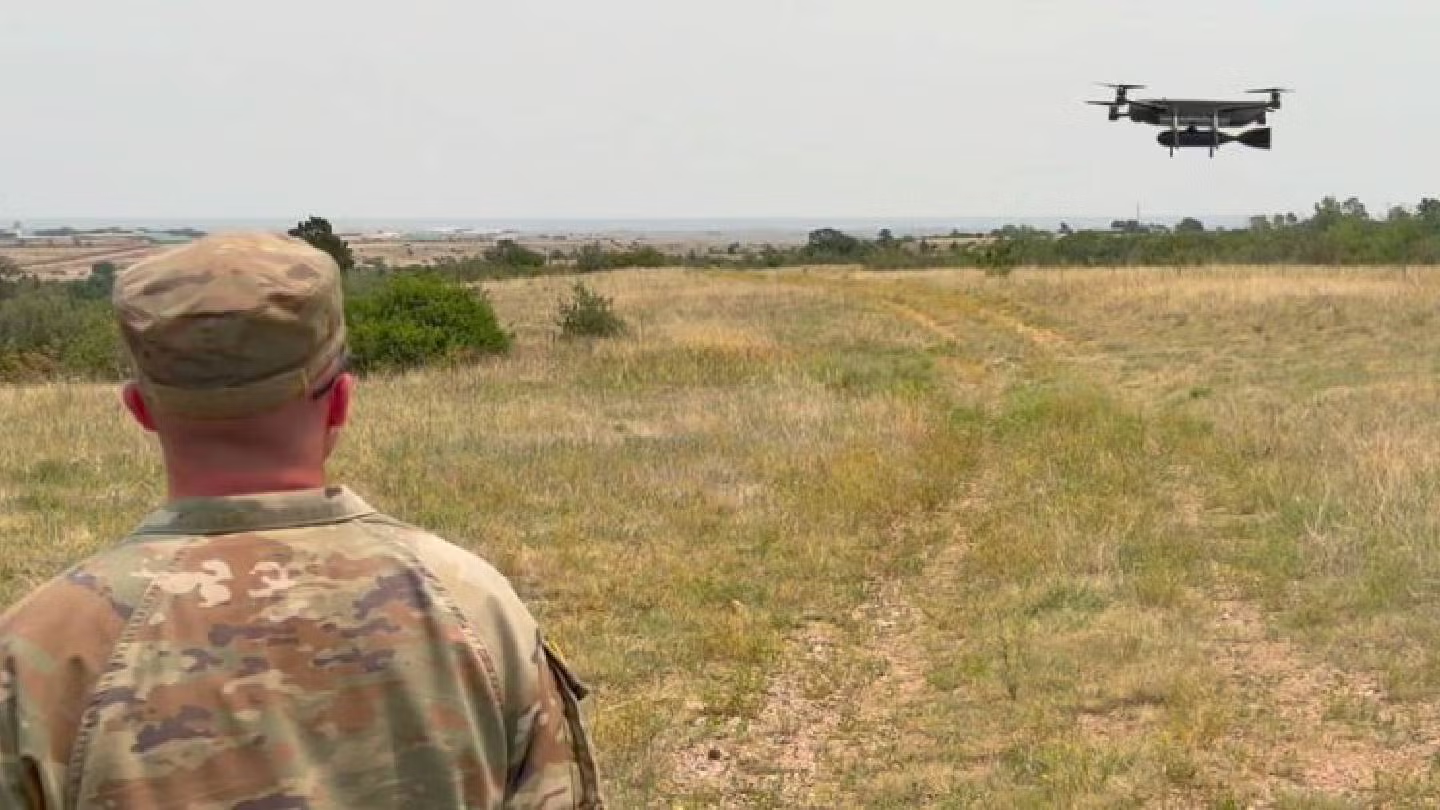
Palladyne AI has commenced work on a contract awarded by the US Air Force Research Laboratory (AFRL) to address coordination challenges among autonomous systems in defence operations.
The project, titled “Hierarchical Adaptive Networked Game-Theoretic Integration of Multiple Echelons (HANGTIME),” seeks to enable collective operation among platforms such as drones, ships, and satellites, which currently function largely in isolation.

Discover B2B Marketing That Performs
Combine business intelligence and editorial excellence to reach engaged professionals across 36 leading media platforms.
The initiative will apply Palladyne AI’s proprietary SwarmOS software platform.
SwarmOS, the defence-specific variant of Palladyne Pilot embodied AI software, is intended to serve as the foundational technology for linking diverse autonomous systems.
The aim is to allow these platforms to share information, adapt to dynamic scenarios, and coordinate activities across space, air, maritime, and land domains.
A novel aspect of HANGTIME is the planned integration of satellite systems, extending the reach of Palladyne AI’s technology from ground-based environments to orbital assets.
The company states that this approach is designed to boost decision-making speed and effectiveness, enhancing the ability of tactical commanders to access intelligence, surveillance, and reconnaissance (ISR) data from multiple sources.
Palladyne AI president and CEO Ben Wolff said: “Our collaboration with AFRL showcases what’s next for autonomous operations. This isn’t about replacing humans—it’s about giving them sharper, faster insight.”
Palladyne AI received this AFRL contract following earlier awards to conduct research, development, and operational validation of SwarmOS and Gremlin-X alongside US Army personnel.
Under these contracts, the company is expected to demonstrate both SwarmOS and Gremlin-X during multiple exercises with the US Army 4th Infantry Division (4ID) in locations across Colorado and California.

