

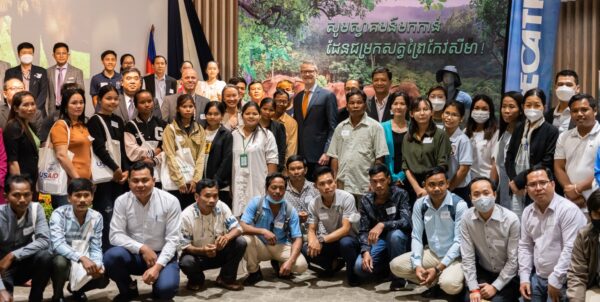
When a team from the U.S. Embassy in Phnom Penh was finally able to meet with the Cambodian government to discuss USAID’s closure in late June 2025, five months after funding was halted, it was clear that their Cambodian counterparts were not happy. Given the complicated history between the two countries, the relationship had experienced ups and downs. But the abrupt halt of development assistance, with no communication for months, was unprecedented.
According to a former member of the U.S. in-country team, Chris Jones (a pseudonym to preserve anonymity), Cambodian officials mentioned the “challenges” caused to Cambodia’s national development goals when a key donor like USAID pulls its funding. According to one senior Cambodian official who spoke to Jones, the timing was particularly difficult as the loss of such significant funding occurred only two months into the Cambodian fiscal year.
While these statements may seem mild, anyone familiar with the language of diplomacy knows that this is about as real as government representatives get in official meetings. One Cambodian I spoke with, Boreth Sun, an expert with over 30 years of experience in the international development sector, was more blunt. “It is abandonment” of Cambodia by the U.S. “all over again,” he said.
Jones’ recounting and Boreth’s reflection echoed through other conversations I had in early 2026. While the shutdown of USAID was seen by officials in Washington as a means of stopping waste and fraud, it was something quite different on the ground in Cambodia and elsewhere around the world.
For decades, USAID funding has been an anchor for community-based development initiatives in Cambodia across a range of issues, including public health, education, environmental protections, agricultural development, democracy building, and human rights. The abrupt withdrawal of funding, the firing of dozens of employees, and the cessation of countless programs felt, according to former USAID employee Mongkol (also a pseudonym) “like an earthquake.”
The seismic waves resulting from the closure have created both direct and indirect effects, many of which continue to emerge one year later. The lingering impact, in ways both predictable and not, has created a real sense of uncertainty about the future of sustainable, social justice-driven development in Cambodia.
Closure Amid Chaos
When Donald Trump was sworn in as U.S. president on January 20, 2025, no particular alarm bells went off at USAID. According to Jones, every new administration reviews existing policy and sets out new priorities. Career foreign services officers know and expect this, and despite the rhetoric of the campaign, no one anticipated what was coming.
Within a week, however, it became apparent this time was going to be different and that those working within the administration “did not understand how [USAID] worked or even what the agency actually did,” as Jones put it.
Issued on inauguration day, the Executive Order Reevaluating and Realigning United States Foreign Aid froze all foreign aid for 90 days while all relevant programs underwent a review. During this time, the administration repeatedly claimed that USAID was rampant with “waste, fraud, and abuse,” though reports have consistently shown this not to be the case.
The January 20 executive order was followed four days later by a stop-work order that applied to all employees of the agency while DOGE – the self-styled “Department of Government Efficiency” – began its review to, in their words, “maximize efficiency and align operations with the national interest.” During this period, career service officers were put on administrative leave and still paid, but local employees and contractors lost their salaries.
On March 10, only six weeks after the initial review began, the secretary of state announced an 83 percent funding cut to USAID and the termination of 5,200 contracts. The Cambodian office was closed, affecting more than 100 American and Cambodian employees.
Communication and information from Washington were practically non-existent and no guidance was provided on what would happen to ongoing work, how to apply for a waiver for life-saving programs, or even when people were expected to pack up their offices. Moreover, due to a gag order, senior USAID officials were prevented from speaking to both members of the Cambodia government and their contractors and grantees to explain what was happening. Everyone was left in the dark.
By July 2025, USAID in Cambodia had been completely dismantled, with the few remaining programs moved under the rubric of the State Department. What used to be a department housing over 20 Americans and dozens of Cambodians with specialized expertise was reduced to two foreign service officers with no prior experience with international development aid, public health, or project management.
The $98 million provided in 2024 to cover a wide range of projects has been slashed to $5 million for landmine and UXO clearance and $45 million to be split between Cambodia and Thailand for border security and other issues related to the cessation of hostilities between the two countries.
Nicholas Enrich, who at the time was the acting administrator for USAID Global Health, sent a memo to all employees in early March stating that the government’s actions “will no doubt result in preventable death, destabilization, and threats to national security on a massive scale.”
Immediate Shocks
While Cambodia has never been the largest recipient of American aid, USAID had been the dominant player in international development assistance to the Kingdom since 1992, providing over $1 billion in development aid. According to several of the Cambodians I spoke with who worked with USAID, the organization was the single largest provider of development assistance within the country, by far.
Within two months of the issuance of the executive order, however, the USAID programs in Cambodia were canceled. The sudden loss of funding left many organizations feeling betrayed and, according to Jones, the chaotic way the entire process was handled – on an unrealistic timeline and with no real information coming directly to the people on the ground – created a real sense of disbelief that this was happening. The lack of clarity, compassion, and understanding on the part of the U.S. government for how USAID actually worked was extremely dangerous and could “cause people to die,” Jones said.
Health and environmental programs were hit particularly hard. Those who worked on USAID’s public health projects immediately raised the alarm over the danger the loss of funding posed for a number of life-saving public health programs, including initiatives addressing tuberculosis, malaria, dengue fever, and HIV/AIDS. While the administration indicated that waivers would be available for life-saving public health programs, according to Jones, no clear guidelines on how to apply or what would merit a waiver were forthcoming at the time. Jones indicated that it also seemed like DOGE was searching for any program that contained words the administration did not like (such as anything related to climate change or DEI), and those programs were defunded, whether they offered life-saving treatments or not.
On the environmental side, one defunded program, the Wonders of the Mekong, had just completed a key study tracking fish species on the Mekong to highlight the need for better environmental protections and to ensure the long-term health of one of the most important waterways in Southeast Asia. Zeb Hogan, one of the leads on the project, summed up the sentiment of many development workers in a recent interview: “The U.S. was a leader in this space and doing really important work. … All of that work was just stopped overnight. And the way it was done was impossible to plan for and very difficult to recover from.”
The list of other programs that were immediately and adversely affected by the abrupt halt of funds is long, and crosses the spectrum of development issues, including $39 million in cuts to literacy and digital literacy programs, $7 million for teacher training, $24 million for Feed the Future, and $12 million for civil society building.
At the time of the closure of USAID, Mongkol was “working on projects aimed at helping smallholder farmers … unlock markets for their products.” The end of the financial assistant, Mongkol said, likely means that for most of those farmers, access to these new markets will close again.
The shuttering of USAID also left many unemployed. According to Jones, this included approximately 20 other Americans working in Cambodia, most of whom have since left the country. Both Cambodians interviewed for this piece who were working at USAID in early 2025 were let go, as were the approximately 50 other Cambodian employees. But the direct hire employees are not the only casualties. While specific numbers are not available, USAID funding supported the jobs of hundreds of people in local NGOs and community groups working on project implementation, many of which have now been forced to end operations.
“When USAID closed, everything closed,” Mongkol said. “There are ripple effects … all the people associated with those projects are affected, and then people in their communities are affected … and it kind of goes outward, and outward, and outward.” He described the sudden closures as a shock that “felt personal.”
While the immediate economic and personal impacts were significant, the continued aftershocks truly highlight the damage done by the administration’s actions. According to Boreth, the work USAID was doing can’t be replaced, and “this void … it’s exacerbated by all the implications where the U.S. has retreated … thus the ripple effect goes beyond USAID closure.”
The Donor Void
One year after USAID’s demise, no one has stepped in to fill the void in development assistance funding. While concrete numbers are difficult to come by, the Cambodians I spoke with who worked with USAID estimate the number of people still unemployed after their termination is still very high.
At the time of our interview in February 2026, Mongkol estimated that only 30 percent had found a new job. While some, like Mongkol and Prathna, a conservation expert who worked with USAID for over 20 years, have been fortunate to find new positions in their field, it is often as contractors, rather than employees, and the salary and benefits are less.
“The closure of USAID highly affected my job and family, while I need to pay for the children’s school fees and daily living,” Prathna shared. “I can get a new job, but local NGOs or private companies have lower benefits compared with international NGOs or companies” like USAID.
Mongkol, who is now working with the United Nations in Cambodia, added that the impacts have been psychological as well as economic, given how challenging it is to find a job in Cambodia right now. Recounting his own experience, he said, “With the primary income source suddenly severed … [t]he home that was supposed to be a sanctuary now felt like a financial ticking clock.”
Many of those who lost their jobs have not been able to find work in their fields and even the Americans have had trouble. According to Jones, only three of the American USAID staff have remained in Cambodia. While others have found related work in the region, many had no choice but to leave the country to find new positions, taking their network connections and years of expertise with them.
Many thought that China would step in to take USAID’s place. While China has close economic ties to Cambodia, both Beijing’s approach to international assistance is very different from that of USAID. China’s aid policy, saud Mongkol, is to work with the government rather than grassroots groups. Chinese financial assistance is also most often in the form of loans directed toward large-scale infrastructure projects, rather than grants that support more community-focused health, education, human rights, and environmental initiatives.
According to Jones, China occasionally promises to fund more grassroots efforts, but funds often don’t come through. Jones further noted that China is neither particularly good at coordinating projects with other donors, which is often needed to effectively carry out the work, nor is it one to contribute to programs related to political conditions, human rights, or democracy, which was a key part of USAID’s efforts. This is a significant loss for the NGOs and members of Cambodia civil society that were working to make improvements in these areas with the assistance of USAID funding.
Others believed that Europe would fill the void, given its similar focus on more grassroots efforts centered on economic, social, environmental, and political development. However, this has not occurred. Instead, European countries, facing an increasingly uncertain security environment, have also been pulling back on international aid to the region.
Boreth, who has worked with many different international aid agencies over the course of his career, summed up the situation: “There are sentiments among development workers here about the rise of ‘Europe First’ also and we are bracing for potential cuts there as well.” He continued, “And the silence of China’s commitment clearly scares lots of us…. So there are no knights coming to rescue us.”
Mongkol concluded: “There is no other country that can jump in at all, even China… with as much as USAID.”
The absence of donor aid on the scale provided by USAID continues to impact dozens of local NGOs. For example, Prathna was working on a project called USAID-CONSERVE, which provided financial and technical support to community groups across Cambodia to help them protect their natural resources and improve livelihoods. After the halt to funding, they carried on as long as they could, but Prathna confirmed that, to date, no other donors have stepped in to fill the gap and the projects have been forced to close.
The reality is, according to the Cambodians I spoke with, that the international aid network often seeks out bigger projects, or projects run by bigger NGOs or the more well-recognized international NGOs. In a country like Cambodia, grassroots groups, especially in the more rural part of the country, are often not on the radar. USAID had been an exception to that, and the loss for community groups is tremendous.
“USAID funds are vital to conserve and protect Cambodia’s … biodiversity, natural resources, and to mitigate climate change,” Prathna said. Their loss will negatively impact economic growth and increase pressure on “natural resources and human capacity development in Cambodia” for a long time to come.
Broken Trust
From its arrival in 1992, USAID had been at the forefront of rebuilding the relationship between the Cambodian people and the United States. This was no small feat given the role that the United States played in Southeast Asia from the 1950s to the 1980s: secretly bombing Cambodian territory during the Vietnam War, supporting the coup in 1970 against Prince Sihanouk by Lon Nol, and targeting communist forces within the country – all of which drove thousands of Cambodians to support the Khmer Rouge in its claim to be standing against the forces of the West.
Despite the damage wrought to the country during the Khmer Rouge period and the subsequent decade of war with Vietnam, the work of USAID helped Cambodia rebuild, while making inroads in improving sentiment towards the United States. According to Mongkol, the long history of USAID in Cambodia is important, for both countries, but especially for Cambodia. And while the relationship between the Cambodian and U.S. governments has never been particularly close, for decades the Cambodian government did not actively dismantle USAID-supported programs related to human rights and democracy-building.
USAID played a key role in “shaping diplomatic relations” between the two countries – which is why the Cambodians I interviewed said the agency’s closure has created a real sense of betrayal. It marks a significant setback in Cambodia-U.S. relations.
The interwoven networks of experts, community leaders, and local activists that were established over decades, and formed the backbone of much of the justice and development work in Cambodia, have been irreparably broken. In the world of international development, particularly at the grassroots level, the work is only as successful as the relationships that you build. As Jones summarized at the end of our interview, there is so much of the kind of work that USAID did that is about “building relationships over time,” and when those who built them are suddenly gone, “it can be very hard to rebuild.”
Mongkol echoed this thought and said that for many people the closure was “kind of like the end of the world.”
Loss of Opportunity
USAID’s sudden closure also bulldozed paths of opportunity for many Cambodians, particularly women and those from marginalized groups. Cambodia is a country that remains largely patriarchal in nature, particularly outside of the main cities. A recent United Nations study found that only 27 percent of middle and senior management positions in Cambodia are held by women, even though women make up a “significant portion” of the workforce. Another study by U.N. Women ranked Cambodia 152nd out of 182 countries for women’s representation in parliament.
In recent years, however, one area where there was steady growth of diversity in leadership positions was the international aid sector. Aid agencies, including USAID, have provided two different tracks of opportunities for women and other groups in Cambodia. First, they offer education, training, and leadership programs that help people develop their own careers. USAID, for example, sponsored the WE Act program to build female entrepreneurship, the Strategy on Global Girls’ Civic and Political Participation to train women for leadership roles in civil society and politics, and encouraged the presence of a diverse array of people in leadership roles in programs supporting agriculture, food security, and environmental protections.
Second, these organizations hire local women, as well as men, to fill needed positions. This not only creates paths for women to grow in a workplace culture that is different from the traditional Cambodian one, but also situates men within this same workplace culture, providing opportunity for their perspectives to change as well. While there can be problems with importing “Western” workplace culture along with international aid, it can have the benefit of offering more opportunities for a wider variety of people and the potential to shift dominant cultural attitudes.
When I asked Chanda (a pseudonym), a Cambodian woman who has worked in a variety of development positions over the years, including with USAID, whether the loss of USAID has the potential to negatively impact the progress of women moving into leadership positions, she unequivocally said “yes.”
Another group that has been negatively impacted by the demise of USAID is young people. Not only is this group likely to be more adversely affected by closure of programs related to education, training, and health, as well as the loss of job opportunities, but there is the very real possibility that U.S. actions have created another generation of young people who see the United States as an enemy rather than a friend.
For Boreth, who was a teenager during the period of the Khmer Rouge, the betrayal felt among Cambodia’s youth today as a result of the abrupt closure of so many programs has some parallels to that period of Cambodia’s history. He reflected that, in some ways, it feels “just like 1975” when the U.S. abandoned Cambodia leading to the fall of Phnom Penh and the arrival of the Khmer Rouge. While he acknowledged that the current situation is “not as dramatic,” he believes there is a similarity for young people in that their “window to the world … is closed” and “lives shattered.” This kind of betrayal and loss of hope can linger for generations.
“The casualties of hope and belief that America as a beacon of liberty is more devastating in the longer term,” Boreth said.
The Future of Development in Cambodia
The sudden loss of this aid has created myriad challenges likely to stymie the years of progress that have been made across the range of programs USAID supported. As Chanda put it, “The skills, local partnerships, systems, and experience built under those [USAID] projects remain. But [the closure and loss of funding] did seriously damage the momentum and reduced the scale of benefits, because many activities and services stopped suddenly.”
But with loss does come the possibility for opportunity, and we are already seeing efforts by the NGOs and civil society groups left standing to find new ways to continue their work. According to Mary-Collier Wilks, an expert on power dynamics in international foreign aid: “[W]ith USAID’s death blow to the previous world order of U.S. hegemony, regional development imaginaries are increasingly prominent in the changing foreign aid order. Within this new order, Cambodians are strategically cultivating new donors to create innovative aid projects as well as trajectories for themselves and their nation.”
Jones agreed that this is a moment, perhaps, to fix some of the things that were wrong with the old system. But he wondered at what cost this opportunity for change has come and whether the broken relationships can ever be mended.
There does remain, among some development workers, a small amount of hope that USAID will return in some form. After all, there seems to be no other country or entity that is able or willing to fill the agency’s shoes.
At the end of our interview, Prathna shared his memory of the day he found out he was losing his job: “I remember feeling a mix of shock and concern, but also a quiet sense of reflection about the contribution I had made and communities I had supported. As the initial emotions settled, I began to see it as turning point, an unexpected but important moment that challenged me to stay resilient, reassess my path, and prepare for a new opportunity.”
He continues to hope that “we can improve Cambodia’s economic situation, biodiversity and natural resources preservation, and reduce global climate change risk together again with USAID support soon” because it has a “hugely positive impact to Cambodia.” However, Prathna also will work to develop new paths for his work in conservation, natural resource management, and climate change mitigation.
Given the current political climate, both in the United States and globally, it is impossible to predict what the future of aid might look like. But Mongkol, who continues to work in the agricultural sector helping small farmers, remains optimistic that USAID in some form, will return. He ended our interview by saying: “My heart is still with USAID and I hope this agency will be back one day.”
