

2025 was Cambodia’s hardest tourism year in a decade. International arrivals finished at 5.57 million, down almost 17 percent on the previous year, with a 43 percent fall in December. The slide has carried into 2026: arrivals for the first five months were down 47.8 percent year-on-year, and May, at 232,000, was the weakest month yet.
The border conflict with Thailand prompted foreign travel advisories and cancellations across every market. A separate reputation problem, the country’s association with cyber-scam compounds, did real damage in Asian markets too. Prime Minister Hun Manet has pointed to safety fears as the main driver of the downturn and described the scam operations as a black economy undermining the country’s legitimate one. None of that is in dispute.
What’s less understood is that the damage is concentrated where it matters least, and that the one part of Cambodia’s tourism that needs fixing is also the easiest to fix.
Take the scam centers first, since they did the most reputational harm. In mid-2025, the government announced a crackdown on scam compounds, and in April of this year it passed a dedicated anti-scam law. The crackdown has not yet reached all known scam compounds, so the honest reading is that the job is not finished yet. But the direction has been set and the crackdown is being pursued publicly, which may help alleviate foreign visitors’ safety concerns.
The border tensions, however, have not eased, and this is an issue largely beyond Cambodia’s lone control. The crossings have been shut for a year, and as recently as June, Prime Minister Hun Manet told Thailand there was no need to discuss reopening them. Yet the damage is lopsided. In the first five months of 2026, land arrivals to Cambodia fell 68 percent, while air arrivals, the visitors who fill hotels and restaurants, fell by just 20 percent. In other words, the traffic Cambodia lost is the traffic from which it earned the least.
It is also worth noting that the headline land arrivals figure counts every border crossing, so a large share of the total is made up of traders, day-trippers, and members of the Cambodian diaspora rather than holidaymakers booking a week in a hotel. The real prize, high-value leisure travel, has been relatively untouched.
For all the noise of the past year, Cambodia’s tourism has one structural weakness: its overdependence on Angkor Wat. The country needs to embrace the opportunity to tell the world of all the other reasons to come.
The Cardamom Mountains contain one of the largest intact rainforests in Southeast Asia, with wildlife Thailand and Vietnam cannot match. Ratanakkiri has volcanic crater lakes and indigenous communities that barely register on the international radar. Phnom Penh’s food scene has in recent years become one of the region’s most interesting; the Financial Times ran a long feature on it this year, as Khmer cuisine began getting restaurant-level attention.
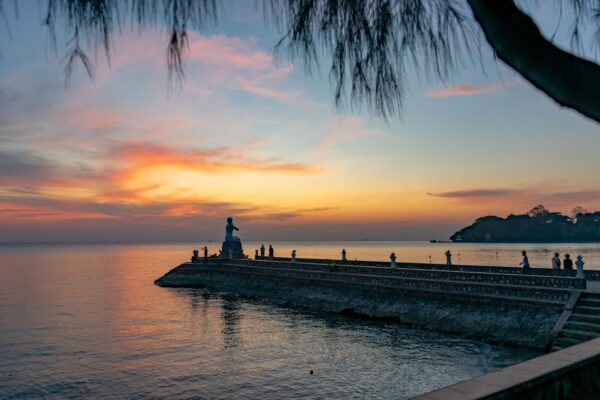
The country’s coastal locations – Kampot, Kep, and the various islands – remain quiet, affordable and genuinely beautiful. Cambodia’s history also offers more than Angkor. The dark legacies of the Khmer Rouge period draw a thoughtful, engaged traveler who stays longer, spends more, and tells people at home.
Cambodia has plenty of attractions but has so far struggled to let the world know about them.
What the country needs is a properly resourced tourism board with a mandate to promote the country internationally. Thailand offers a good example. The Tourism Authority of Thailand (TAT) is slated to spend roughly $140 million on 22 strategic initiatives in 2026 alone, with public targets and a single coherent story, this year’s being “Healing is the New Luxury.” It seeks to steer visitors beyond popular sites like Bangkok and Phuket, toward Mekong cruises, themed trains, and a “Hidden Gem Cities” campaign that pushes people toward Sukhothai and Phetchaburi, so the country never becomes hostage to one or two destinations.
The Cambodia Tourism Board, created in July 2024 to run promotions with private-sector involvement, isn’t standing still. In May 2026 it launched a “Visit Cambodia in the Green Season” campaign, aimed at stretching the tourist season past the usual November-to-March peak. In June 2026, it established a visa-free arrangement with China, which seeks to expand the single largest tourism market. The board has signed an MoU with Visa for anonymized spending data to target high-value travelers, and at ITB Berlin 2026 it represented the country with a bigger, more visible stand.
What the board lacks is a proper budget. TAT’s international marketing runs to nine figures. The CTB’s promotional budget has never been made public. The missing ingredients are funding, a multi-year mandate, and the autonomy to run campaigns without waiting on the approval of the Ministry of Tourism.
There are seven obvious moves that the Board could make to reverse the fortunes of Cambodia’s tourism sector.
The first is to fix connectivity. Air arrivals in Phnom Penh were down more than 25 percent early in 2026, while Thailand and Vietnam aggressively courted low-cost carriers and opened new routes. A board with a proper budget could offer real incentives and help rebuild them. One initiative would be to underwrite a block of seats on a new route, then give them away as competition prizes. This would reduce the launch risk for the airline, while filling the plane with visitors who arrive ready to talk about Cambodia.
The second would be to put the Mekong on the map. The lower Mekong, the Tonlé Sap, the Irrawaddy dolphins at Kratie, and the four-rivers confluence in Phnom Penh are assets that Thailand is already seeking to market its own version of. A river circuit of this kind would need no new infrastructure, only someone to package the boat operators, guesthouses, birdwatching guides and fishing communities into something a travel agent in London or Seoul can sell.
Third, the government should own “dark tourism” properly. The Killing Fields and Tuol Sleng Genocide Museum draw hundreds of thousands of visitors each year, most of whom leave within an afternoon. A serious memory circuit linking Phnom Penh, and the provinces that are home to key Khmer Rouge memorial sites, tied to a reconciliation project and proper interpretation, would become a unique multi-day experience.
The fourth is to make Phnom Penh a regional base for remote workers and “digital nomads.” Bali, Danang, and Chiang Mai own this market now, but are crowded and getting more expensive. Phnom Penh has fast internet, cheap rent, real coffee culture, and a creative international community. A proper long-stay visa, a handful of co-working partnerships and a small, targeted campaign would cost almost nothing and generate organic word of mouth among Southeast Asia-based expatriates.
The government’s fifth goal should be to focus the media’s attention on Khmer cuisine. Vietnam owns pho, Thailand owns tom yam; amok, lok lak, and kuoy tiev are just as distinctive but almost unknown abroad.
Sixth, treat Kep’s derelict French villas and Kampot’s riverside shopfronts as an asset. This architecture doesn’t exist anywhere else on the Cambodian coast. A properly funded board could offer restoration grants or tax breaks tied to heritage preservation, protect Bokor Hill Station’s ruins, and set height and density limits before land prices make that politically difficult. Once buildings like these are gone, no marketing budget brings them back.
Finally, the authorities need to correct the safety misconceptions head-on. Much of the past year’s reputational damage was overblown. Phnom Penh is, by most measures, among the safest cities in the region for visitors, and the scam compounds that drove the headlines preyed on people contacted online from abroad, not on tourists visiting the country. A properly funded tourism board could put verified safety data, embassy briefings, and on-the-ground journalist visits to work, so that perception is brought into alignment with reality.
None of this is fanciful, and most of it would be cheap against the return. The expensive part – the product – is already present in Cambodia. For perspective: Croatia, population 3.9 million, draws 20 million visitors a year. Cambodia, which is far larger and home to one of the most recognizable heritage sites on earth, currently takes in a fraction of that. The gap between those two numbers simply reflects a lack of public awareness of what Cambodia has to offer.
The shocks of 2025 will pass. What decides the next decade is whether Cambodia funds the institution that turns its attractions into arrivals: hoteliers in Kampot, tour operators in Battambang, guesthouse owners along the coast all stand to gain from a board that can market the country. A Cambodia Tourism Board with TAT-scale backing, a real budget, a multi-year mandate and the freedom to act is the highest-return investment the country can make.
