

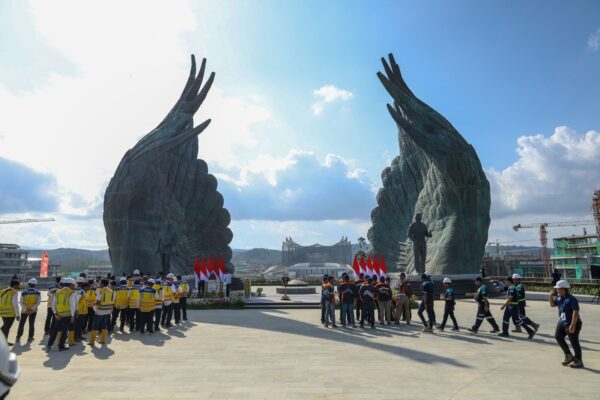
Countries these days (some of them) build shiny, new capitals for several reasons. Maybe the old one has grown so congested, polluted, or waterlogged that getting from A to B feels like sitting an MIT Engineering entrance test. Perhaps – and we don’t say this out loud – it simply doesn’t work; the city that is.
The other reason for packing up everything and moving it all to an inhospitable faraway place by caravanserai is that the political class, which often travels abroad – and not by camel train anymore – has become quietly ashamed of their capital.
The political classes of today dreams of destinations that call to mind classic science fiction. Think Naypyidaw in Myanmar, or Astana, the capital of Kazakhstan – just the names are redolent of Asimov in his prime.
Indonesia has been aiming to achieve both aspirational cities at once – but has since run out of money to finish the job.
Nusantara, the $32 billion new capital that will one day emerge from the steamy jungles of East Kalimantan, is the most visible expression of a country that has decided it can out-build its neighbors even while its currency is doing a flop-of-the-century act. Much of the gasp-eliciting work in the new capital has been done; for example, the Garuda Palace, which is topped with swooping golden eagle wings.
President Prabowo Subianto slept there overnight in January, in what was widely read as symbolic commitment to the project, but then the bean counters began to bean count.
The $32 billion was never supposed to be paid for by the state. The idea was that private investors – developers, foreign firms, sovereign wealth funds – would cover roughly 80 percent of the cost, or about $25.6 billion, with the government picking up the remaining fifth, for roads, water, the palace, and the ministries.
The Nusantara Capital Authority (IKN) reports around $13.6 billion in signed investment commitments, but only about $4 billion of that has actually been realized in construction – roughly 15 percent of the sum private capital was supposed to deliver.
Meanwhile the government’s own fifth has dwindled too: Indonesia’s own budget documents show the IKN allocation falling from roughly $2.7 billion in 2024 to about $390 million in the 2026 draft budget – an 85 percent cut.
The result is less a city where the roads have no names than a city that has no roads to begin with. Some 10,000 people – mostly construction workers and civil servants – toil out a distant existence there, far from the 1.2 million residents once promised. Dare it be said: in a ghost city.
Meanwhile Jakarta – polluted, gridlocked, and reportedly the fastest-sinking major city on Earth – carries on as the actual seat of government.
As a local quip has it, Indonesia has two capitals: one that’s drowning and one that’s a rumor.
Meanwhile, the Indonesian rupiah (IDR) has plummeted during the first half of 2026, and is currently among the worst-performing currencies on the planet. In June, it breached the psychologically loaded 18,000-to-the-dollar level, a level lower than during the height of the Asian financial crisis of 1997-98.
The government’s own policy responses have done little to instill confidence in the Indonesian economy. A new regulation forcing non-oil-and-gas exporters to repatriate and park all earnings in state-owned banks for a minimum of 12 months has been read by foreign investors as the kind of capital control that precedes a much bigger scramble for dollars. The creation of Danantara – a sprawling new sovereign wealth vehicle now consolidating stakes across state-owned enterprises – has added to the unease.
One Jakarta-based analyst put it more bluntly, arguing that the fault lies less with the central bank than with a government whose generous social spending and export mandates have spooked investors regardless of what interest rates do.
While Nusantara chases its 2045 deadline, the government has been pouring extraordinary sums into its Free Nutritious Meals program (MBG), Prabowo’s signature campaign promise to feed something close to 80 to 90 million schoolchildren and pregnant women. The 2026 allocation, originally pitched at around IDR 335 trillion ($19 billion), has been trimmed to about IDR 268 trillion since the whole enterprise collapsed into scandal. The former head of the National Nutrition Agency, which was administering the MBG program, was arrested on corruption charges in June, accused of manipulating foundation selection and procurement. At least half a dozen more suspects have since followed him into custody – most recently the chairman of a food-security foundation accused of running an affiliated network of shell partners in order to skim contracts.
To sum things up, Indonesia is building a $32 billion capital in Borneo and at the same time, is running a multibillion-dollar corruption-riddled school lunch program. It can’t afford to properly fund either. Meanwhile, the currency is sliding toward new historic lows.
Obviously, Jakarta is not lacking ambition. If anything, it has more ambition than any government in Southeast Asia.
In November 2025, Jakarta, according to the United Nations, overtook Tokyo as the world’s largest city at 41.9 million people.
If Nusantara wins, will it replace Jakarta? Probably not by the U.N. population metrics cited above, but hopefully by measures that start from scratch and give Indonesia the new capital promised from the beginning – currency and budget challenges notwithstanding.
